



Vigilance and vegetables boost border lifestyle









Brand-new world
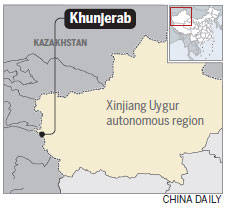
It took Sun some time to become accustomed to life in Khunjerab when he arrived in 1996. It was a brand-new world, especially as most of the locals are members of the Tajik ethnic group, a Persian-speaking people considered the only Caucasians in China.
"At first, my stomach protested because the Tajik diet is different from my hometown food. The staple food was meat and naan, an ovenbaked flat-bread. I could not find enough vegetables," he said.
However, as a 17-year-old rookie who had just been assigned to the People's Armed Police Force at the Khunjerab Pass, Sun had no option but to endure the situation.
In 1968, China established a frontier inspection station in Khunjerab because of its geopolitical significance. The station lies on the Karakoram Highway, aka the China-Pakistan Friendship Highway, which links Xinjiang with the Gilgit-Baltistan territory of Pakistan.
Conditions at the station are improving, thanks to increased government funding since the late 1990s, but as Tashikurgan lies on the edge of the Pamir Plateau, often known as "the roof of the world", the air and temperature have always been obstacles to habitation.
"The oxygen deficit is a problem for people like tourists who only stay a short while. For many recruits, the discomfort caused by the altitude only takes a few weeks to alleviate. However, the lack of vitamins meant we were troubled by a range of ailments, including chapped skin, hair loss and gum ulcers," Sun said.
"In 1997, on my birthday, I ate vegetables for the first time since I arrived. I had some noodles with a little bit of spinach in them, and I realized that all my comrades were staring at the dish. I shared it with them, as I knew it was also the first time for them. On that day, I swore that someday, there would be plates of vegetables on our table."
Normally, the optimal sowing season is spring. However, after Nowruz - the Persian New Year, which marks the beginning of spring - the land in Tashikurgan is as dry as a baguette that has been left out for 10 years.
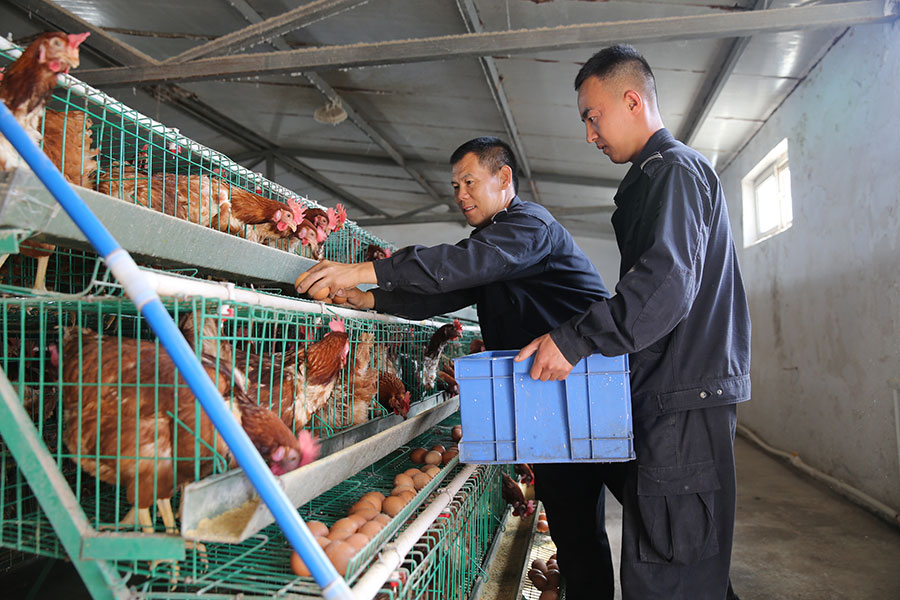
"The Tajiks are born nomads, and they can only grow potatoes or highland barley. Besides, the frostless season only lasts two months; therefore, there was almost no agriculture in Tashikurgan in the past," Sun said. As the son of a farmer, born and raised in the countryside, Sun learned how to farm by constantly watching and listening to the most experienced farmers. So, in his third year in Khunjerab, he requested a transfer to the station's logistics division to bring his talent into play.
Setback
In his first experiment, based on the plateau's characteristic climate, he used plastic mulch to suppress weeds and maintain temperatures. After a few days, the seedlings he'd planted broke through the soil.
However, an unexpected gale shattered his expectations. As the temperature suddenly plummeted, all the seedlings died.
"I knew that the first step was always the hardest, and once again, I deeply felt the difference between the plains and plateaus. But I knew I was not the first and only person to feel that, and that there must be a way to solve the problem," he said.
For the next few years, he was more like an agronomist than a police officer. He scanned every agricultural book and planting manual he could get his hands on, and when not engaged in daily training or border patrols, he immersed himself in experiments.
"I felt like a graduate student. The farmland was my university, and I found a tutor who was a plateau planting expert at the Academy of Agricultural Sciences in Kashgar. Under his guidance, I easily finished my 'dissertation'," he said.
In 2002, Sun finally made his breakthrough as he worked out the nutrition and temperatures required to grow seeds in the station's feeding block. After the seeds sprouted, he transplanted them to a greenhouse.
Now, more than 30 kinds of vegetables are grown in Tashikurgan - including red peppers, cucumbers, carrots - and gourds, and 90 percent of the vegetables in the station's kitchen come from Sun's greenhouse.
In 2005, after visiting the greenhouse, Zang Aiwu, then Party secretary of Tashikurgan, was so impressed by Sun's achievements that he decided to promote the approach to vegetable cultivation across the county.
Sun became widely known, and was appointed as a planting instructor by a number of establishments.
Moreover, local radio and television stations broadcast programs in which he introduced his techniques to more people.


Today's Top News
- China's national legislature to hold press conference ahead of annual session
- Well-being of people high on China's agenda
- Turning ancient wisdom into modern vitality
- GDP milestone lays solid foundation for blueprint rollout
- Wider conflict in Middle East feared
- China 'deeply concerned' over tension, UN hears





