



New US act to 'have little impact' on HK
Local businessman Allan Zeman says legislation 'was pushed forward by some very anti-China US senators'









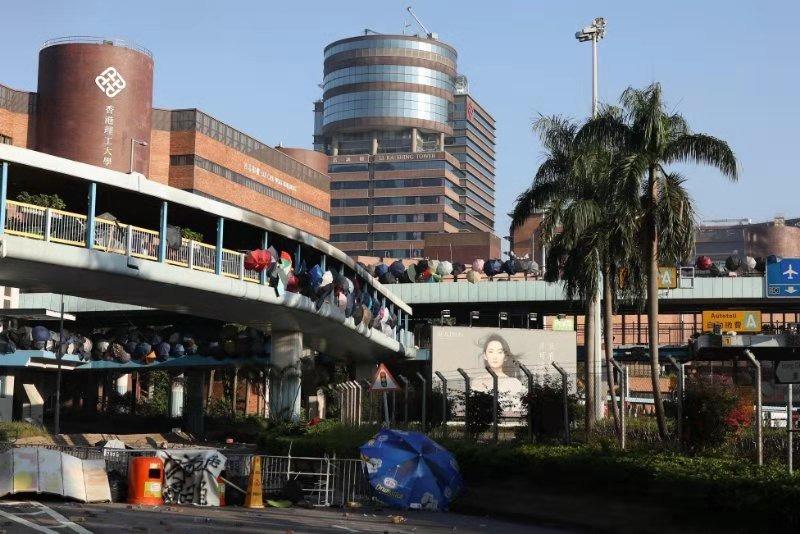
The United States is interfering with China's internal affairs by passing the so-called Hong Kong Human Rights and Democracy Act, said Allan Zeman, local businessman and the father of Lan Kwai Fong-the world-famous entertainment district.
Calling it a highly politically motivated piece of legislation, Zeman said that the law is misnamed because it basically deals with trade issues but not the "human rights" and "democracy" issues that its title suggests.
In an exclusive interview with China Daily, Zeman said the act "was pushed forward by some very anti-China US senators, including Ted Cruz, Marco Rubio and Josh Hawley, who seized the opportunity to attack China at a time Hong Kong has gone through months of radical protests marred by violence, as well as the 2019 Hong Kong District Council elections".
"US President Donald Trump was reluctant to sign the bill," Zeman said. "But he eventually signed it at the last minute to appease the senators of the Republican Party, which he belongs to, in the hope they would not vote for his impeachment, instigated by the Democratic Party," he said, referring to the Democrat-led US House of Representatives' efforts to formally charge Trump with malfeasance in office.
Trump signed the bill into law last Wednesday. It commits the United States to supporting the protests in Hong Kong and requires sanctions and other diplomatic actions if Hong Kong-which has its own legal system-is judged to be insufficiently autonomous.
Commenting on the signing of the bill, economist Tim Harcourt said: "It's another speed bump along the way to friendlier relations" between Beijing and Washington. The JW Nevile Fellow in Economics at the University of New South Wales Business School said he doubted that the bill would have any significant impact on Hong Kong and its relationship with the US.
Zeman said he doesn't expect the new law to make much of a difference to Hong Kong in any case.
"The Hong Kong act will only have little impact on Hong Kong in the short term because Hong Kong remains a good place to do business, given its strengths, such as 'one country, two systems', judicial independence, and low its tax regime," he said.
"The US will be unlikely to revoke Hong Kong's independent tariffs territory status, given that the US reaps a favorable trade balance of about US$33 billion every year. But if Hong Kong would ever lose the US market, it can still survive because it has the vast mainland market behind it and can look to other foreign markets."
Biased views
Zeman, who was born in what was then West Germany and is now a naturalized Chinese citizen, pointed out that US culture is all about human rights, freedom and democracy. Yet US citizens do not know much about matters outside their country because many of them have not left their country and rely only on news and social media, he said.
"Some media organizations in Hong Kong have strong political inclinations, and so their news reports are biased and incomplete," he said. "Coupled with the popularity of social media, fake news and rumors about what happened in Hong Kong and the ways the Hong Kong Police Force handled the violent protests were spread around the world very quickly," he said.
Zeman said the US Congress should have sent people to Hong Kong to collect balanced, impartial views, but not just views from anti-government people in the other political camp. "For example, when Republican Senator Ted Cruz visited Hong Kong in mid-October, he said he didn't see any violence here," he said.
"Again, it is ridiculous for the US, a country which does not have the best human rights record, to criticize the human rights conditions in Hong Kong. In fact, Hong Kong ranked third in the Human Rights Index in 2018 co-compiled by the Cato Institute, while the US was in 17th place."
Bill gives cover to nationalism
In an article published by the US magazine The Nation, Tobita Chow, director of Justice Is Global, and Jake Werner, a historian teaching at the University of Chicago, said that the bill's "China-versus-the-West" framing hurts progressive causes on both sides of the divide.
The bill is the latest expression of a binary that pits China against the West, according to the two scholars. US political elites on both sides have embraced this narrative, in part for its usefulness in undermining the domestic demands for radical change that each faces.
On the US side, members of the political establishment have seized on anti-China politics with the hope of co-opting the rising demands for change to aid efforts that will reinforce US global hegemony.
As The Washington Post's David Ignatius put it, "Americans may be mistrustful of elites, but they also want to believe in something larger than themselves…. (The China challenge) can unite the country and summon disaffected Americans to a test on which their future livelihoods depend, quite literally."
This anti-China narrative pushes Americans toward a Cold War mentality, prioritizing geopolitical struggles over efforts to fight economic inequality, structural racism, and climate change-and dooming the international cooperation needed to address those problems, they wrote.
"The national security establishment sees great-power competition with China as the top reason to expand the already bloated military budget," they added. "Many Democratic leaders are now hoping to outbid the GOP on anti-China measures, moving onto terrain that is tilted in favor of the GOP's white nationalist base."
The two scholars said that the act not only threatens progress in Hong Kong by strengthening divisions between protesters and mainlanders, but also includes measures aimed at turning Hong Kong into a tool of US foreign policy, such as compelling it to help enforce US sanctions against Iran.
They said the challenge for progressives is to construct an alternative that escapes the binary and redraws the lines of political confrontation, adding that there are abundant grounds for solidarity among the people of the Chinese mainland, Hong Kong, and the US in the form of shared aspirations for a more equal, sustainable society.
"Our enemies are not other countries; they are the unaccountable elites and nationalist ideologues of all countries," they said.
Cai Hong and Karl Wilson contributed to this story.


- 6 injured after explosion at Hong Kong dockyard
- Spring snow blankets red plum blossoms in Guangping county, Hebei
- Intl faculty, students experience Chinese New Year flavors in Sanming
- Cementing rural foundation for Chinese modernization
- Field experts find balance of hard work and family tenderness
- Mountain quest reveals hidden riches







