



Does the China-US engagement assumption still hold?









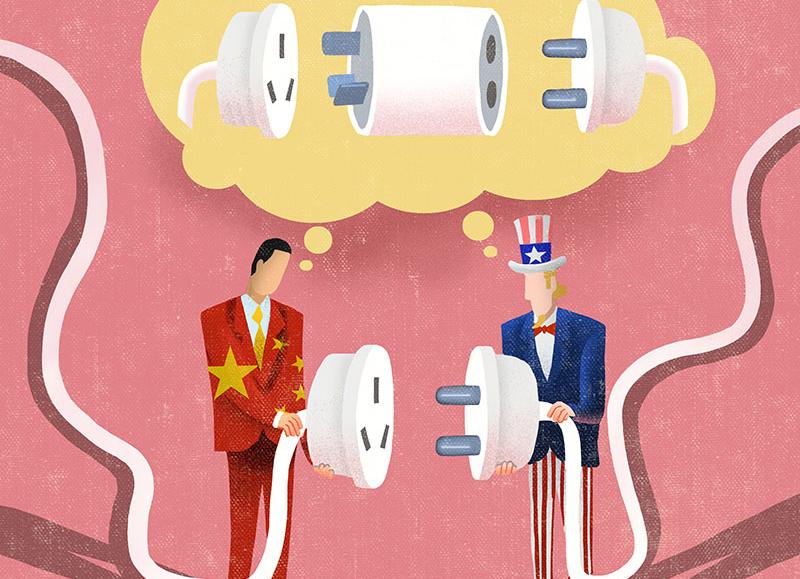
Over the past decade, strategic circles in the United States have been debating one question: Does the assumption of China-US engagement still hold?
It has be argued that as long as the US clings to its engagement policy with China, the Chinese political and economic systems will become increasingly liberalized. But between 2007, when the book “China Fantasy” by former Los Angeles Times correspondent in China James Mann came out, and 2017, when the first national security strategy of the Trump administration was released, the idea seemed to be gaining traction that the engagement assumption was no longer valid. In the US, government and academia alike coalesced around this understanding.
Nevertheless, people rarely look at the other side of the story. Was there any assumption on the part of China in its dealings with the US? If so, in the same vein, does the assumption still hold today?
As a matter of fact, China has had its own basic assumption in formulating its strategy toward the US over the decades: If China pursues a largely cooperative approach with the US and the world at large, and aims to integrate and embed itself into the international system, then the international system will accommodate China’s peaceful development. Put another way, the thinking went, the international system had reinvented itself in such a way that an emerging power could grow through peaceful development, rather than resorting to war or colonization.
Since the late 1970s, China has been in the midst of such a stage of “peaceful development,” during which it has grown into a rising power through peaceful means. On this positive note, I had been asking myself a question for the last seven or eight years: On top of peaceful development, is it possible for China to achieve a “peaceful leapfrog”? Would the current international system accommodate a China that is bigger and stronger than the US in economic scale, military power, technological prowess — and even in per capita terms? My answer was tentatively affirmative at that time. I believed that the US would not oppose it, and even if it would, there is no way it could stop China’s development. Because we are living in an interconnected world, a handful of pushbacks by the US will not reverse China’s peaceful rise or peaceful leapfrog.
But the development of China-US relations in the past two years have diminished my optimism. I am less sure when I see bashing of Huawei and other Chinese high-tech companies, on scanty evidence, if any; and when I hear Steve Bannon talking up “regime change” in China in public.
Most people in China are more realistic than I am. There is an emerging mainstream view that the US has a crystal clear goal — to keep China down. Having heard and seen so much negative rhetoric and action from the US toward China, and though I personally believe “keeping China down” is an idea held by a small minority in the US, it’s hard for Chinese experts on the US like me to convince Chinese people that this is not a long-term strategic goal of the US.
For China, the US and the rest of the world, this is an issue of fundamental importance and consequence. Much is at stake, including China’s strategic vision for external relations, and strategies toward the US And it bears on how other latecomer countries see the international system. Academic circles need to discuss these questions: Is the nature of the current international system the same as it was in the past? Are we experiencing a throwback to a jungle of nation states? How relevant and applicable is the theory of realism in the context of the current international system?
What the US says and does as the leader of the liberal international order, prompts more countries to reach the conclusion that they could never achieve development and leapfrog in the current system — a perception that augurs ill for the international system.
The Trump administration claims that the US will engage in “strategic competition” with China. But the word “competition” carries different connotations. Competition could be benign or malicious, and it comes in many shapes and forms. What kind of competition the US government has in mind has yet to become clear.
Professor Jing Huang of Beijing Language and Culture University poses a worthy question: What is the China-US competition about? Is it about who has the upper hand(高下之爭)? Or about who prevails over the other(勝負(fù)之爭)? Or about who lives at the expense of the other(生死之爭)? Maybe our friends across the Pacific could help supply a somewhat accurate answer.
The author is Assistant President, University of International Relations.





