



Young workers lured to capital cluster









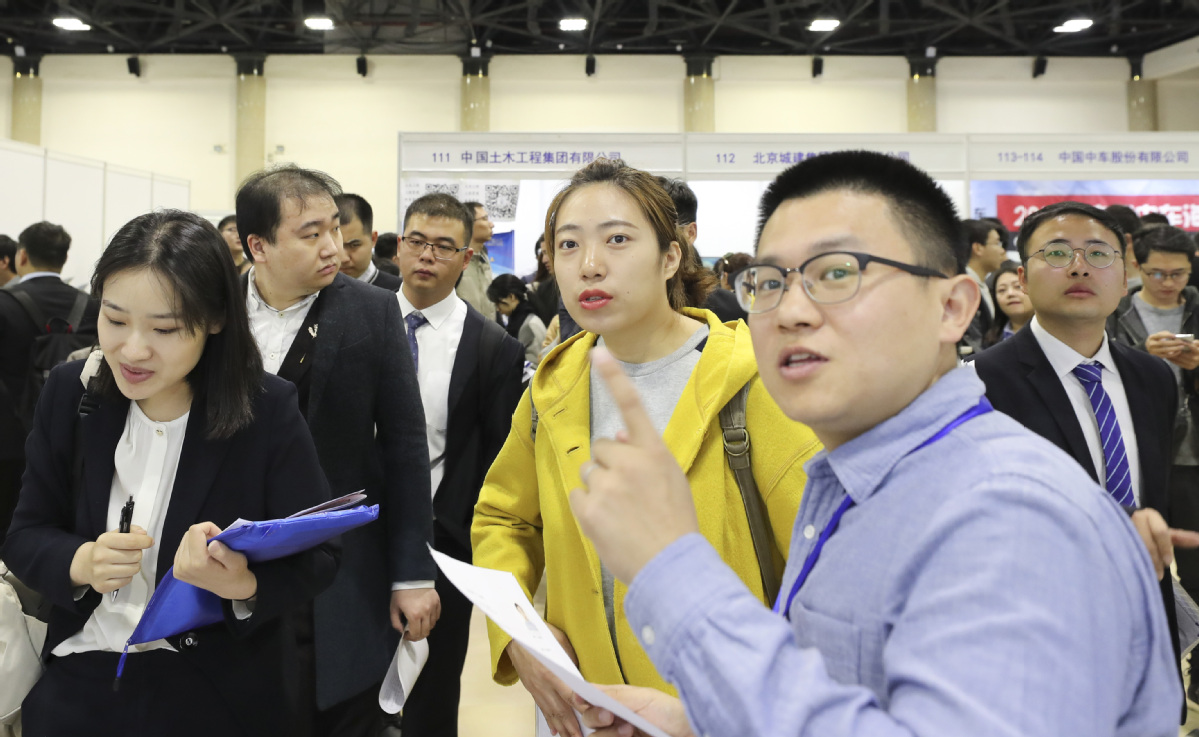
Young workers are being lured to the Beijing-Tianjin-Hebei province cluster with golden opportunities in the industries that have relocated there, experts said.
A study released by the Beijing Municipal Party School recently found that the permanent population-people who lived in a place for more than six months-of the region exceeded 112 million in 2018, up 1.28 million over 2015, even though the number of permanent residents of the capital dropped in 2017 and 2018.
Under the regional development plan, some manufacturing industries like automotives have moved from the capital to Hebei province, attracting a large group of migrants and benefiting from becoming an industrial cluster, said Lu Jiehua, a professor of sociology at Peking University.
Wang Guangzhou, a population and labor economy researcher at the Chinese Academy of Social Sciences, pointed out that as the national technology and science hub, Beijing attracts more high-tech talent to the city and many professionals also came for the educational and cultural resources.
At the same time, neighboring Hebei province took over some of the factories and wholesale markets from the capital, bringing together a large number of labor-intensive industries, he said, adding that Beijing also transferred part of its economic development role to Tianjin, which started to boost its service industry in 2014.
"It's one result of the regional economy. The transformation of industrial structures gradually filled the revenue gap between Beijing and Hebei, and brought more job opportunities to residents of the region," Wang said.
To some degree, regional economic development shifts the population structure in the capital.
Increasing numbers of migrants have relocated to the neighboring area from the central city over the past years, he said.
China's regional development blueprint changes with local situations, and development trajectories vary from region to region.
For example, in the Yangtze River Delta region, the interior provinces near Shanghai provide abundant financing opportunities for small and medium-sized enterprises, as they are highly market-driven to promote economic development. But in the Beijing-Tianjin-Hebei cluster, the regional goal is to be a globally renowned technology hub and more industry-focused, Wang said.
"Thus, targeted regional development plans are necessary to facilitate overall development in a more efficient way," he said.
The study found that the population in Hebei last year grew significantly-by 1.31 million-compared with 2015.
The relocation of Beijing's wholesale market in Xicheng district to Hebei brought about 20,000 people to the province, which also shaped the demographic structure of Hebei as more migrants relocated to the region and gathered more labor-intensive workers, said Lu, the professor.
With the relocation of many factories to Hebei, livelihoods in the province improved as well, providing a better living environment for the migrants.
"It is in line with the plan for the integrated development of the Beijing-Tianjin-Hebei cluster, to promote Beijing as the center for national politics, cultural industries, international exchange and technological innovation," he said. "The population shift would ensure the capital eases the 'big city diseases' in a move to improve people's livelihoods."
According to an urban development plan released in 2016 by the Beijing government, the capital planned to cap its population at 23 million by 2020, with 10.85 million in the city's six core districts.
Huang Shisong, a researcher of the National Academy of Development and Strategy at Renmin University of China, said the booming industrial upgrade in the Beijing-Tianjin-Hebei region also attracted some workers from southern provinces.
"Beijing's population shift and the agglomeration of population in the Beijing-Tianjin-Hebei region reflect the changing industrial upgrade and the expansion of market scale in the area, which also contribute to part of the plan of building the cluster into a world-class metropolitan area, to better help the capital's overall city development," he added.
High real estate prices and strict housing registration in Beijing have resulted in a large number of people working in Beijing but living in neighboring towns and counties in Hebei province, Lu said.
"Tianjin also benefits from this," said Lu. "In the last three years, as the city introduced several demographic policies to lure talent, its population grew rapidly."


- China's top political advisory body unveils agenda of the annual session
- Geologists brave rugged terrain in Yunnan prospecting mission
- Senior enterprise official facing probe
- China's anti-graft authorities reveal extent of year's work
- Former Haikou Party chief gets death sentence with reprieve
- Purchase of US-made weapons to push Taiwan closer to the peril of war: spokesman







