Hopes for Tibet quinoa crops survive on plateau









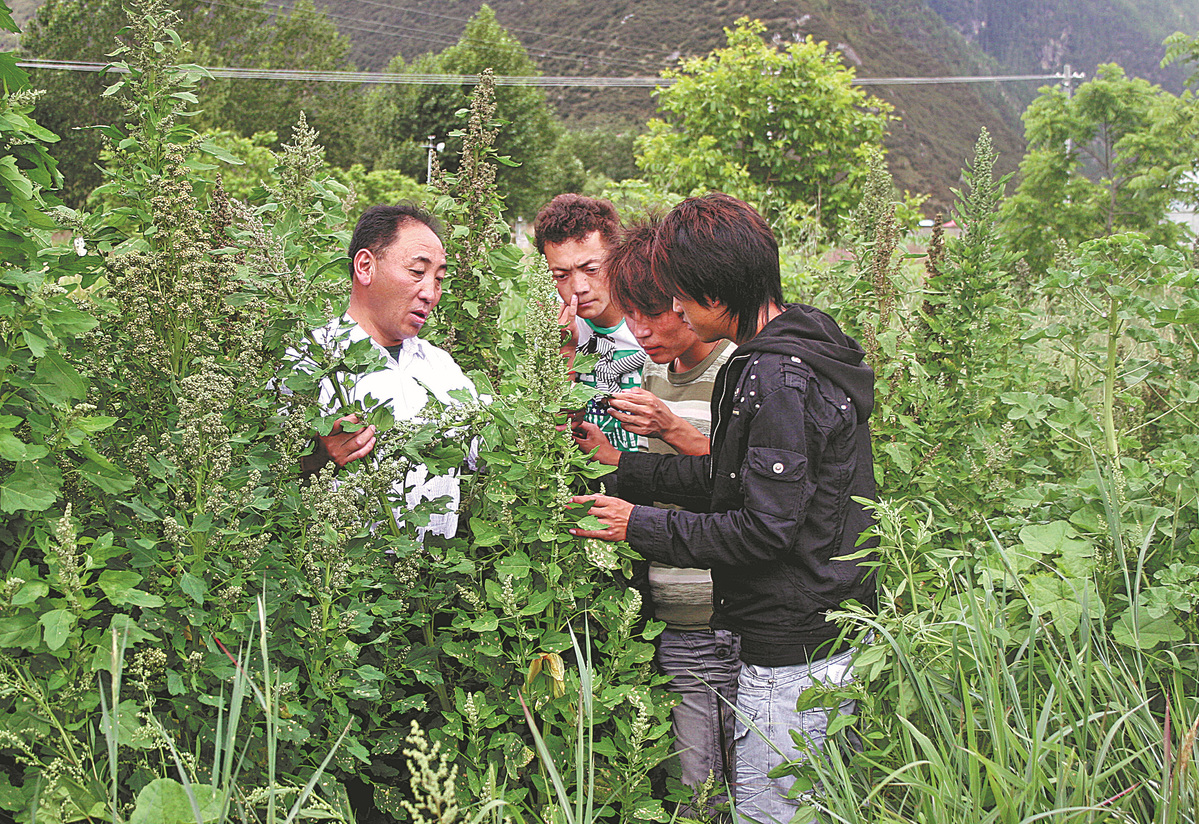
In 1985, when the 10th Panchen Lama, a leading figure of Tibetan Buddhism, visited Bolivia, he was offered quinoa as a gift.
Quinoa originated in the high flat plains of the Andes and is popular in South America, being widely planted in Bolivia, Chile and Ecuador.
When the 10th Panchen Lama, Erdeni Chosgyi Gyantsen, took quinoa back to China, it was such a new crop it was difficult for most people to accept.
The grain is the only plant that contains all nine essential amino acids required by the human body. It is also rich in high-quality protein and has a variety of trace elements, said Gonbo Tashi, a retired professor of the Tibet College of Agriculture and Animal Husbandry.
"Quinoa is ideal for those who want to lose weight because the food alone can provide the comprehensive nutrition required by the human body," said Gonbo Tashi, who was the first agricultural expert who tried to plant quinoa at high altitudes in China.
Between 2003 and 2007, he studied environmental and resources management at the University of Hawaii in the United States and later gained a doctorate from Northwest Agriculture and Forestry University in Shaanxi province.
He majored in crop cultivation in college, focusing on how to introduce more crop varieties to the Qinghai-Tibet Plateau. "There were only five main crops in Tibet, and I had been looking for an appropriate crop for many years," Gonbo Tashi said. "I have put my heart and soul into the study of quinoa my entire life."
Seeding growth
In 1996, with a grant of 50,000 yuan ($7,730) and permission from local authorities, Gonbo Tashi planted quinoa on 3 million square meters of farmland in Nyingchi in the southeast of the Tibet autonomous region.
"With the region's average altitude above 4,000 meters, Tibet is an ideal place for quinoa. Organic quinoa products can be produced in Tibet, as most places in the region are free from pollution," Gonbo Tashi said.
He runs a company that also sells quinoa seeds to the Ningxia Hui autonomous region and Qinghai, Gansu and Shaanxi provinces.
In 2008, the trial planting of quinoa began in Shaanxi, followed by Gansu and Qinghai. Planting in those provinces has proceeded faster than it has in Tibet as investment has been greater and transportation is more developed and convenient.
Tibet was the first place in China where the quinoa planting trials were successful, but cultivation has not been conducted on a big enough scale. The quinoa yield has been low, resulting in a high price of 120 yuan ($18.60) per kilogram, making it too costly for consumers.
Gonbo Tashi said the development of quinoa in Tibet needs policy support from the local government, and training programs should be offered for local farmers on how to grow the crop.
In Tibet, quinoa is grown in Lhokha, Nyingchi and Shigatse.
Gonbo Tashi said the company has contracts with companies and farmers to grow quinoa and offers training on growing the grain to farmers two to three times a year.
The consumers of quinoa products in Tibet include infants, people pursuing healthier lifestyles and pregnant women. "Some postpartum women take quinoa products to gain physical strength, and some people who want to lose weight love the grain," he said.
Ecological value
However, quinoa is more than a healthy food. In France, it is used to produce cosmetics and skin care products, and in Ecuador it is used to make shampoo, soap and other products.
"In China, I think the biggest potential for quinoa is how to develop it into infant products. Many mothers have high work pressure and wean their infants early, so lack of nutrition is an issue for some children," he said, adding that quinoa can supplement the dietary needs of infants and children in China.
Gonbo Tashi said the market for quinoa is underdeveloped in China, and at the moment it cannot replace staples such as rice and wheat.
"From the perspective of food security, quinoa is a recommended choice, as it can grow on barren land, and in sandy and alkaline soil. And that's why the planting of quinoa has drawn the attention of the Food and Agriculture Organization of the United Nations," he said.



- Dazzling Guangzhou lantern display begins countdown to Spring Festival
- Huizhou takes major step forward as petrochemical hotspot
- Beijing's Shunyi district cracks down on crimes related to public welfare
- Hunan's smoked fish and meat arrive in time for Spring Festival
- International arrivals to Guizhou skyrocket after visa-free policies
- Hubei deputy proposes museum of ancient Chinese law at Qin bamboo slip site