



Correct use of resources crucial for food security









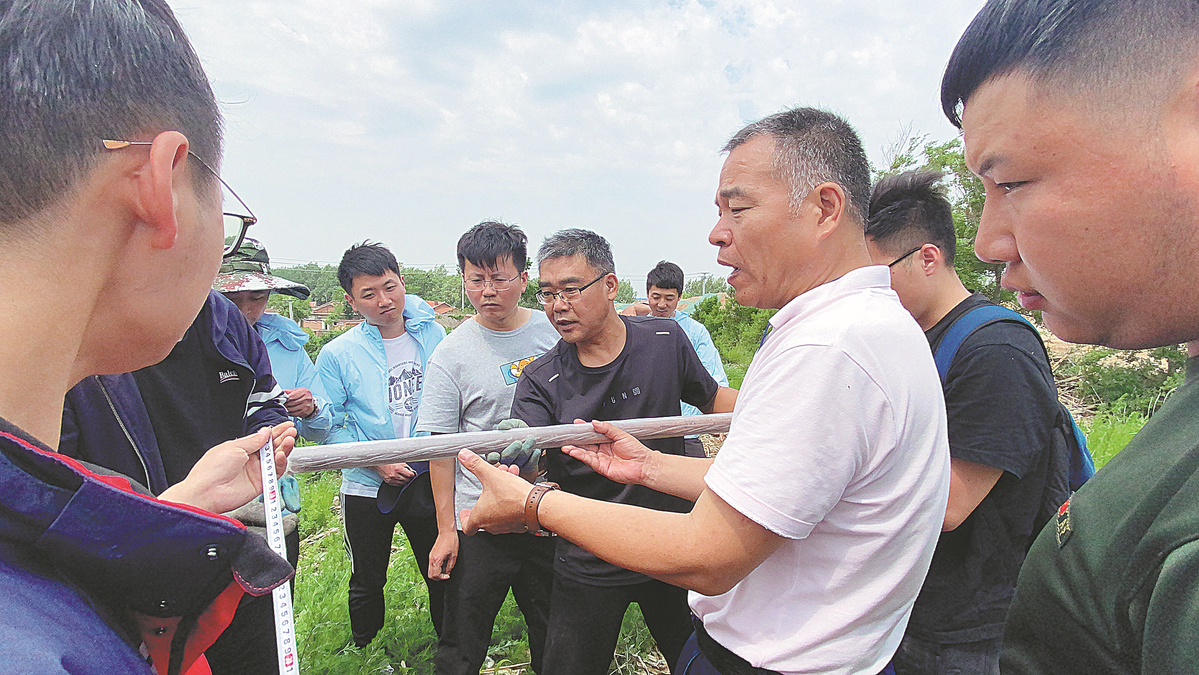
Kong Xiangbin, a professor at China Agricultural University in Beijing, has devoted nearly 20 years to the protection of cultivated land.
Going deep into fields with a soil drill to conduct surveys on the quality of arable land is a regular task for the 52-year-old scientist, who specializes in the study of land resources.
"We regard protecting farmland as our mission, and we keep working to ensure the nation's food security. We must fight to ensure that the rice bowls of the Chinese people are held firmly in our own hands," he said.
China is the world's most-populous nation, but it has limited land resources. That means it is essential to protect the land and use it efficiently to produce quality food for its 1.4 billion population. However, the amount of quality land is shrinking as urbanization and industrialization continue.
"The exploitation of plowed land has reached its limit. Only if we maintain our resources can we leave sustainable farmland for our descendants," Kong said.
He is concerned about the declining quality of available land, especially in megacities and in populous East China. Those concerns have motivated him to provide technological support for land protection.
Kong started his task by evaluating the potential of cultivated land resources in specific regions. "Only by clearly understanding the real capacity of China's arable land can we win this battle," he said.
His team proposed a three-tier potential capacity system for arable land resources: theoretical capacity; maximum achievable capacity; and farmers' actual capacity.
Those guidelines have been applied when agricultural land has been classified in the western regions, thus providing technological support for the use of arable land resources in a reasonable and protective manner, Kong said.
In February 2014, he published an article called "China Must Protect High-quality Arable Land" in Nature magazine, marking China's first piece about management of land resources in the renowned journal.
In the article, Kong and his team described an improved change model for land use, which can accurately simulate the dynamic change pattern in the use of cultivated farmland and ensure precise control of available resources.
Though China's grain output is rising year-on-year, that is largely because of extra hectares made available from the transfer of wetland, woodland, grassland and tidal flats.
Meanwhile, the overuse of fertilizers, pesticides and water resources has resulted in a thinner layer of black soil in Northeast China, lower groundwater levels in the north of the country and polluted cultivated soil in the south.
"The cultivated land in our country is like a machine that never rests," Kong said. "To ensure food security, we must develop arable land resources in a sustainable way, so overloaded land can 'take a breather'."
Protection of arable land resources will not only ensure food security, but also protect farmers' rights and interests, so it is essential to establish a land-use supervision system, according to Kong.
"The transfer of cultivated land resources involves ownership, contract management, development and the right to use. It is necessary to use land rights to protect farmers' rights and interests," he said.
In April, an equipment-laden vehicle developed by Kong's team set out from Beijing and passed through five counties in Northeast China to collect information about land quality, including organic matter content and metal pollution in the soil. The data was uploaded to the land survey cloud computing platform.
The investigators only needed to drive the equipment into a survey area, engage the system and operate a drone to quickly collect relevant information about the land quality, Kong said.
More than 2,000 pieces of information and 200 soil samples were collected during the 21-day survey. The equipment has also helped with land and soil surveys in Beijing, Tianjin and a number of other cities, greatly improving efficiency.
"No matter what you do, as long as you forge ahead and dig deep in a certain field of activity, it is only a matter of time before you will reap results," Kong said, referring to his years of research.


- Guangzhou railway hub tops 10 million passengers since start of holiday travel rush
- Shanghai Jiao Tong University celebrates 130th anniversary with illumination ceremony
- Over 100 domestic, foreign teams to take part in intl embodied robot application competition
- Former Hebei official expelled, case sent for prosecution
- Former Guizhou political adviser expelled, dismissed for graft
- Ice and snow activities, desert hot springs draw holiday crowds to Aksu, Xinjiang







