South China birthrates high









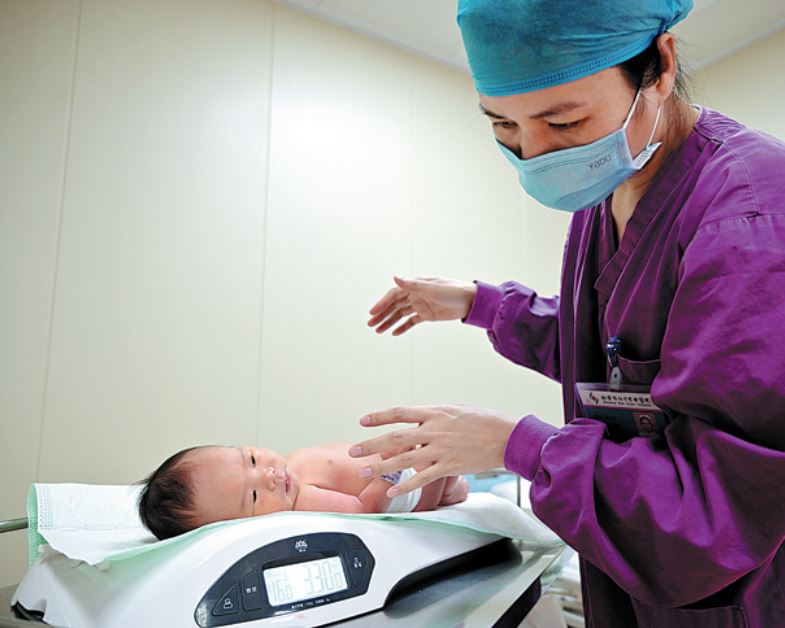
Region's culture, large populations of ethnic minorities among main factors
Having given birth to her first child only four months ago, Huang Qiufang is already hoping for a second.
The 29-year-old in Shantou, Guangdong province, has been greatly affected by the atmosphere around her since she was young.
"People in my city love children and want to build a big family with a lot of them," Huang said, adding that both her parents have six siblings, while she has a sister and a brother.
Such a phenomenon is, to some extent, reflected in a birth map released recently by Sohu.com, which showed that people in provinces and regions around South China, such as Guangdong, Hainan, Fujian, Jiangxi and Anhui provinces as well as the Guangxi Zhuang autonomous region, have a comparatively higher willingness to have children.
The birthrate of all these provinces and regions in 2019 exceeded 12 births per 1,000 population, far above the national average of 10.4 per 1,000.
These areas also share some similarities, according to Sohu's analysis of the map: they are either regions with large ethnic group populations, who are allowed by national policies to have more children, such as Guangxi; or those with a deeply rooted sense of having more children, such as Guangdong.
The map also showed that among the 20 cities with the strongest desire for children, eight are in Guangdong.
"Generally, the birthrate among residents in one place will drop as the economy develops, but Guangdong seems to be an exception," Sohu said in the analysis.
Among eight of the cities on the list of the top 20 cities with the highest birthrates, five-Guangzhou, Shenzhen, Zhuhai, Dongguan and Zhaoqing-are located in the developed and prosperous Pearl River Delta area.
Of those five cities, Shenzhen particularly shines, with a birthrate of more than 20 per 1,000, the highest in the country, according to the map.
Wang Mei, director of the Research Institute on Public Policies and Social Governance of China Development Institute, a think tank in Shenzhen, said working age individuals (15 to 64) and women of childbearing age (15 to 49) make up a large proportion of the city's population.
Data from the seventh national census conducted last year showed that Dongguan and Shenzhen are the two cities with the largest proportion of working age groups-81.4 percent and 79.5 percent, respectively-in China. The proportion in both Guangzhou and Zhuhai reached 74 percent, Sohu said.
"The quickly developing industries in these cities have attracted large young populations, which boosts the local birthrate," it said in the analysis.
A similar situation is occurring in Xiamen, Fujian, the map showed. With people age 15 to 59 accounting for almost three-quarters of the population, the city is also on the list of high birthrates.
"Like Shenzhen, Xiamen is also a city with very high housing prices. But the large proportion of young people partly offsets the declining willingness to have children, which has led to the fear that having children will add to a family's burden," Sohu said.
Wang said when fertility-friendly environments and policies are established in cities such as Shenzhen, a stronger willingness for maternity will be seen among women or families.
"For those who haven't had children, they might consider having one; for those who have already had one, they might think of having a second or third child," she said.
In that sense, if more beneficial policies are released in the city, it will possibly continue to see a rise in the number of newborns, she added.
Lyu Na, a 29-year-old Shenzhen resident who will give birth to her first child in early December, said the preferential maternity policies in the city have greatly reduced her economic burden, at least during her pregnancy.
Expenditures on all kinds of checks, physical examinations and necessary medicines and nutritional supplements from the very early stage of pregnancy to delivery-and even on some assessments after delivery-can be largely covered by social security and maternity insurance, Lyu said.
"Last week, I went to the hospital, and my doctor prescribed some examinations for my 36th week of pregnancy. The bill was about 1,500 yuan ($230), but I paid no more than 150 yuan, as the rest was covered by the government," she said.
"I'm very happy, as the policies in Shenzhen are super friendly and reduce my financial burden greatly," she added.




- Beijing's Shunyi district cracks down on crimes related to public welfare
- Hunan's smoked fish and meat arrive in time for Spring Festival
- International arrivals to Guizhou skyrocket after visa-free policies
- Hubei deputy proposes museum of ancient Chinese law at Qin bamboo slip site
- Snow leopard captured after attacking skier, killing sheep in Xinjiang
- UK, Chinese universities join hands to tackle global health challenges