Yangtze delta integration reaps rewards









Urban-rural balance
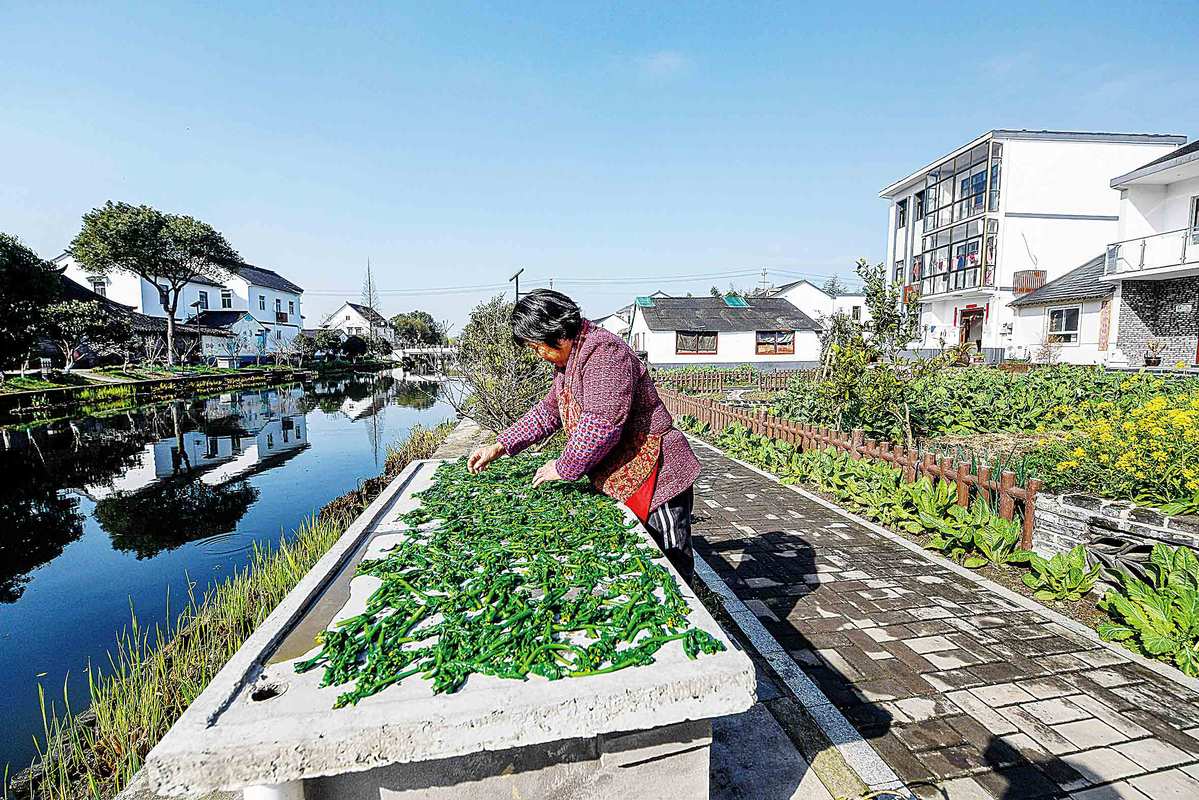
In addition to showcasing sustainable and green practices, the Yangtze River Delta integration strategy aims to achieve urban-rural coordinated development, an example of which can be found in Henggang village, Jiashan, Zhejiang.
Officials in Henggang, which boasts picturesque scenery and is about a 40-minute drive from Shanghai, are working with villagers to build "the ideal back garden" for citizens from the metropolis.
This initiative, launched in 2016, has been accelerated since the delta integration plan was announced. The local government has built roads, installed street lighting and other infrastructure, helped renovate old houses into three-story villas in traditional Jiangnan style, and is attracting tourists with numerous farming activities.
The entire area is covered by the 5G network, and charging poles for electric cars have been erected for visitors from Shanghai and neighboring areas.
Henggang Party chief Zhang Lin said: "We used to be a village that raised pigs. There were 1,670 people and 24,000 pigs." Tourism has helped farmers earn more, Zhang added.
In an interview with Xinhua News Agency in July, Zhang said the village had more than 10 farm-stay hostels run by locals, creating annual revenue of 3 million yuan ($468,000).
Ma Dongmei, one of the hostel owners, said: "Many tourists from Shanghai return to our hostel. They greatly enjoy our home-raised chickens and ducks."
Her hostel can cater to 200 guests for meals. Visitors savor local dishes featuring organic vegetables grown by residents or the chickens and ducks raised by Ma.
The local government has also launched environmental projects, such as treating a foul-smelling river that flows through the village. Its water quality has been raised from Grade V, the lowest national level, to Grade III, Zhang said.
Strolling through a paddy field, Zhang said the village also holds cultural festivals to attract tourists. In May, the village organized the Henggang Day for Tourism, while on Sunday, a music festival will open in the village, staged jointly with a radio station in Jiaxing city.
"Last year, the music festival drew more than 100,000 clicks online, attracting some 3,000 tourists to the village," Zhang said. "The real point is that people who come to Henggang provide residents with opportunities for their businesses, such as selling agricultural produce and providing accommodations.
The most telling evidence of the benefits of Yangtze River Delta integration are arguably the way in which it influences people's everyday lives.
Since the strategy was launched, governments in the three provinces and Shanghai have started to reduce administrative hurdles for services related to pension programs, business taxation and other civil or commercial matters.
According to the Yangtze River Delta Regional Cooperation Office, 119 public services that used to require local government registration or approval can now be processed in all 41 cities in the delta.
In Wujiang, Jiangsu, a government service center opened in May to help the public with matters that used to necessitate traveling to other provinces.
Luo Yiping, an accountant at the Canny Elevator Co, visited the center to complete tax returns for the company's branches in the Qingpu district of Shanghai. "To deal with such returns, I used to have to visit offices in locations where the company's projects were based," she said.
There are 35 comprehensive service affairs offices across the region-12 in Qingpu, 13 in Wujiang, and 10 in Jiashan, according to the Yangtze River Delta e-governance platform.
If people do have to travel, transportation services in the region are improving. The Yaoyang Highway, jointly built by the Jinshan government in Shanghai and the Jiashan authorities, opened in December, cutting traveling time between the two locations from 30 minutes to five.
Xu Lihua, who lives in Shanghai and works in Jiashan, has been commuting between the two cities since 2016, when her company launched new investment in Jiashan.
"The company's shuttle bus drivers now use this new route. It not only saves time, but also money. For every single trip, car drivers can save 10 yuan in highway toll fees, while there are higher savings for freight vehicle operators," she said.



- Dazzling Guangzhou lantern display begins countdown to Spring Festival
- Huizhou takes major step forward as petrochemical hotspot
- Beijing's Shunyi district cracks down on crimes related to public welfare
- Hunan's smoked fish and meat arrive in time for Spring Festival
- International arrivals to Guizhou skyrocket after visa-free policies
- Hubei deputy proposes museum of ancient Chinese law at Qin bamboo slip site