



Nothing to appreciate about slanted eyes commercial imagery









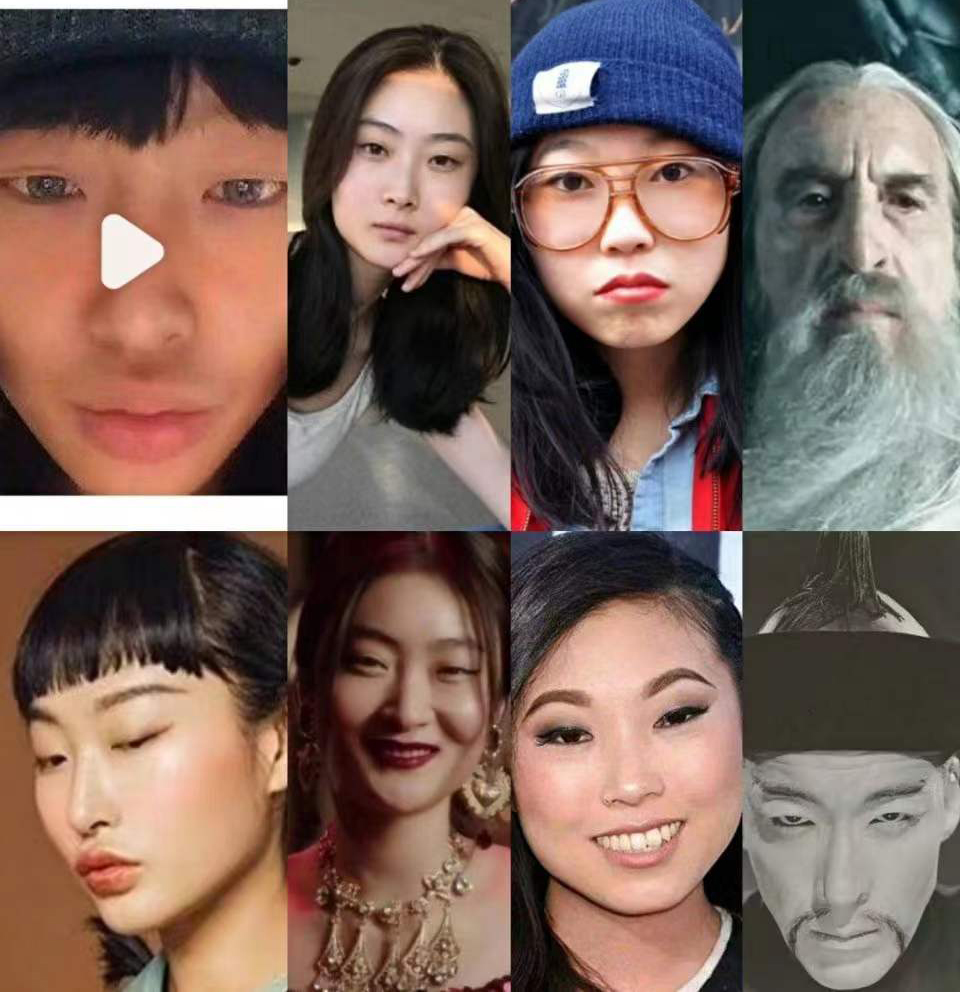
Combo photo shows the same models and actors with (bottom) and without slanted-eyes makeup
--It's poles apart between "slanted eyes"—which is the product of makeup or racist gestures—and "small, narrow, or thin" eyes, which some people are born with naturally and shouldn't be ashamed of.
There is something that can catch me off guard whenever I watch a Hollywood film or stream a TV show in foreign languages: the Chinese characters, the Chinese elements, the Chinese food… As much as I am amused by how irrelevantly the Chinese proverbs are recited or how bizarrely Chinese cuisine is cooked and consumed, I often find myself cringing at the way those Chinese cast members look—foxy eyes, high cheekbones, flat faces with heavy makeup—in troupes, in sequels, in series. If there is a cinematic universe of Chinese characters, the audience must have trouble telling them apart.
Every now and then, that feeling overflows from the big screen and lands on a random fashion show, a magazine cover, or a printout of a commercial poster. One question tugs on my mind: why do Chinese have to "look" (or be portrayed) like that—all the time? That's why I can't appreciate commercials made by Three Squirrels (a Chinese snack retailer) or Mercedes-Benz, both of which feature models with cosmetics-induced slanted eyes.
My bewilderment arises not from how grotesque their countenances are (they sure have their own styles should they appear in personal makeup tutorials), but from the fact that by appearing in popular commercials with cosmetics-induced slanted eyes, they, unconsciously, are reinforcing a stereotype originated a century ago—that slanted eyes represent the common feature, the unique beauty shared by Chinese people.
The stereotypical depiction of Chinese could find its roots as early as the 19th century when Sinophobia and exclusionism were at their height in the West. The infamous racist cartoon The Yellow Terror in all His Glory published in 1899 illustrated just how Chinese people (and in a broader concept non-white) were vilified—a skinny figure with slanted and angry eyes who was presented as a menace to the Western world.
Even after China rose up against imperialism and started to assimilate itself into the world, that stereotype persisted. Not only were Chinese women often pigeonholed as the "China Doll" and Chinese men as the killers who specialized in Kung Fu, but they were also often treated as common tropes in Hollywood films like The Face of Fu Manchu, a 1965 thriller, with sallow faces and slanted eyes, all intentionally "fine-tuned" through makeup.
"Slanted eyes" isn't just a racist symbol of the past, it is a stereotypical cliché that flourishes to this day. In the modern fashion industry, a pair of slanted eyes can be deemed as a classic beauty typology; and sometimes, it becomes the vogue for models to compete to appropriate from this or that culture. In the field of sports, on the other hand, it is occasionally deployed as a weapon to belittle Asian opponents—a blatant racist move and a departure from sportsmanship.
The special preference for "slanted eyes"—whether as a peculiar taste or as a racism-driven weapon—is just an embodiment of Orientalism, which Edward Sa?d, an American academic, defines as "a Western style of dominating, restructuring, and having authority over the Orient." Slanted eyes, or foxy eyes—it isn't the way most Chinese people actually look like. It isn't what most Chinese think beauty is. IT IS what the West thinks a Chinese person should look like, or where his or her uniqueness lies.
On Jan. 3, the BBC published an article examining the heated debate surrounding the slanted eyes controversy. Good for them that they acknowledged that "slanted eyes" have their racist roots. But at the same time they biasedly (what a surprise) mixed up "slanted eyes" with "small, narrow, and thin" eyes, and claimed that the episode mirrored the Chinese society's "rejection of aesthetic pluralism". It's poles apart between "slanted eyes"—which is the product of makeup or the racist gestures—and "small, narrow, or thin" eyes, which some people are born with naturally and shouldn't be ashamed of. Besides, of the billions of different appearances, it is unreasonable to always highlight an outdated and stereotypical flaw—that's not a showcase of "aesthetic pluralism" but a reinforcement of Orientalism and aesthetic hegemony.
Aesthetics evolve, but stereotypes remain—this should become the real focus of the discussion. Asians are good at math. Chinese have foxy eyes. Indians have a heavy accent… We are marching forward in the second decade of the 21st century with marvelous scientific advancements and continually shifting aesthetic tastes, shouldn't we also then just leave these stinky and decayed stereotypes behind?





