



Living within the limits
The key global challenge is to break the downward spiral of social tensions caused by resource scarcity which is eroding trust and the capacity to act









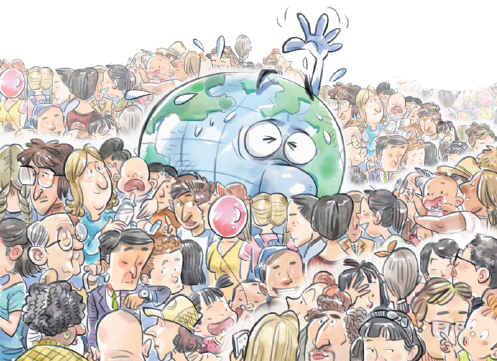
The 1972 book, Limits to Growth, warned that the Earth's resources would not be able to support the exponential rates of economic and population growth and would collapse before the end of this century.
Alongside numerous other initiatives at the time, this warning helped establish the environmental movement, and its effort to limit the human ecological footprint.
Today, 50 years later, we know that the world has followed the scenario predicted in the book-broadly speaking. The human footprint has continued to grow and now exceeds the estimated safe operating space for humanity with respect to the functioning of the Earth's natural systems, in many areas-most worrying in climate. This is evident in the rise in global temperatures.
But global society has not yet seen collapse-at least not global collapse. Neither from resource scarcity, emissions of chemicals or toxic substances, land erosion, nor ecosystem depletion.
There are, of course, growing signs of local collapse-not only driven by global warming, but also by social tensions. In many places there has been a decline in human well-being driven by poverty, inequity, disempowerment, and sheer frustration at the slow global response to the global overshoot of nature's support capacity.
So what is most likely to happen over the next 50 years? Most likely there will be a continuation of the feeble global response to the climate overshoot. We will see a "too little too late" scenario, where human well-being declines, and social tensions rise toward 2050.
Well-being will decline because the physical environment is gradually destroyed by the overshoot. But more importantly, social tensions will rise because life for the human majority will gradually become ever more unbearable as decades pass without a fundamental solution to the problems of global poverty, rising inequity, disempowerment, and continuing rise in global temperatures, heat waves, forest fires and rising sea levels. In effect I believe, using Limits to Growth language, that regional social collapse will precede global environmental collapse.
Of course, there will be huge regional differences. Social tensions, and possibly conflict, will rise everywhere, but for different reasons. In the developed world, it will be because of slow decline in material well-being and rising inequity. In the Global South it will be because of lacking economic progress and enduring poverty. In some emerging economies, tensions may be softened temporarily by rapid economic growth.
In China, tensions may be the weakest, as the population savors the nation's continued rise to become a great power. But everywhere the mood will be darkened by continuing global warming, ever more scary extreme weather, the accelerating decline of biodiversity and sporadic resource scarcity in new and changing niches.
The most scary aspect of this prospect is that rising social tensions will reduce the capacity of society to act rationally and strongly in the face of adversity. The higher the tensions, the less trust in government, and the lower capacity to put in place solutions to the problem of declining well-being within planetary boundaries. The solutions are known: the world needs to replace fossil energy with renewables, to shift to regenerative agriculture, to eliminate absolute poverty using the Chinese development model (strong government funding of clear five-year plans), and to reduce inequity by making the global rich pay the bill, which is only 1-3 percent of the global income.
The main global challenge in the 2020s will be to break the downward spiral that erodes trust and capacity to act. This can only be done by achieving visible progress in one or more of the turnarounds that are needed to increase well-being within planetary boundaries.
Achieving rapid implementation of turnarounds will be hard, because the solutions are not profitable from the investor point of view. Hence, they will require subsidies or bans to be implemented with strong enforcement. And subsidies and bans may be politically impossible with voters who do not particularly like higher taxes and more regulation.
It is possible to increase the wellbeing of the majority within planetary boundaries. But it requires broad popular support for strong collective action. And such support must be built soon-before social collapse erodes our capacity to act.
The author is a professor emeritus of climate strategy at the BI Norwegian Business School. The author contributed this article to China Watch, a think tank powered by China Daily. The views do not necessarily reflect those of China Daily. Contact the editor at editor@chinawatch.cn





