



Field goals









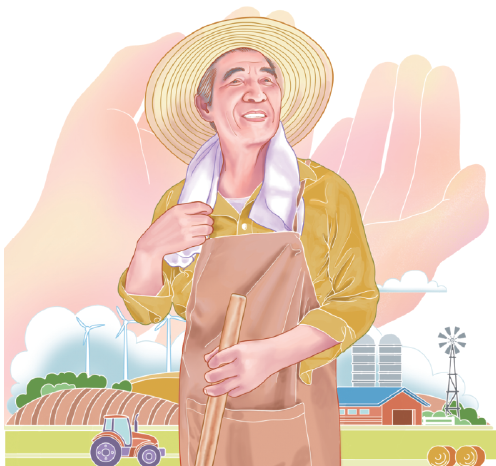
Vitalization of rural areas requires more than simply promoting agricultural development
China's No 1 Central Document for this year, the first policy statement released by China's central authorities each year, underlined preventing a large-scale recurrence of poverty as a bottom-line requirement. China has devoted massive efforts to completing the historical task of eliminating absolute poverty. However, it is still necessary to secure the achievements already made. Only on this basis can the nation push forward rural vitalization across the board.
There are several kinds of rural households that deserve special attention to prevent the recurrence of poverty-h(huán)ouseholds that are still on the edge of poverty and families experiencing severe difficulties in life due to diseases, natural disasters and accidents.
It is important to strengthen the forecasting and early warning system for natural disasters, and establishing an effective mechanism that monitors the recurrence of poverty is integral for consolidating and expanding the achievements of poverty alleviation. The COVID-19 pandemic and floods in Henan province last year shed light on some deficiencies in emergency management. Individuals and families who have been lifted out of poverty are susceptible to shocks from outside. The pandemic poses difficulties for rural migrant workers who work in urban areas, and last year's floods resulted in reduced crop yield. Families that have been left in a disadvantaged position due to such events must be included in the monitoring mechanism, and timely assistance must be offered by grassroots-level departments in order to eliminate the risk of their returning to poverty.
The No 1 Central Document highlighted the importance of rural industries and job creation to enable the sustained and steady increase in the incomes of people who have been lifted out of poverty. It is no easy task to establish a modern system of industries in rural areas. The biggest challenge lies in the people factor. Despite its abundance of unique, natural and cultural resources, there is still a shortage of human resources in rural areas. Only by attracting more capable professionals can the rural area truly put its various resources to good use, tap into the potential of its idle assets and realize the real value of the assets.
On the one hand, it is important to develop local professionals, including new types of farmers, migrant workers who return home to start new businesses. On the other hand, the rural areas need to attract more professionals from outside, such as urban retirees who are willing to return to their home villages, intellectuals, artists and entrepreneurs, since they can bring various resources with them.
There are some challenges. Most young rural residents still prefer migrating to urban areas judging by the trend of rural population flows. A way must be found to enable those who decide to stay in the countryside to realize their potential. The development of rural industries needs to give greater priority to the creation of new business models and the integration of different industries rather than merely promoting agricultural development. Thus there are opportunities and prospects for businesses and capital to expand to the countryside. Villages meanwhile should give priority to attracting capital from outside.
Villages that cannot develop complex business models can also find their own way of vitalization. It is clear that rural vitalization is a long-term strategy that spans to 2035, and it is a task that needs to be undertaken step by step.
Rural vitalization is a process that must be pushed forward on a by-category and step-by-step basis. China, as a large country with significant gaps between and within regions, cannot adopt the same path of rural vitalization for all areas. Some villages that cannot give rise to new business models are likely to decline or even disappear over the longer term. For such villages, it is important to ensure that their residents can have access to basic public services.
It also needs to be emphasized that farmers should take the leading role in the vitalization process. There should be support from the outside in terms of information, policies, planning and so on to create a better development environment for farmers. But ultimately, it is up to the farmers and the villages to decide the paths they take in the vitalization process.
The main reason why most developing countries fail to address the rural issue is that they fail to achieve overall industrialization and urbanization. In 2018, countries with a per capita GDP similar to that of China saw the proportion of non-agricultural industries in GDP exceed 90 percent, and the same is true for China. However, in most such countries, the urban population accounts for more than 75 percent of the total population. In China, only about 60 percent of the population lives in urban areas. The large percentage of rural population and the low share of agricultural industries in the country's GDP indicate a low level of modernization in China's rural areas and the need for the nation to continue promoting urbanization, and to be more accurate, a new type of urbanization.
First, a new type of urbanization requires the transfer of labor from the agricultural sector. Even though the problem has been greatly alleviated as the nation has advanced its urbanization and industrialization in the past, there is still immense potential going forward.
Second, it takes a new development paradigm to continue promoting a new type of urbanization. The traditional way of urbanization cannot absorb all the agricultural population without a transformation process. A new type of urbanization is not transferring the rural population to major cities for them to become engaged in low-end, labor-intensive industries as in the past. Instead, the nation should develop its townships and villages and integrate them with urban areas, making them a new space for the population, economy and social culture.
Third, the development of the photovoltaic industries has played a significant role in the nation's poverty alleviation process. Photovoltaic industries can usher in benefits as collective assets of villages. They can also be a source of income for low-income households.
Yu Lerong is an associate professor at China Agricultural University. Li Xiaoyun is the honorary dean of the China Institute of South-South Agricultural Cooperation. The authors contributed this article to China Watch, a think tank powered by China Daily. The views do not necessarily reflect those of China Daily.
Contact the editor at editor@chinawatch.cn





