



Trade aid
China should actively urge developed countries to uphold a fair and just global market order to help the least developed countries









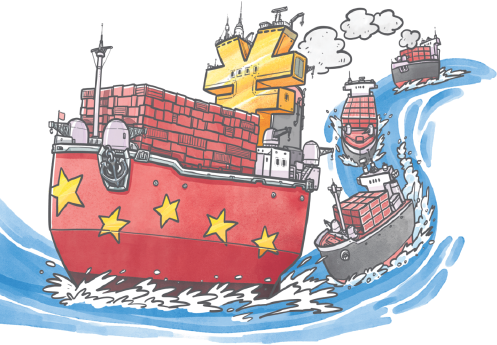
Aid for trade refers to measures and funds to help developing countries to improve their trade capacity and level of economic development. Its goal is to spur economic growth through trade and enable developing countries to benefit from economic globalization. As one of the biggest beneficiaries of free trade, China has the experience and capability to help other developing countries improve their trade capacity.
The COVID-19 pandemic has had a strong impact on the world economy, and global challenges have emerged one after another. The international community is holding back in embracing the next stage of economic globalization, and the least-developed nations are facing the risk of being marginalized in global value chains. In this context, China can play an active role in helping the least developed countries to develop their trade.
The global economic downturn has fueled rising protectionism and unilateralism. The developed countries have shifted their focus to promoting exports of their own commodities, and are too preoccupied to focus on exploring markets in developing countries. This has led to a significant weakening of their support for African countries. According to the latest data released by the Organization for Economic Cooperation and Development, the international assistance volume from members of the organization's Development Assistance Committee, which are all developed economies, is on a downward trend, even though the gross volume of international assistance globally is rising as a whole. This overall increase is mainly attributable to contributions from emerging donors such as China and non-governmental organizations.
Some developed countries indicated at a high-level meeting of the OECD Development Assistance Committee in November 2020 that they would try their best to maintain their official development assistance budgets in 2021. But in reality, unilateralism has already gained ground in the United States, the largest donor globally. The United Kingdom, another key donor, cut its foreign aid budget by a total of 7.2 billion pounds ($9.45 billion) in 2020 and 2021 combined.
Meanwhile, the least developed nations have seen a surge in their demand for aid for trade assistance. The further integration of the global economy has given rise to stronger enthusiasm among developing countries for regional economic integration, regional unity and the development of intra-regional trade and logistics, in a bid to improve their overall negotiation capabilities in international trade.
Africa, a continent with the largest number of least-developed nations, is an example. Member states of the African Union kicked off negotiations on the African Continental Free Trade Area in June 2015, aiming to realize the free flow of goods, services and personnel within the region. But even after its launch in January 2021, the FTA in Africa still requires external support and facilitation due to the wide range of countries involved, the sizeable number of detailed issues and remarkable regional differences.
To facilitate their growth, China can intensify its efforts to help developing countries build up their trade capacity.
One important way is to encourage developing countries to gradually reduce non-tariff barriers. Kwesi Quartey, deputy chairperson of the African Union Commission, said that many African countries use non-tariff barriers to restrict the import of goods and protect their domestic industries, and such measures may continue to exist in the continent. The reduction of non-tariff barriers in developing countries cannot be achieved overnight. It is a viable solution to start by promoting regional trade, supporting developing countries coordinating economic and trade policies with their neighboring countries, breaking down the barriers to cross-border trade and investment cooperation, and encouraging countries to first realize economic integration with neighboring countries.
China can join hands with related stakeholders to work out solutions to ease the bottlenecks troubling key countries after conducting field research on their major border ports, seaports and cross-border transportation hubs. It is also viable for China and the relevant countries to make joint efforts to formulate development plans, upgrade their operation management systems, improve on-site operation procedures and train personnel.
Many developing countries are endowed with natural advantages for agricultural development with their favorable climate and soil conditions. However, they still have to import food from other countries due to their low technology levels. Therefore, there exists great potential for increased cooperation between China and relevant countries in the sectors of technology transfer, high-quality cotton seeds, agricultural machinery and fertilizers so as to help them improve farming technology, train agricultural technicians and extend agribusiness chains. It is important to improve trade capacity by developing equipment and technologies, including cold chains for the preservation of products, warehousing and analytical laboratories, and to strengthen quality control for agricultural products.
The developed countries must be urged to honor their World Trade Organization commitments. In December 2015, the 10th WTO Ministerial Conference adopted the Nairobi Ministerial Declaration and nine decisions. The 162 WTO members made an important commitment regarding the least-developed countries during the conference, agreeing to abolish agricultural export subsidies in an all-round way. The developed economies pledged to immediately eliminate most of their agricultural export subsidies, while developing countries pledged to do so in 2018.
Preferential treatment should be given to the least-developed countries in terms of rules of origin and service exemptions. China, as a representative of developing countries in the WTO, should actively urge developed countries to honor this commitment in order to uphold a fair and just global market order and protect the agricultural development of the least-developed countries.
The author is a researcher at the Chinese Academy of International Trade and Economic Cooperation under the Ministry of Commerce.
The author contributed this article to China Watch, a think tank powered by China Daily. The views do not necessarily reflect those of China Daily.
Contact the editor at editor@chinawatch.cn





