



Correct orientation
China and India need to strengthen their cooperation to accelerate the creation of a new multipolar world order









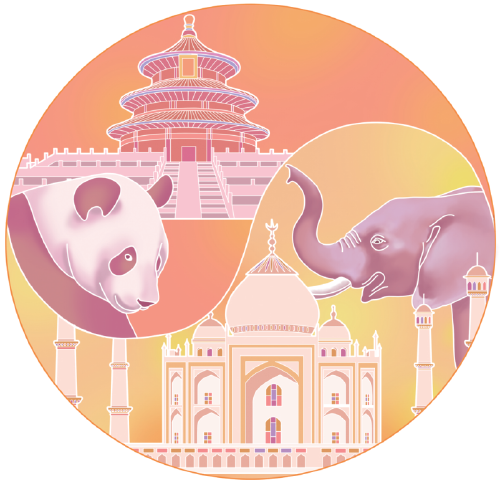
The test of mature political leadership in international relations is the ability to solve problems peacefully, and to direct diplomacy to achieve this objective. Nations that are guided by civilizational wisdom, and are concerned with the common good of humankind, have a greater ability to do this than those trying to advance their own hegemony. Judged by this test, the conclusion is inescapable that India and China, the world's two most populous nations and inheritors of two ancient civilizations, have the greatest opportunity and also the most pressing responsibility to guide the current fast-changing global order in the direction of what Chinese President Xi Jinping calls "a community with a shared future for mankind".
However, for this responsibility to be discharged, India and China must cross the hurdle posed by the border problem they have inherited from the colonial past. For several decades, this problem has been consciously put on the back burner, which helped the two countries develop bilateral relations in a cooperative and comprehensive manner. That was a wise course to follow. Unfortunately, the relations soured after the violent, albeit limited, conflict in June 2020 and the consequent military standoff along the Line of Actual Control. Now, diplomacy has once again taken center-stage. The recent working visit to New Delhi by China's State Councillor and Foreign Minister Wang Yi has created hopes of the resumption of high-level political dialogue between the two Asian neighbors.
As expected, cynics, along with those inspired by the West's agenda of driving a permanent wedge between India and China, have highlighted the apparent gulf between the official statements of the two sides after Wang's visit. However, what they conveniently overlook is the room for optimism the visit has opened for a forward movement in the dialogue process. The very fact that Wang held substantive talks with his Indian counterpart Subrahmanyam Jaishankar and India's National Security Adviser Ajit Doval is an indication that the two sides are keen to move the bilateral ties ahead, instead of keeping them static.
Belying the expectations in some Western capitals, New Delhi and Beijing have actually achieved progress in the 15 rounds of military-level talks to end the tension on the border. The military standoff is an aberration, which must be ended-better sooner than later. On Ukraine, while calling for an immediate end to the conflict, both countries have refused to join the United States and Western European countries in condemning Russia. Nor have they backed the illegal and arbitrary sanctions imposed on it. India's independent foreign policy has particularly irked Washington and exposed the faultlines in the US-led Quad platform.
North Atlantic Treaty Organization's eastward expansion in Europe and its ploy to rope in Ukraine was problematic. At a time when there is a manifest need for a new global security architecture to secure world peace, NATO, a relic of the Cold War era, has no right to exist at all.
Most importantly, Wang's constructive pronouncements before, during and after his visit to New Delhi and other South Asian capitals, have underscored China's commitment to improve relations with India. He reminded Indian audiences that "the two countries are not threats to each other but opportunities for each other's development". He wisely said that China and India should help each other accomplish their goals, instead of "draining each other's energies".There is great merit in the three-point proposal he put forward.
First, "both sides should view the bilateral relations from a long-term vision", which means, China and India should put their differences over the border issues at a proper position in the bilateral relations. Second, the two countries "should view each other's development with a win-win mentality". Third, they "should take part in the multilateral process with a cooperative posture".
Equally relevant for the forward movement in India-China relations are the "three mutuals" mentioned by Jaishankar-"mutual respect, mutual sensitivity and mutual interest".
A good start to a journey means half the road traversed. Following Wang's groundbreaking visit, India and China should agree to the following two points to ensure that the journey moves far, and predictably, in the right direction.
First, India and China can cooperate effectively in the BRICS platform. Within the BRICS framework, cooperation among Russia, India and China needs to be strengthened to accelerate the creation of a new multipolar world order.
Second, India and China should resume more frequent strategic political dialogues, including the stalled process of informal summits, so that they can create a new long-term consensus on bilateral relations and multilateral cooperation. In the rapidly changing global situation, several old and new challenges and opportunities are beckoning India and China to work together for mutual good, and for the good of Asia and the world.
The author, who served as a close aide to India's late prime minister Atal Bihari Vajpayee, is the founder of Forum for a New South Asia. The author contributed this article to China Watch, a think tank powered by China Daily. The views do not necessarily reflect those of China Daily.





