



Western human rights view is flawed









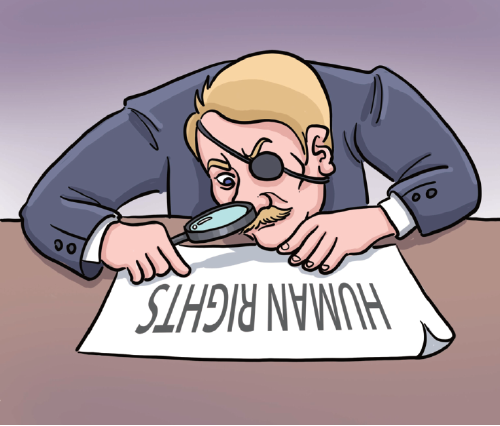
The United Nations' system of human rights is rather comprehensive and covers civil, political, economic, social and cultural rights.
However, the Western view and practice of human rights, especially those of the US, are rather problematic-for example, there is a lack of balance among different rights. Also, the US and other Western countries often unduly emphasize civil and political rights while ignoring the right to life, and development, economic, social and cultural rights.
Worse, despite being the sole superpower, the United States has not been party to six of the nine core human rights conventions. And judging by the UN's standards, human rights problems abound in the US and other Western countries. For example, more than 30 million people (out of the US' total population of about 330 million) don't have any medical insurance, and none of the Western countries guarantees equal pay for equal work for men and women. Both are violations of the UN International Covenant on Economic, Social and Cultural Rights.
Besides, the West doesn't recognize the intricate relationship between individual rights and collective rights. The West tends to believe that human rights are individual rights, and contends that collective rights can be abused, without acknowledging that individual rights, too, could be abused and cause huge damage to collective rights.
For instance, a few years ago, a few Danish and French cartoonists infuriated Muslims around the world by publishing cartoons that many believed blasphemed Islam, yet they resorted to freedom of speech, an individual right, to justify their actions. And during the peak of the COVID-19 pandemic in Western countries, many refused to wear a face mask or observe anti-pandemic measures in the name of personal freedom, leading inevitably to a heavy toll of human lives.
In contrast to the Western concept, the relationship between individual and collective rights, in Chinese philosophy, is dialectical.
An ideal human rights protection system should take into account both individual and collective rights, both freedom and responsibility, and strike a balance between rights and obligations. In this regard, China's concept of human rights, which balances rights and obligations, is more in line with the requirements of the times.
The US and many Western countries also tend to ignore the differences in national conditions and demands that all countries follow the same human rights norms. But the fact is, human rights cannot be dissociated from the social and political conditions, and history and culture of a country. Ignoring these conditions, the US has been trying to forcibly transplant Western human rights concepts in other countries, and using human rights as a political tool to interfere in their internal affairs, leading to political fights, social turmoil, economic ills and human suffering.
The West is also trapped in a legalism dilemma. It regards human rights issues almost solely as legal issues, which is by itself controversial. In comparison, China believes in protecting and promoting human rights through comprehensive economic, social and political measures while improving the rule of law.
Take China's targeted poverty-alleviation work for example. The government regards poverty-alleviation as a core human right, organizes vocational education and special training for the poor people so they can emerge from poverty through development. It has also introduced policies to provide credit guarantees for poor households and asked banks to provide those in need with loans. Such practices have gone way beyond the Western approach to protecting human rights and have thus enriched the practice and concept of human rights.
The West has on the whole failed to properly handle the relationship between cultural traditions and human rights. In fact, rich human rights ideas are embedded in traditional Chinese culture and many other cultures.
By promoting Western values as "universal values" and regarding other people's culture as backward compared with Western culture, this approach is an attempt to replace the world's rich and diverse cultures with the Western culture. Indeed, the international human rights cause should be more inclusive of different cultures and wisdom.
More important, the US should be held responsible for human rights violations committed in its foreign aggression wars. For instance, the US has turned the Afghan people's life into a living hell with its two-decade occupation of the country. UNICEF recently said that nearly half of Afghanistan's children are malnourished, and 3.2 million children below five are at risk of death due to severe malnutrition. And the UN humanitarian coordinator for Afghanistan said that 95 percent of the Afghan people do not have enough food.
The $2.3 trillion the US squandered in the Afghan war could have eliminated extreme poverty across the world. Or it could have saved the tens of millions of Americans from the heavy debt of college education. But the US administration is unwilling to do so, because the US political system has long been hijacked by the military-industrial interest group, which has made astronomical profits from wars, including the Afghanistan and Iraq wars, the Syrian and Yemen civil wars, and now the Russia-Ukraine conflict.
The US is entangled in its own human rights issues, but it never gets tired of lecturing others on human rights, while violating the human rights of many people at home and abroad.
It's time the US stopped pretending to be the defender of human rights, improved its human rights record both at home and abroad and desisted from using human rights as a diplomatic tool, and joined other countries in promoting the international human rights cause.
The views don't necessarily represent those of China Daily.
The author is dean of the China Institute at Fudan University.
If you have a specific expertise, or would like to share your thought about our stories, then send us your writings at opinion@chinadaily.com.cn, and comment@chinadaily.com.cn.





