



Wang sits for interview on recent meetings









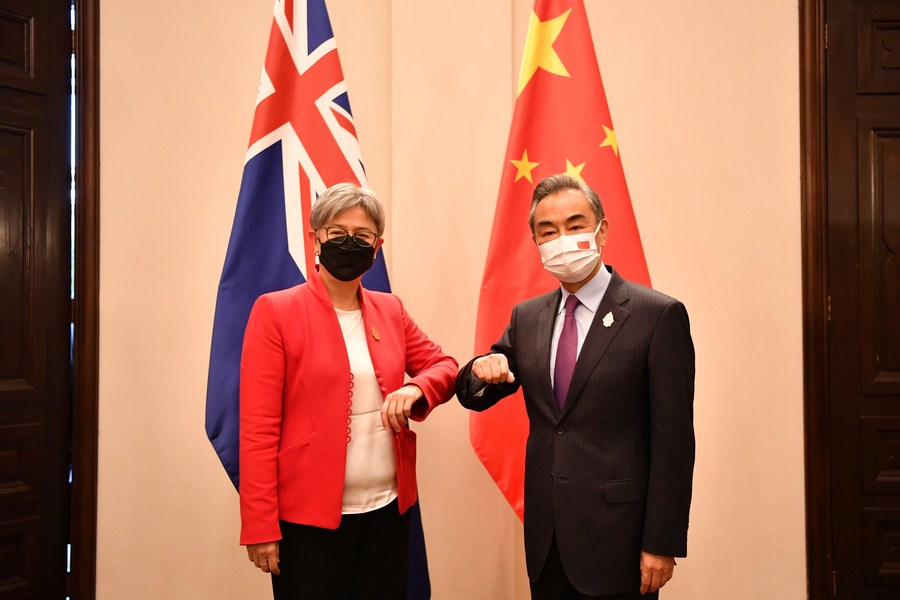
V. Q: Australia, Canada and the Republic of Korea (ROK) have just gone through changes of government. How do you feel about having first direct talks with the foreign ministers of the three countries?
A: The deepest feeling of face-to-face exchanges with the three foreign ministers is that all three countries attach importance to the relations with China, that they all hope to strengthen communication, enhance mutual understanding and seek mutually beneficial cooperation, and that they all advocate abiding by internationally recognized rules such as the purposes and principles of the UN Charter.
In the past few years, China-Australia relations have encountered difficulties, the root cause of which lies in the fact that the former Australian government insisted on regarding China as a "rival" or even a threat, with a series of irresponsible and imprudent words and deeds against China. At present, China-Australia relations are facing both challenges and opportunities. China is ready to re-examine, re-calibrate, and reinvigorate bilateral ties in the spirit of mutual respect. We have noted that the Australian side reiterated that China and Australia are comprehensive strategic partners and Australia will continue to pursue the one-China principle. China hopes that the Australian side will correct its perception of China, refrain from hyping up and exaggerating differences and participating in containing China, conduct constructive exchanges on the basis of mutual respect and in a rational and pragmatic manner, and strive to bring bilateral relations back on the right track.
China-Canada relations have long been at the forefront of China's relations with developed countries. China and Canada have never been rivals, but partners, and China has never been a threat, but an opportunity. Sound and stable China-Canada relations are in the common interest of both sides. The foreign ministers' meeting was constructive and candid. The improvement and development of China-Canada relations require the joint efforts of both sides. Specifically, we should steer the development of bilateral relations on the right course, properly manage differences, uphold mutual respect, stick to independence, and seek win-win cooperation.
China and the ROK are inseparable neighbors and partners. The two countries are in a security environment where the two peoples rise and fall together, and have formed an industrial cycle of converging interests. This year marks the 30th anniversary of the establishment of diplomatic relations between China and the ROK. Bilateral relations embrace development opportunities and also face some practical challenges. When the new ROK government was taking shape, the two heads of state had a successful phone conversation, ushering in a smooth transition and a good start in bilateral relations. It is in the common interests of both sides to well maintain and develop bilateral relations, otherwise, the two countries will both suffer. This is an important experience in the development of bilateral relations over the past 30 years. The two sides should reaffirm the original aspiration of establishing diplomatic ties, focus on mutually beneficial cooperation and remove external interference, so as to maintain the momentum for sound and steady development of bilateral relations.
VI. Q: The international community paid close attention to the meeting between the Chinese Foreign Minister and the U.S. Secretary of State in Bali. How do you make of this meeting?
A: The two sides had a long meeting in Bali, conducting comprehensive and candid communication on how to improve China-U.S. relations and properly cope with major international and regional challenges. Both sides agreed that the meeting was substantive and constructive, and accumulated conditions for future high-level interactions. We both hold that currently, China-U.S. relations are at a critical juncture, and it is necessary and helpful to maintain such regular communication.
During the meeting, the Chinese side highlighted that the United States has a serious misperception of China, which led to the obvious miscalibration of its views on China, interests and competition, and thus resulted in a China policy that deviates from the right track. The United States should not view China-U.S. relations only from the perspective of major-power competition, nor should it handle China-U.S. affairs with a zero-sum game mindset. The United States should immediately stop interfering in China's internal affairs and harming China's interests on issues related to Taiwan, Xinjiang, and Hong Kong, as well as maritime issues. China took the initiative to put forth four lists to the U.S. side, with three of them respectively demanding the U.S. side to eliminate negative factors in bilateral relations and one aimed at exploring the way to promote mutually beneficial cooperation between the two countries. This attests to the fact that the Chinese side is principled and constructive. The Chinese side also put forward proposals for positive interactions between China and the United States in the Asia-Pacific region, as well as establishing rules that both sides should observe. The two sides also reached concrete consensus on advancing the China-U.S. joint working group consultation to solve respective concerns, provide facilitation for diplomatic and consular personnel to discharge their functions, and resume exchanges and consultation on people-to-people and cultural matters. Both sides agreed to cooperate in climate change, public health, and other fields.
The fundamental approach to steering China-U.S. relations out of difficulties is earnestly implementing the common understandings reached by the two heads of state. The two sides should discuss the establishment of guidelines for their behaviors in the spirit of mutual respect, peaceful coexistence, avoidance of confrontation and win-win cooperation. President Biden has reiterated the five commitments on multiple occasions, and this time Secretary of State Antony Blinken has made further positive statements. The key is that the United States should live up to its words. The United States should eliminate the strategic anxiety of "threat inflation", abandon the I-win-you-lose habitual thinking, reject being kidnapped groundlessly by "political correctness", stop a series of wrong acts that undermine China-U.S. relations and regional strategic stability, work with China to effectively manage and control differences, and act on peaceful coexistence and achieve positive interactions first in the Asia-Pacific region.


- China's development dividend highlighted
- Jinan in Shandong immersed in Lantern Festival joy
- Scoop up yuanxiao to uncover Hefei's charm
- China's CPPCC session to open Wednesday
- Shanghai Cherry Blossom Festival 2026 to illuminate Gucun Park with nighttime blossoms
- China lauded for role in global poverty reduction





