



Feast and famine









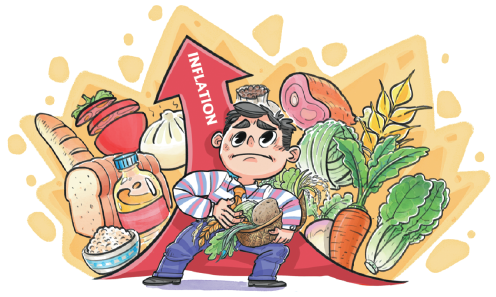
The soaring global inflation is posing new challenges to realizing the sustainable Development Goal of no hunger
Since March 2020, on the heels of the US Federal Reserve's ultra loose monetary policy, the world's major economies have adopted varying degrees of loose monetary policy, creating today's global high inflation. According to International Monetary Fund data, in June the US consumer price index rose 9.1 percent from a year ago, the largest increase in 40 years.
A high inflation-induced surge in food prices is a common problem people are facing. US Bureau of Labor Statistics data shows that food prices increased by 10.4 percent for the 12 months ending June 2022. Specifically, in US cities, the price of flour rose to 0.5 dollar a pound, up 39.9 percent year-on-year. The prices of ground beef, bacon, chicken, and fresh milk rose by 12.2 percent, 11 percent, 23.9 percent, and 16.8 percent, respectively.
If the United States, which enjoys the most abundant food supplies globally, is suffering from rampant inflation, things can only be worse in other countries. An extreme case is Turkiye, whose CPI increased by 78.6 percent in June 2022 compared to June 2021, and of that, food prices rose 93.9 percent year-on-year. And things are not improving. The Turkish Statistical Institute said consumer prices rose by 79.6 percent from a year earlier in July and food prices rose 94.7 percent.
The international community and governments across the world have realized the harmfulness of high inflation. The US has started tightening monetary policy since March 2022, pushing global commodity prices into a downward cycle. Despite that, prices of farm produce are still at record high levels, as it takes time to rein in food prices and the CPI.
In the face of surging food prices amid high inflation, the world's commercial agriculture sector-such as large professional producers and traders of bulk farm-products in major bulk farm-produce exporting nations or regions including the US and Latin America-has reported marked growth in earnings. For instance, the US agribusiness giant ADM reported second-quarter earnings of $1.24 billion, up 74.2 percent year-on-year. It posted revenue of $27.28 billion in the period, up 19 percent year-on-year.
However, we should take into account that the global rural population currently stands at 3.4 billion. The overwhelming majority of them are smallholder farmers, whose agricultural production is mainly used for satisfying family demand and just a very small share goes to the marketplace for exchanges. Instead of benefitting from surging food prices, they are suffering from global inflation-induced price hikes across the board. Higher expenditure on life necessities further worsens their condition and indirectly increases the global population affected by hunger and malnutrition. The number of people affected by hunger globally rose by nearly 150 million since the outbreak of the COVID-19 pandemic, according to data from the Food and Agriculture Organization of the United Nations.
The problem does not stop there. From the perspective of economic growth, global high inflation will bring about more uncertainties to growth prospects, and more often than not, will result in an economic recession. In its World Economic Outlook updated in July 2022, the IMF said it expects growth to slow from last year's 6.1 percent across the globe to 3.2 percent this year, citing inflation as a major concern. It said that the synchronized monetary tightening across countries is historically unprecedented, and its effects are expected to bite in 2023, when global growth slows to 2.9 percent.
This will inevitably result in a plunge in prices of agricultural products, hurting companies and people engaged in the commercial agriculture sector. In a nutshell, there's no real winner throughout the process of high global inflation.
In general, moderate inflation plays a positive role in promoting economic growth and wealth reallocation, but sharp inflation or even hyperinflation is a common enemy of the world. Surging inflation across the globe also poses a serious threat to global food security.
Since the Green Revolution, the global population affected by hunger has dropped thanks to higher agricultural productivity-induced lower prices of agricultural products, which makes low-price food benefit the low-income groups. The proportion of people affected by hunger and malnutrition dropped from 37 percent in the 1970s to 8 percent in 2018. However, the global inflation since the outbreak of the COVID-19 pandemic has enhanced people's food expenses, and reduced low-income people's accessibility to food, creating the first major rebound in the proportion of people affected by hunger and malnutrition in more than 50 years. The proportion will rise further if conditions continue to worsen.
In the long run, we are aiming to achieve the goal of Zero Hunger for the whole of humanity. In the short run, the international community should further bolster cooperation in the face of current difficult situations. At the macro level, we need to bridge political differences, stabilize international trade and investment, restore confidence in economic growth, and reduce poverty to the greatest extent, so as to guarantee low-income people's accessibility to food. In the area of agricultural production, we need to beef up support for countries mired in or on the brink of food crisis in agricultural sci-tech popularization and agricultural assistance, better incentivize local agricultural producers, and promote the increase in local agricultural output and rural development. With regard to customer behavior, we should vigorously advocate healthy diets, effectively reduce food waste, and strive for a food consumption pattern that's resource-efficient and environment-friendly.
China has long been committed to helping other developing countries advance poverty reduction, food security and social progress, not only setting a stellar example in these areas with its own explorations and practices, but also accumulating rich experience in providing aid for foreign countries.
The author is a researcher of the Rural Development Institute at the Chinese Academy of Social Sciences. The author contributed this article to China Watch, a think tank powered by China Daily. The views do not necessarily reflect those of China Daily.
Contact the editor at editor@chinawatch.cn.





