



Biden's China policy is contradictory









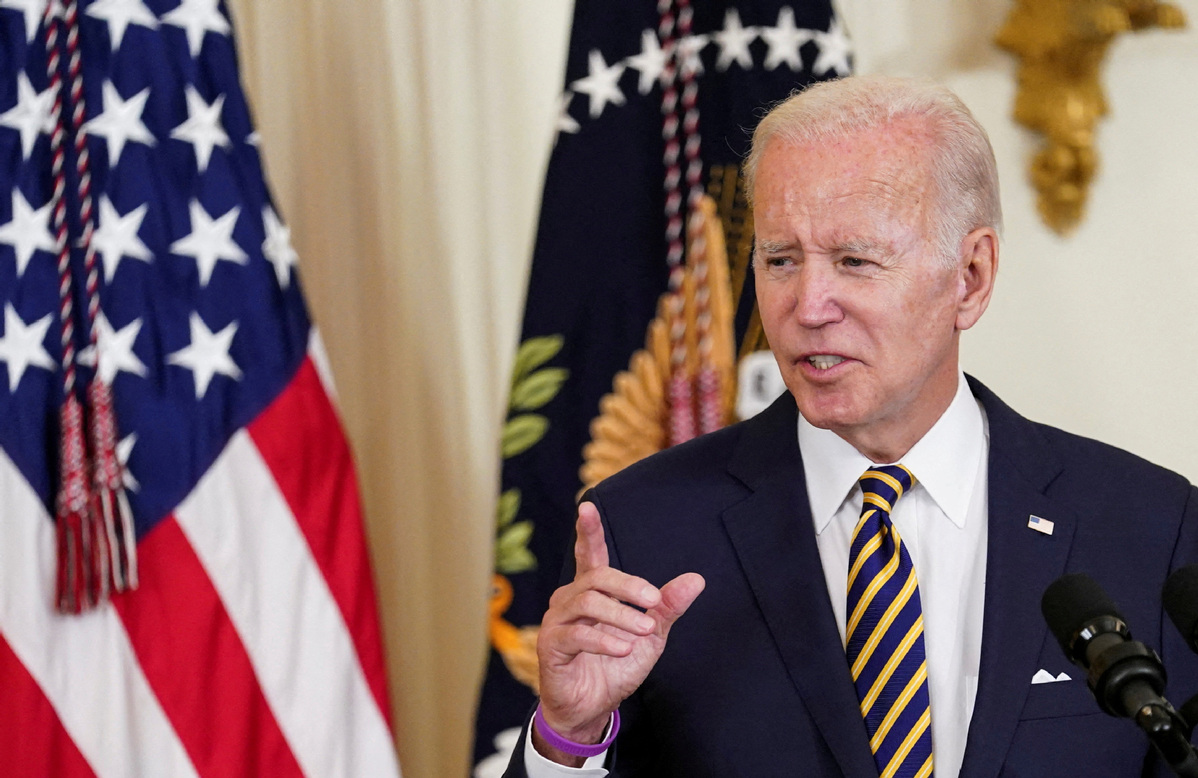
"We now know that nations, like people, can go crazy. They may act on assumptions quite contrary to reality and plunge into unnecessary disasters." These are the first sentences written by John K. Fairbank in the introduction to Gary May's book, China Scapegoat: The Diplomatic Ordeal of John Carter Vincent. The book is the story of one of the three "Johns" who were blamed for the "loss of China" in the late 1940s.
Now in the 2020s, more than seven decades later, some American leaders blame former US president Richard Nixon for the broadly defined engagement with China. This first became evident during the Donald Trump administration, as in its first and only National Security Strategy report in 2017, it negated the assumption of a Sino-US engagement strategy.
Three years later, then US secretary of state Mike Pompeo, delivering a speech on the US' China policy at the Richard Nixon Presidential Library and Museum, appeared to target Nixon for his engagement policy with China. And his emphasis that "the awakening is happening" had a strong Cold War tinge.
Since incumbent President Joe Biden has embraced, rather added to, Trump's China policy, it seems bilateral relations will deteriorate further.
Biden is playing a different game by giving conflicting messages on his China policy. In his first address to the United Nations General Assembly, Biden said the US was not seeking a new Cold War and didn't want to see a world divided into rigid blocs. Yet during his 19 months in office, Biden has tried to mobilize allies and partners on "ideological" lines, claiming the strategic competition between China and the United States was "a battle between the utility of democracies in the 21st century and autocracies".
Biden wants to scare the hell out of US allies and partners, so they coordinate their China policies with the US, which is like a "unite-to-divide" strategy. The US is tearing apart the world in general, and the Asia-Pacific region in particular, with the aim of containing China.
Biden reassured President Xi Jinping during their recent conservation on the phone that the US does not seek to change China's political system. And yet he is pushing ahead with his "Indo-Pacific" strategy, which is aimed at reshaping the strategic environment in which China operates and tilting the balance in favor of the US and its allies.
Biden has also said the US does not seek to strengthen its alliances to contain China's rise. But his administration's moves in the last one and a half years tell another story. The US, the United Kingdom and Australia formed a security partnership called AUKUS in September 2021 to help Australia acquire eight nuclear-powered submarines, among other things, in gross violation of the Nuclear Nonproliferation Treaty.
There are other moves that the US has made with other major allies and partners under the umbrella of NATO, the G7 and the QUAD. Biden and his officials do not mention China by name, but all their policies are targeted against China.
Biden also said the US does not support "Taiwan independence". However, the US has been hollowing out the one-China principle, and Biden himself has vowed to protect Taiwan. Although the White Office walked back his remarks, for Beijing he is no longer trustworthy.
The US administration has also announced more arms sales to Taiwan, allowed more high-ranking officials to visit the island, and sent more warships to sail through the Taiwan Straits. The most offensive US move, by far, is US House Speaker Nancy Pelosi's recent visit to Taiwan. Following Pelosi and another congressional delegation's visits to Taiwan, the office of the US Trade Representative announced this week the US and Taiwan have agreed to start the "Initiative on 21st-Century Trade" talks possibly early this autumn.
Biden has said the US does not intend to trigger a conflict with China. But the key question is how to prevent a conflict. That unfortunately doesn't seem to be of any importance to US officials as Secretary of State Antony Blinken has continued with his toxic rhetoric against China.
Without changing its China policy and stopping its provocative moves against China, the Biden administration cannot convince China that it working to avoid a conflict.
Biden and his team are all seasoned politicians, but they are also anxious and arrogant. Since taking office, Biden has announced many policies and projects. But like the other policies, his China policy too is in accordance with international relations principles, but cannot be delivered in the way it is planned.
Sino-US relations have been deteriorating in recent years, and the window for a strategically stable relationship is closing. Considering that both China and the US major global powers, it is essential that decision-makers in Washington think twice before targeting China.
More than seventy years ago, the diplomatic ordeal of John Carter Vincent, a China hand who served in the US embassy from the 1920s to the 1940s, was a tragedy of gigantic dimensions. Sinophobia and ideological anxiety that gripped the US after that became the driving force of the US' China policy and remolded America's foreign policy. The same story should not be repeated in the 21st century, because China is no longer the country it was 70 years ago.
The author is the deputy director general of the Institute for International Strategic Studies, Party School of the Central Committee of CPC (National Academy of Governance).
The views don't necessarily reflect those of China Daily.
If you have a specific expertise, or would like to share your thought about our stories, then send us your writings at opinion@chinadaily.com.cn, and comment@chinadaily.com.cn.





