



China, Mongolia have to jointly fight against desertification









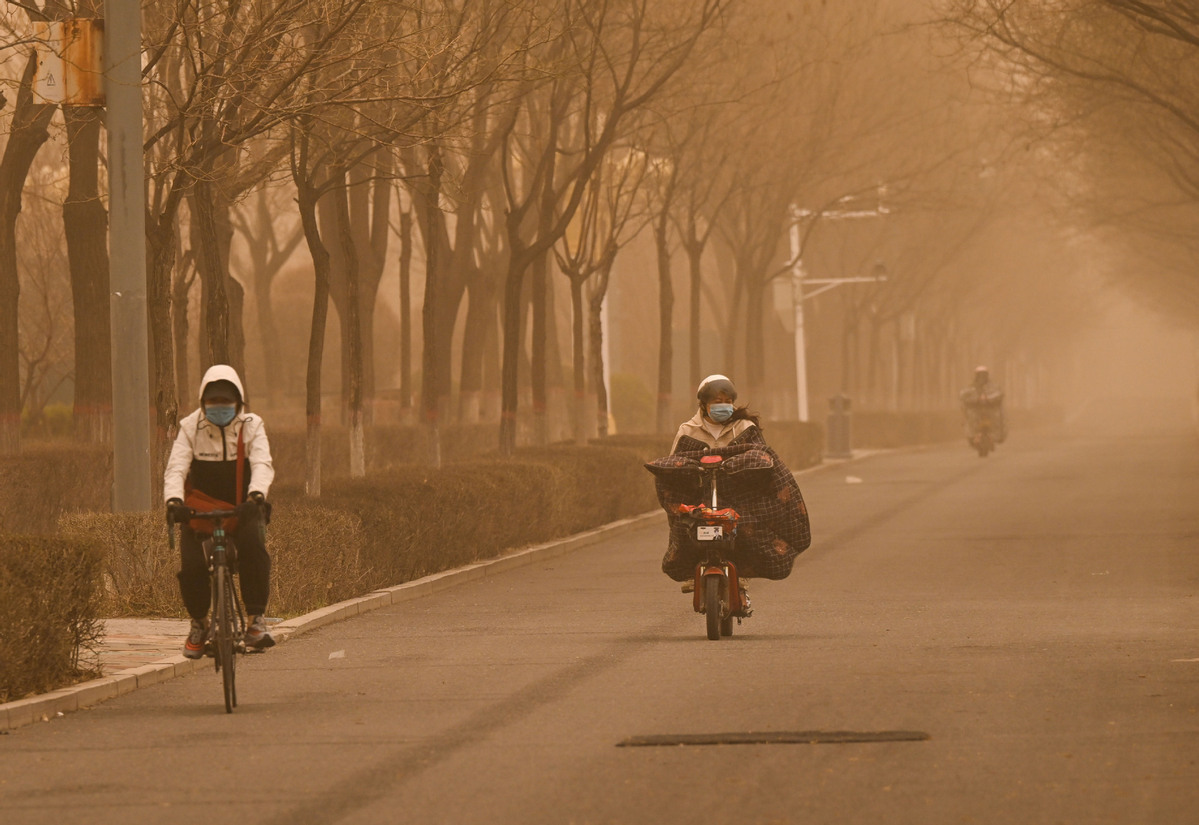
Severe sandstorms have hit the northern and northeastern parts of China, even some provinces south of the Yangtze River for several times this spring. They have affected the Republic of Korea and Japan, too, and forced residents in some places to stay indoors for health reasons.
Sandstorms are not new to China, but this spring's sandstorms have been different from previous ones. First, they have been widespread, affecting 18 provinces in China, including some in southern provinces and municipalities such as Hubei, Hunan, Jiangxi, Anhui and Zhejiang provinces, and Shanghai.
Second, this year's sandstorms have also been frequent — four in one month and eight so far this year.
Third, the sandstorms have lasted longer than usual, resulting in several days of heavy pollution in Beijing — the first time that has happened in nearly a decade. Shanghai, too, has experienced hours of severe pollution.
What causes heavy, severe sandstorms
Sandstorms are caused, first, due to strong winds blowing from north to south, carrying with them huge volumes of sand across several provinces in China. The expansive desert region in northern China and the southern Mongolia is the second cause of the sandstorms. And third, lower precipitation and rising temperatures, which loosen the sand and soil on the surface, create the perfect conditions for heavy sandstorms.
Desertification is a process where general climate transformation and inappropriate human activities exceed the ecosystem's rehabilitation capability in dry and less humid terrains, leading to a decrease in the biological productivity of land. In fact, desertification and soil degradation have become a crucial environmental issue around the world, not least because they can also influence political, social and economic issues.
The lower precipitation level and high temperatures in the Gobi desert in southern Mongolia and northern, central and western parts of China's Inner Mongolia autonomous region are perhaps the direct factors for the extreme sandstorms this spring. Also, the influence of cyclones on southern Mongolia is conducive to the formation of extreme sandstorms.
According to the Desertification Survey of Mongolia in 2015, conducted by the Division of Desertification Study Institute of Geography and Geoecology of the Mongolian Academy of Sciences, 77.8 percent of Mongolia's land is degraded, with 35.3 percent slightly degraded, 25.9 percent moderately degraded, and 6.7 percent and 9.9 percent severely and extremely degraded respectively.
Based on the numeric index, environmental scientists prepared a map of the region, which highlights the major factors that cause desertification. As per the map, 10.4 percent of Mongolia's land doesn't show any effects of these factors or any signs of desertification, 1.9 percent of the effects of human activities, 16.0 percent of the natural factor, 13.8 percent of the climate factor, 20.8 percent of wind erosion, 0.1 percent of water erosion, 13.1 percent of the combined factors of human activities and climate, and 23.9 percent of the combined factors of wind and human activities.
This means 10.4 percent of Mongolia's land area shows no sign of desertification, 39 percent is affected by human activities or a combination of factors, and 50.6 percent is affected by natural factors or a combination of natural and other factors. In other words, natural factors are responsible for heavy and very heavy desertification in 56 percent and human activities in 44 percent of the cases in Mongolia.
The survey's results also show the overall area of desertification in Mongolia has not decreased, and the degree of desertification varies from region to region. As of today, desertification is particularly serious in the Dundgovi, ?v?rkhangai, Govisümber, Dornogovi, Bayankhongor, T?v, Govi-Altai and ?mn?govi provinces.
Also, desertification in Mongolia is influenced by many factors, including indirect factors such as population growth, socioeconomic development and international trade, and direct factors such as inappropriate use of land, as well as climate change. It is worth noting that recent environmental degradation in Mongolia is mainly man-made, for example, the over-exploitation of the limited natural resources.
Need to strengthen ecological protection
Although the most important measures to combat desertification in China over the past two decades, such as the environmental protection plan as part of the Three-North Shelterbelt Project, have produced remarkable results, the frequent occurrence of sandstorms this spring shows ecological protection needs to be further strengthened, especially through deeper cooperation between China and Mongolia on desertification control.
The Division of Desertification Study Institute of Geography and Geoecology of the Mongolian Academy of Sciences has been playing a leading role in deepening China-Mongolia cooperation on fighting desertification, and working out scientific projects in cooperation with many Chinese research institutions and universities.
In 2017-19, in cooperation with the Northwest Institute of Eco-Environment and Resources of the Chinese Academy of Sciences, the Mongolian institute worked on a project called "Key Techniques for Sand Dune Stabilization and Vegetation Recovery in the Typical Regions of the Countries along the Silk Road Economic Belt".
In 2018-20, in cooperation with the Inner Mongolia Normal University, and the agricultural and livestock products processing institute of Inner Mongolia, the Mongolian Academy of Sciences worked on a project titled "Application of Remote Sensing Monitoring and Repair Technology a Demonstration of Degraded Grassland in Mongolia".
Also, in 2018-20, the Mongolian institute worked with the Xinjiang Institute of Ecology and Geography of the Chinese Academy of Sciences on a project titled "China-Mongolia Cooperation Research and Demonstration on Grassland Desertification Control". And in 2022, in cooperation with the Institute of Geography and Natural Resources of the Chinese Academy of Sciences, the Mongolian researchers worked on a project called "Planting Trees and Shrubs to Stabilize the Movement of Sand".
In other words, cooperation between China and Mongolia on desertification control is still in the initial stage. And hence, in the face of the recent extreme sandstorms, the two sides should jointly implement environmental protection measures.
First, environmental diplomacy, namely, cooperation on environmental protection and desertification control, should be listed as an important topic of discussion by the two countries during high-level exchanges. During Mongolian President Ukhnaagiin Khurelsukh's visit to China in 2022, the two heads of state agreed to strengthen cooperation on environmental protection and desertification control. And President Xi Jinping expressed support for Mongolia's "One Billion Trees" campaign, which is aimed at combating desertification, yellow dust storms, and land degradation. This is a good start for the two countries' high-level exchanges and cooperation on environmental protection and desertification control.
Second, Chinese and Mongolian scientific research institutions should work together to develop a trans-boundary desertification map and monitoring system, which should take into consideration all natural and socioeconomic factors causing land degradation and desertification. Desertification assessment and monitoring are needed to determine whether desertification is taking place in only certain areas, and provide a basis for devising the right measures to control desertification and land degradation.
Third, China and Mongolia should establish a special fund to jointly deal with regional environmental issues such as desertification control. This is important also because of the high environmental similarity between northern, central and western Inner Mongolia in China and the Gobi region in southern Mongolia. Also, the joint fund should support Chinese universities and environmental research institutions to provide necessary technical and program support for Mongolia's environmental protection and sustainable development.
Besides, China should encourage researchers to visit Mongolia and spread knowledge about desertification and teach the people how to control desertification.
And fourth, the two sides should encourage Chinese environmental NGOs, private enterprises and individual volunteers to participate in environmental protection projects in Mongolia. As for the Chinese and Mongolian governments, they need to conduct environmental diplomacy, while environmental NGOs, private enterprises and individual volunteers should promote people-to-people exchanges in order to prevent and control desertification.
Ganchudur Ts is head of the Division of Desertification Study, Institute of Geography and Geoecology, Mongolian Academy of Sciences; and Meng Gencang is a professor at the China Research Center for Northeast Asian Languages, Dalian University of Foreign Languages.
The views don't necessarily represent those of China Daily.





