



Gui Haichao to be 1st Chinese civilian in space









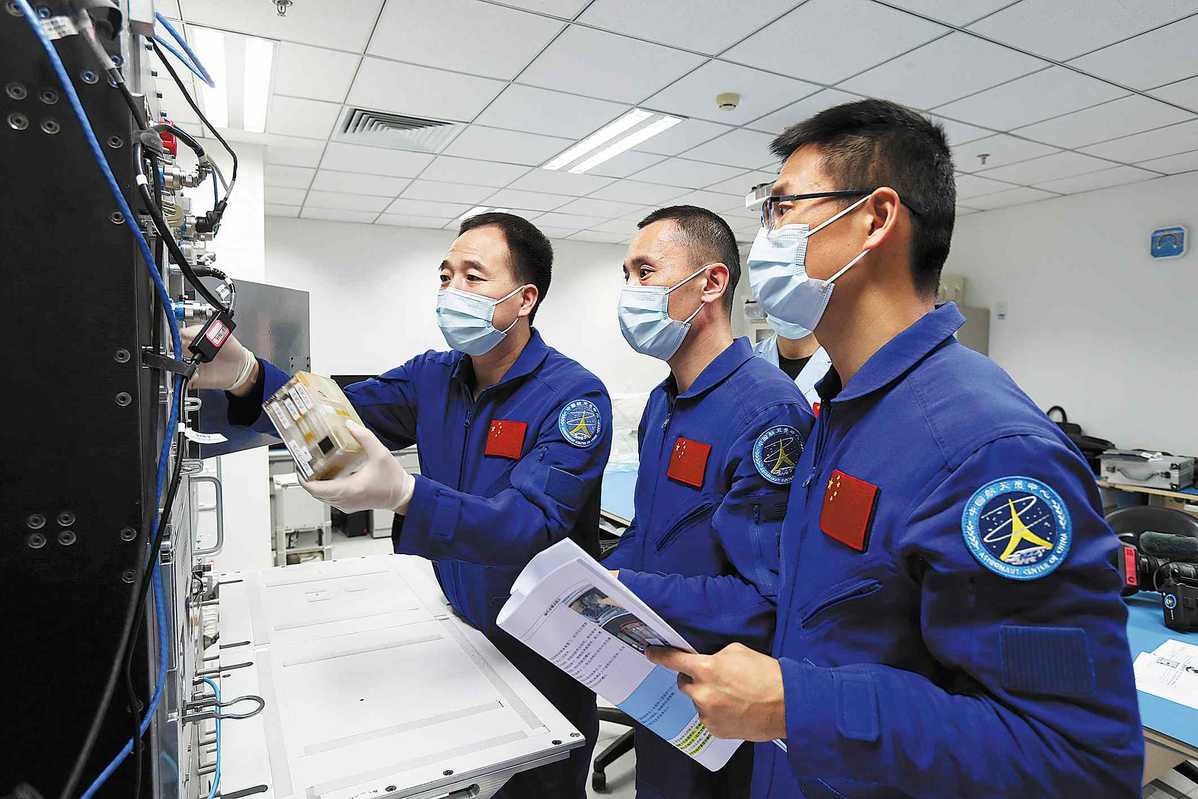
The vocation of astronaut had for a long time seemed "sacred and distant" to Gui Haichao until the researcher became a member of the Astronaut Center of China. The 36-year-old from Yunnan province will become the first Chinese civilian to fly in space.
Fifteen years ago, Gui was a senior at the School of Astronautics under Beihang University, formerly known as the Beijing University of Aeronautics and Astronautics, majoring in spacecraft design and engineering.
"When Jing Haipeng was flying onboard the Shenzhou VII spaceship in September 2008, I was still a university student. I watched the live broadcast of our nation's first spacewalk that was carried out by the Shenzhou VII crew," he said during a recent interview at the Astronaut Center of China in Beijing before heading to the Jiuquan Satellite Launch Center for his maiden flight.
"I just couldn't even imagine at that time that I would become a colleague of his and train and live in the same place. And now I am an astronaut in his crew and we will fly together to the space station," said Gui, now a professor and doctoral supervisor at Beihang University.
In the following years, Gui continued his study at Beihang and graduated in the summer of 2014 with a doctor's degree in spacecraft design.
The young researcher then spent two years in a post-doctoral program working on integrated directional and orbital control technology for sophisticated spacecraft at the Department of Earth and Space Science and Engineering at York University in Toronto.
In the summer of 2016, Gui undertook post-doctoral research on the detection of small celestial bodies and high-precision forecast technology for spacecraft movement at the Department of Aerospace Engineering at Ryerson University, which was later renamed Toronto Metropolitan University.
He returned to Beihang in September 2017 after receiving the university's invitation to teach as an associate professor at the School of Astronautics.
At Beihang, the researcher's academic interests included spacecraft dynamics, guidance, navigation and control technology for aerospace systems. He has published more than 50 journal articles and academic conference papers.
In the spring of 2018, Gui and his colleagues were told by the school's president that China's manned space authorities had decided to select the third batch of astronauts, including the first spaceflight engineers and science payloads specialists.
"The president told us that the posts of spaceflight engineer and science payloads specialist would be open to civilians working for nonmilitary research entities. He said this was a very precious opportunity and encouraged those interested to apply.
"I have been a fan of space exploration for many years and sometimes dreamed about doing my research in space, so I was excited hearing this news and immediately came to the school's administrative office to fill in the application form," the academic recalled.
After rounds of physical checks and professional tests, Gui earned a place in the elite club and started training at the Astronaut Center of China.
According to Wang Yue, a classmate and co-worker of Gui at the School of Astronautics, Gui told him privately that the physical training at the astronaut center was "intense and demanding" and posed a huge challenge to him.
"But he didn't quit and managed to pass all tests," Wang said.
Su Wenjie, Gui's first doctoral student, said the professor did not relax his attention and instruction on his students after he started training at the astronaut center.
"When his training schedule wasn't so tight, Professor Gui would read my papers and send me some articles he thought might be of help to my research," she said.
Speaking about his experience at the astronaut center, Gui said: "After joining this team, the 'heroes and heroines' I had watched on TV and in the newspaper became the training mentors, sports mates, close friends as well as co-workers of us, the new astronauts."
Thanks to his perseverance and diligence, Gui progressed rapidly in every training course and was chosen for the Shenzhou XVI mission to become the first civilian and scientist in this country to travel in orbit.
During the coming flight, Gui will be responsible for operating, maintaining and repairing science equipment. He will control experiments and collect, sort and conduct initial analysis of data.
The professor said he feels fortunate and honored to become the first Chinese science payloads specialist to fly in space.
"I am sure that with mission commander Jing's guidance and the crew members' close cooperation, we will successfully perform our duties. We will use our efforts to contribute to the great 'New Era' and meet the expectations of the Party and the people," Gui said.


- Senior enterprise official facing probe
- China's anti-graft authorities reveal extent of year's work
- Former Haikou Party chief gets death sentence with reprieve
- Purchase of US-made weapons to push Taiwan closer to the peril of war: spokesman
- WIC calls for submission of cultural heritage digitalization cases
- China calls for global opposition to Japanese neo-militarism










