



Lai's US transit threatens cross-Strait peace









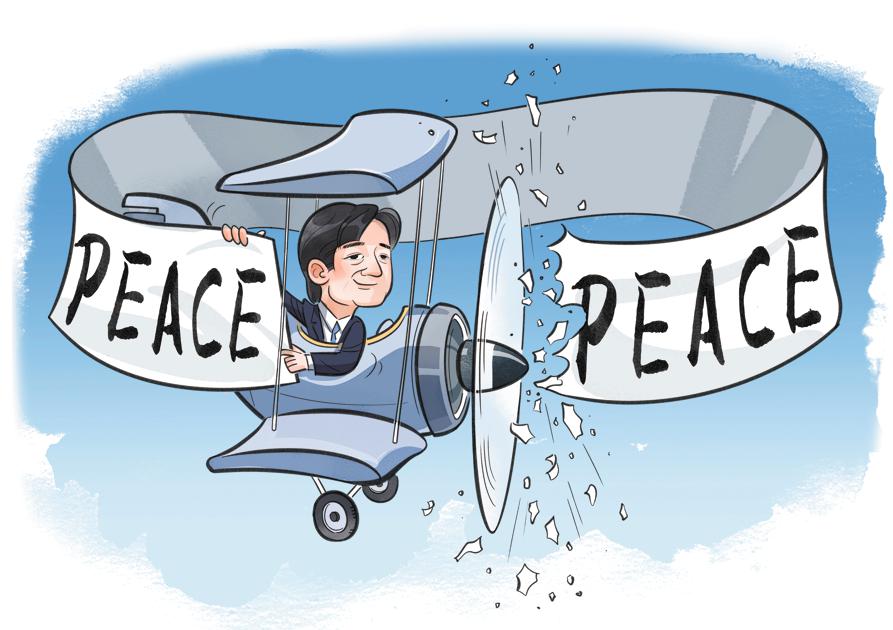
The fact that the United States has allowed Lai Ching-te, Taiwan politician and the Democratic Progressive Party chief, to transit through New York and San Francisco airports on his way to and back from Paraguay goes against the pledge the US made in the three Sino-US joint communiqués.
The US' permission to Lai, who is also the DPP candidate for the island's 2024 election, to transit through the country is especially objectionable because Lai calls himself a "pragmatic advocate of Taiwan independence", highlighting his pro-independence stance.
Efforts to strengthen the so-called Taipei-Washington relations have become a crucial strategy for the DPP and Lai to divert attention from the ruling Democratic Progressive Party's poor performance on the island and win more votes.
However, Lai's transit through the US will have grave consequences because of his pro-independence stance. As a contender for Taiwan leadership, his ability to manage cross-Strait relations has been questioned by many. Even many politicians in Washington doubt Lai's ability to follow Tsai Ing-wen's policy on cross-Strait ties.
In July, Lai published an op-ed in The Wall Street Journal outlining his four main "pillars" for peace — strengthening deterrence, enhancing economic security, promoting democratic partnerships, and maintaining the status quo across the Taiwan Strait — in an attempt to convince the US he could manage cross-Strait relations well.
But later, Lai said that if a Taiwan leader could "enter the White House", the island's "political objectives" will be automatically "achieved", which is in direct contradiction to the US' "one-China policy", under which Taiwan leaders are not permitted to enter Washington, let alone the White House.
This exposes Lai's political opportunism, especially his attempt to cater to pro-independence supporters on the island. Those familiar with the Taiwan political landscape and cross-Strait relations know that Lai has adopted a confrontational attitude against Beijing, refusing to acknowledge the 1992 Consensus that there is only one China and Taiwan is an inalienable part of China, which is the foundation of cross-Strait exchanges and Sino-US ties.
Washington made some clear commitments when establishing diplomatic relations with Beijing. For example, in the Joint Communique on the Establishment of Diplomatic Relations between the People's Republic of China and the United States of America in 1979, Washington said: "The United States of America recognizes the Government of the People's Republic of China as the sole legal Government of China. Within this context, the people of the United States will maintain cultural, commercial, and other unofficial relations with the people of Taiwan."
But by allowing Lai to transit through the US, regardless of the rationale given by some US politicians, the US has tried to further hollow out the one-China principle. This move by the Joe Biden administration can be seen as political support to the DPP and Lai, and an attempt to use the island against the Chinese mainland amid the rising "pro-Taiwan, anti-Beijing" sentiments in the US.
The mainland has ample legal basis and rights to take appropriate action against Lai's transit, and preventing "Taiwan independence" and foreign interference in the nation's internal affairs are critical to maintaining peace and stability across the Strait.
Beijing can use laws such as the Anti-Secession Law, the Criminal Law, the National Security Law and the Anti-Foreign Sanctions Law to penalize those advocating "Taiwan independence" and take countermeasures against foreign entities collaborating with separatist forces on the island. Beijing has the military capability, too, to end pro-independence on the island and safeguard national sovereignty.
The Taiwan question is not only a core interest of Beijing but also forms the foundation of diplomatic relations between Beijing and Washington. As such, Lai's transit through the US is not a "routine" matter; it is a serious move by separatist forces on the island trying to achieve "Taiwan independence" by leveraging US support.
In the face of such provocations, the mainland should take strong countermeasures, because allowing this trend to continue could embolden Lai and the DPP to change the status quo across the Strait and trigger a conflict, endangering the interests of Taiwan residents.
The author is a researcher at the Institute of Taiwan Studies, Chinese Academy of Social Sciences. The views don't necessarily represent those of China Daily.
If you have a specific expertise, or would like to share your thought about our stories, then send us your writings at opinion@chinadaily.com.cn, and comment@chinadaily.com.cn.





