



Big increase: Crested ibis population exceeds 10,000 globally after 42 years of protection









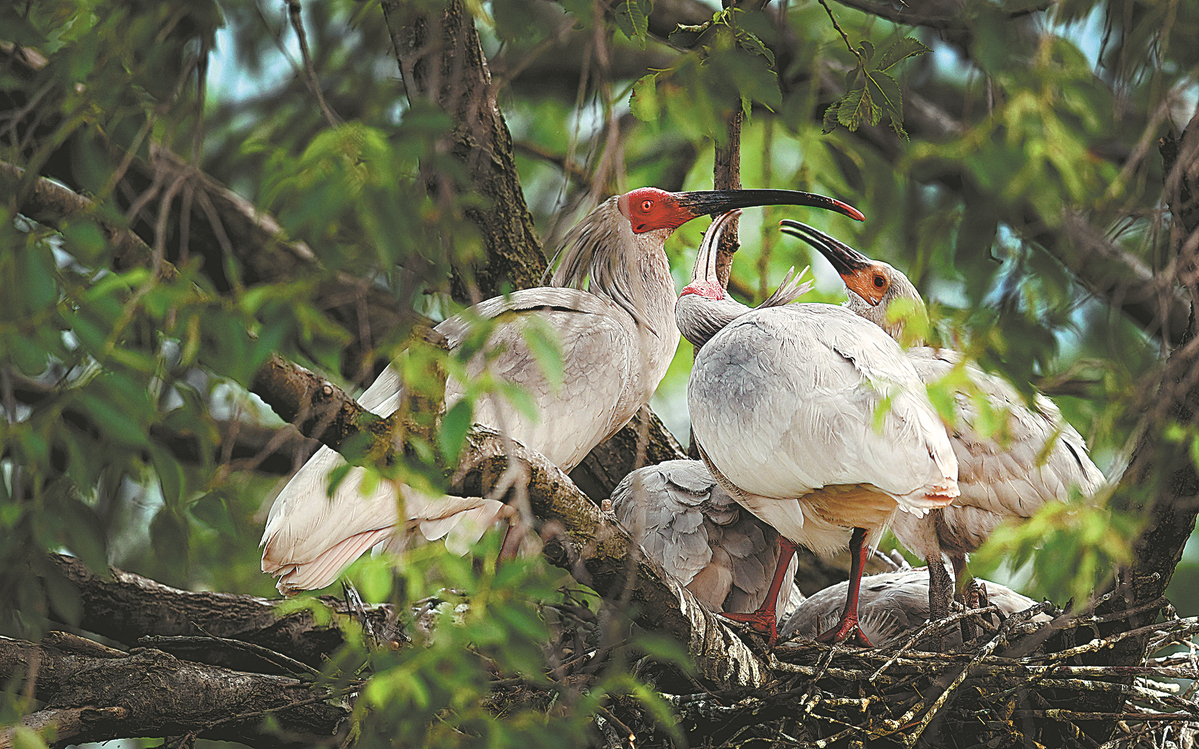
More than four decades of protection has seen China's crested ibis population climb from seven to more than 9,000. The global total now exceeds 10,000, a provincial forestry bureau official told a conference in Hanzhong, Shaanxi province, on Thursday.
The rare bird was once widely distributed in East Asia, but its numbers declined due to the effects of environmental pollution and human activities.
In 1978, a team from the Chinese Academy of Sciences' Institute of Zoology led by ornithologist Liu Yinzeng traveled more than 50,000 kilometers to more than 260 known former habitats in several provinces in an attempt to find crested ibises, which were feared to be extinct in the wild. In 1981, they discovered a pair of adult crested ibises nesting with three chicks in a tree in Shaanxi's Yangxian county, and two older ibises nearby.
The protection of the species was stepped up in 1990, when the Crested Ibis Captive Breeding and Conservation Center was established in Yangxian to increase its population and genetic diversity.
The center developed artificial breeding techniques for the bird, including artificial insemination, hatching, chick rearing and training.
In 2004, China launched a program to reintroduce crested ibises into the wild in Yangxian. The released birds adapted well in the wild and mated and reproduced with the wild population.
Multiple wild-release programs have since been conducted in provinces including Shaanxi, Gansu and Hubei, with the population in Shaanxi alone now 6,654.


- Guangzhou railway hub tops 10 million passengers since start of holiday travel rush
- Shanghai Jiao Tong University celebrates 130th anniversary with illumination ceremony
- Over 100 domestic, foreign teams to take part in intl embodied robot application competition
- Former Hebei official expelled, case sent for prosecution
- Former Guizhou political adviser expelled, dismissed for graft
- Ice and snow activities, desert hot springs draw holiday crowds to Aksu, Xinjiang







