



Industrial and commercial rooftops have big potential









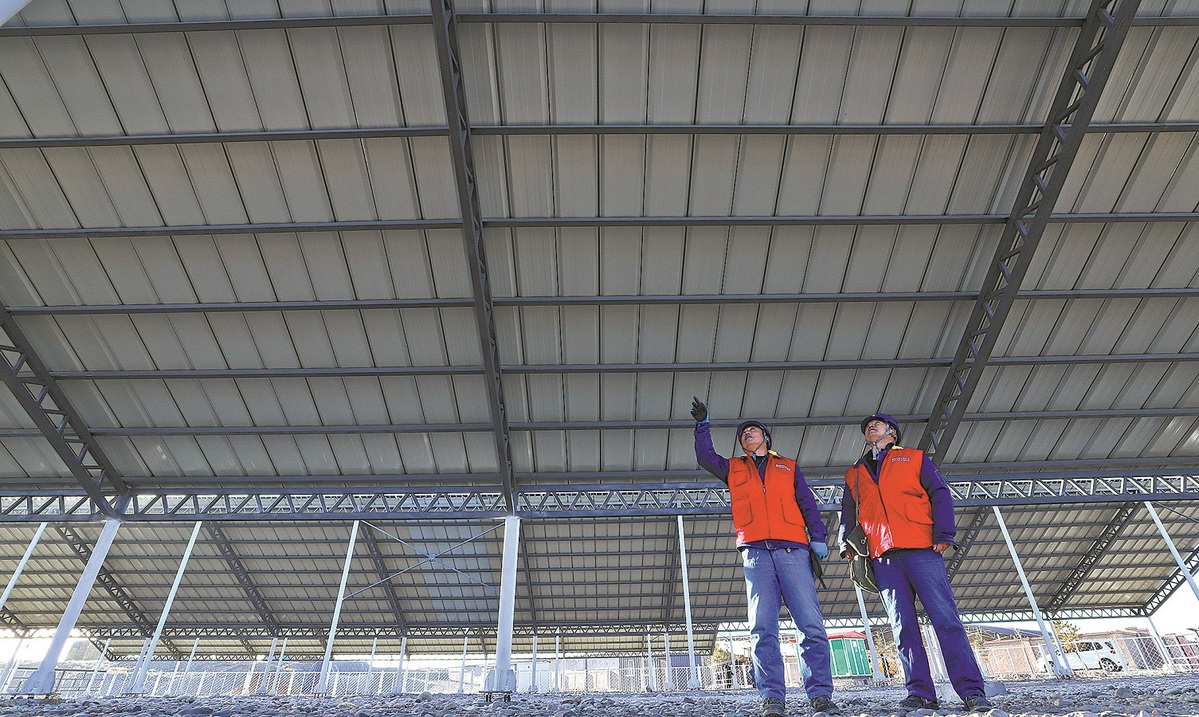
China is expected to see robust growth in the development of distributed solar photovoltaic systems mounted to industrial and commercial buildings, industry insiders said.
While the high price of electricity for businesses provides an economic driver for the potential boom, the increasingly high demand for green power from enterprises, especially listed ones, will also add impetus, they said.
The development of distributed solar PV in China has gained momentum in recent years.
In 2022, the nationwide increase in solar PV power generation capacity stood at roughly 87.4 gigawatts, 51.1 GW of which was contributed by distributed facilities — those installed close to the place where the electricity will be used. That marked the second straight year that the proportion of distributed solar PV reached more than half of the newly added capacity.
It was a trend that continued in the first three quarters of last year, with the National Energy Administration saying that 67.1 GW of new distributed solar PV capacity was connected to the grid from January to September, representing almost 52.1 percent of newly added solar PV capacity.
Often installed on a building's rooftop or facade, distributed solar PV electricity systems avoid the high distribution losses that occur in traditional centralized power generation and transmission.
Qian Jing, vice-president of Jinko Solar, a major Chinese PV player, said she believes distributed solar PV will play an increasingly bigger role in promoting the growth of solar PV capacity, with a bigger contribution coming from industrial and commercial solar PV.
The development of centralized ground-mounted solar PV stations is restricted by the availability of land, she said, as well as the grid's inability to absorb large amounts of intermittent solar power.
She said tapping industrial and commercial distributed solar PV has great potential in China because of the country's special national conditions.
In many foreign countries, most residents have their own rooftops on which solar panels can be installed. In China, that is not the case, she said.
Most urban residents in China, who are major electricity consumers, live in apartment buildings, Qian said. As urbanization continues, the number of residents in rural parts of China has declined substantially, and many of those left in rural areas are elderly people with low electricity demand.
Qian said distributed solar PV systems offer a viable solution for enterprises to address their high electricity costs and demand for green power.
The prices businesses pay for electricity are much higher than those paid by households, she said, and many companies are subject to power rationing during summer, the peak season for electricity consumption.
Installing solar panels is a good way for businesses to solve these problems, Qian said, especially because summer is the best season for solar PV power generation.
She said listed companies in many countries, including China, are required to disclose details of their carbon emissions, which will potentially increase such companies' demand for green electricity.
One option is to have their own solar power generation systems, she said, while another is moving factories to western parts of the country where green electricity is more readily available and accessible.
Wang Weiquan, deputy secretary-general of the Chinese Renewable Energy Industries Association, also said industrial and commercial distributed solar PV will play an increasingly dominant role in solar PV power development in China.
He said highly developed regions in eastern China that are still heavily dependent on fossil fuel cannot solely rely on importing green electricity from western parts of the country as they work toward carbon neutrality.
They also need to produce green electricity to meet part of their power demand, Wang said.
"It's almost impossible for these regions to develop many large-scale ground-mounted solar PV stations, as they have limited land but dense populations," he said, adding that tapping the potential of rooftops was an inevitable choice.
Compared with rural houses, industrial and commercial complexes have much bigger and stronger rooftops, making solar PV installation safer and more efficient, he said.


- China's progress in antibiotic guidance trumpeted
- Beijing hospital blazes trail for treatment of rare diseases
- Scientists from Spain, China discover Jurassic lizard tracks in Europe
- China Coast Guard conducts patrols around China's Huangyan Island
- China's courts conclude 2.5m IP cases in five years
- Thousands of cherry blossoms bloom in Chongqing, drawing visitors









