


Brushing up a legacy









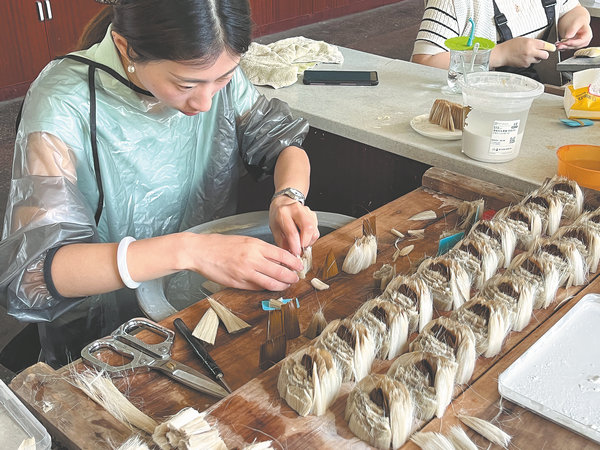
Supple fur
Legend has it that one day in 223 BC, as Meng Tian, a great general of the Qin state, who later oversaw the construction of the Great Wall, was out hunting. At some point, he saw the tail of an unlucky hare had left a trail of blood on the ground, which inspired him to make the first Chinese writing brush in history.
Meng first got some hare fur, inserted it into a bamboo stick, and tried to use it to write. However, the fur of the hare was so sleek that the brush failed to absorb ink. After trying several times in vain, he casually threw the brush into a lime pit outside a window.
Several days later, Meng came across the abandoned brush and picked it up, finding that the fur had become supple. He dipped it into ink and wrote several characters very smoothly. Unintentionally, the lime wash had degreased the fur. Lime is still applied today.
In another version of the legend, instead of hare fur and bamboo stick, Meng used a wooden stick, harder deer fur in the middle and softer goat wool on the outside, a method also still employed today.
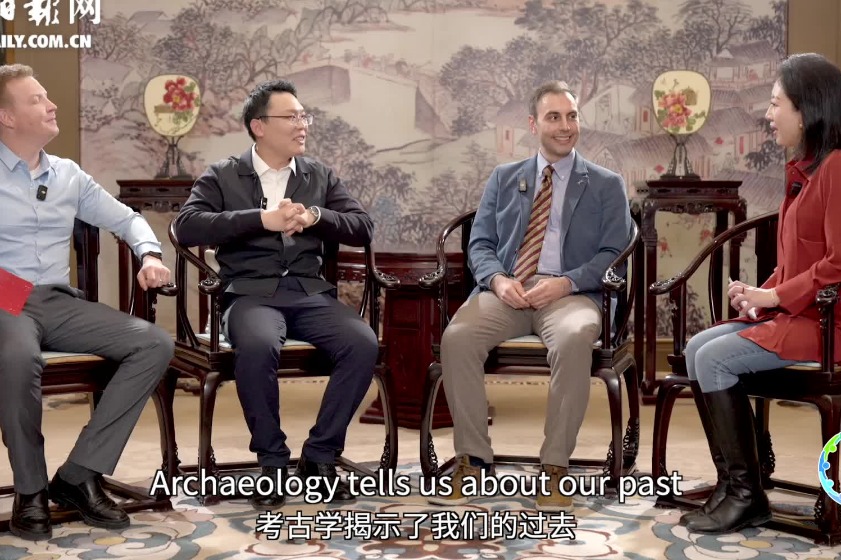
Archaeological discoveries have long refuted the legends about Meng inventing the Chinese writing brush.
Archaeological evidence shows that more than 6,000 years ago, people living in the Banpo site, 10 kilometers east of today's Xi'an, Shaanxi province, used brushes to draw patterns and lines on the surface of pottery. However, compared with pottery or oracle bones, brushes are difficult to preserve and thus rarely seen in ancient ruins.
In the following thousands of years before Meng's time, brush traces are also shown on the oracle bones and pottery from the Shang Dynasty (c. 16th century-11th century BC). It is believed that the inscriptions were engraved on the oracle bones after being written with a brush. Among the inscriptions, there is a character, yu, that means a writing brush. It vividly depicts a hand holding a brush.
In the late 1950s, archaeologists unearthed a writing brush in Xinyang of Henan province. Dating to the early Warring States Period (475-221 BC), this brush is the oldest one ever discovered in China, much earlier than Meng's mythical "invention".
In another tomb of the middle Warring States Period discovered in Changsha, Hunan province, a writing brush made of good-quality hare fur and an 18.5-centimeter bamboo handle was found. The brush tip was 2.5 cm long. It was an epitome of the writing tool in early times.
In the next more than 2,000 years, writing brushes underwent a significant evolution alongside the advancement of writing mediums — from oracle bones, bamboo slips and silk to different types of paper. Also, changes in writing postures due to the increase in furniture height, especially starting from the Song Dynasty (960-1279), and the growth of distinct schools of painting and calligraphy all played pivotal roles in shaping the evolution of writing brushes.
In the vicissitudes of history, the center for making top-quality writing brushes shifted from one place to another. Before the Yuan Dynasty (1271-1368), the most refined writing brushes, usually made of hare fur, were produced in Xuancheng of today's Anhui province, although there were also brush makers in other places like Huzhou in today's Zhejiang province.
As the Northern Song period (960-1127) collapsed, the court of the Southern Song period (1127-1279) moved its capital to Lin'an, known today as Hangzhou, Zhejiang province. Subsequently, a significant influx of writing brush artisans migrated to Huzhou, a neighboring city of Hangzhou, which already housed numerous brush makers.
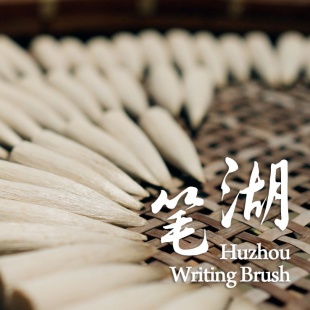
Since the Yuan Dynasty, Huzhou writing brushes have supplanted those crafted in Xuancheng, establishing themselves as the premier writing tool in China. During the Ming (1368-1644) and Qing (1644-1911) dynasties, Huzhou writing brushes were esteemed to such an extent that they were presented to the emperors as tributes.
Huzhou writing brushes are distinguished by their sharpness, neatness, and durability. Structurally, the brush should be well-built, featuring resilient bristles that swiftly regain their original shape after compression.
However, in the latter half of the last century, with the widespread adoption of modern pens, writing brushes began to recede from their long-standing prominence. In an effort to safeguard this ancient craft, the artistry of the Huzhou writing brushes was designated as a form of national intangible cultural heritage in 2006.