


Brushing up a legacy










Perfecting the craft
The complete crafting process of a Huzhou writing brush comprises eight procedures, meticulously subdivided into 128 steps, according to Qiu Changming, a national-level inheritor of the craftsmanship.
The 74-year-old is one of the writing brush master artisans in Shanlian town of Huzhou.
Artisans in the town have worshipped General Meng as the forefather of the writing brush for thousands of years. While Meng seemingly didn't actually invent the brush, he is still believed to have, in reality, improved the materials and techniques used to produce it, Qiu says.
Over generations, artisans in Huzhou have continuously honed their craft, driven by the patronage of esteemed calligraphers like Wang Xizhi and Wang Xianzhi during the Eastern Jin Dynasty (317-420), as well as literary figures, such as Du Mu in the Tang Dynasty (618-907) and Su Shi in the Song Dynasty, all of whom once worked in this region.

The pinnacle of demand arrived with the renowned calligrapher Zhao Mengfu, a native of Huzhou, during the end of the Song and the start of the Yuan.
Zhao, who's known for his unwavering dedication, was reputed to inscribe 10,000 characters daily over a remarkable span of 60 years. Echoing the wisdom of Confucius that emphasizes the importance of tool preparation for excellence in work, Zhao carefully attended to his brushes, frequently commissioning artisans for their maintenance. To meet his standard, artisans needed to choose the best fur from 10 good brushes to make just one.
"Now, similarly, we can pick only one qualified strand from thousands, which shows the fineness of our craft," Qiu says.
In 1966, at age 16, Qiu, who came from a poor family, got the chance to work at the Shanlian Huzhou Ink Brush Factory as an apprentice to master Yao Guanqing.
Yao was born at the end of the Qing Dynasty and trained to be a writing brush artisan.
Since the Yuan Dynasty, the Huzhou writing brush had garnered acclaim from successive generations of literati. Following centuries of development, a cadre of artisans specializing in crafting Huzhou brushes was established in Shanlian.
During the 1910s, the small town saw more than 1,000 artisans work in more than 300 family workshops. Some artisans went to Suzhou, Shanghai and Beijing to make and sell writing brushes, and Yao was one of them. After 1949, he returned to Shanlian and worked in family workshops.
In 1956, the Shanlian Huzhou Ink Brush Factory was established, and Yao and other 600 brush makers were recruited. At that time, masters were apprehensive about taking apprentices. All his life, Yao had only one apprentice, Qiu.

It takes 25 to 30 days to make a Huzhou writing brush at the factory, depending on the weather. Among the eight major procedures, the most important two are those completed in a water basin usually by woman artisans, and polishing, a step usually done by men. Qiu's job is polishing.
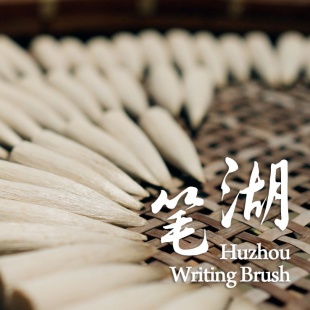
A traditional Huzhou writing brush typically comprises a brush made of goat wool and a handle made of bamboo.
"If you put a strand of goat wool under a microscope, you will see the tiny pores on it. That's why goat wool brushes can absorb the most ink compared with brushes made of hare fur or yellow weasel fur," Qiu says. "So it is better to write big characters on wide paper, a fashion popular among calligraphers in later times, especially during the Qing Dynasty."
What is most special about the Huzhou brush lies in its tip. The longer and the more transparent the tip is, the better the brush, Qiu says.
A brush with a fine tip, when pressed, sees its strands spread out fully and neatly. During writing, the ink flows evenly and smoothly. After lifting the brush, the tip returns to its original conical shape without splitting. A fine-tip brush is also durable and long-lasting.
In ancient times, goats raised in Huzhou ate not only grass but also mulberry leaves in winter, so their wool contained more protein compared with goats in other places. But now people in Huzhou do not raise such goats, so the factory purchases goat wool from Nantong in Jiangsu province.
But each goat can only provide 150 grams of wool and only a third of it has a sharp tip. The selection of qualified strands relies on artisans' fine work in the water basin.