Rare dove trees flourish in Wawu
Conservation efforts protect unique species only found wild in China









Editor's Note: As protection of the planet's flora, fauna and resources becomes increasingly important, China Daily is publishing a series of stories to illustrate the country's commitment to safeguarding the natural world.
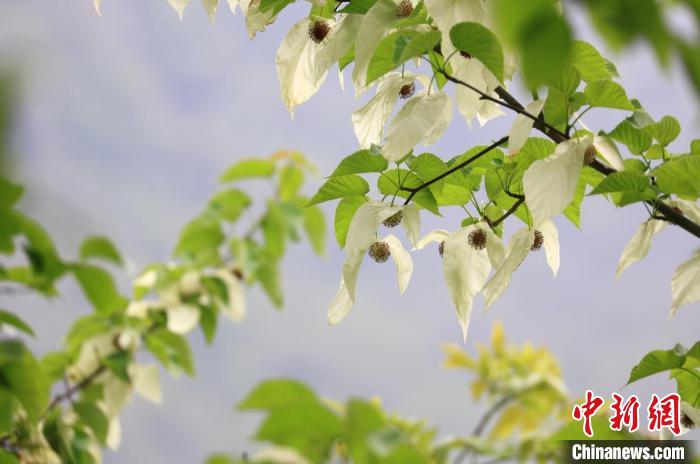
Scattered across the mountainside in rural Wawu Mountain, a few hours' drive from Chengdu in Sichuan province, a tree twists its way up 25 meters to the forest canopy. Its delicate snow-white bracts, resembling the wings of a dove, snap off in the light breeze and float softly to the ground.
The fragile nature of this act belies the robust reality of the history of this plant species — dove trees have existed on this planet for over 60 million years.
However, despite surviving throughout this time in Europe, North America and Asia, dove trees rarely thrive, and today can only be found in the wild in Sichuan, Guizhou, Hunan and Hubei provinces in China, mostly at altitudes between 1,500 to 2,000 meters.
"Wawu Mountain National Forest Park is one of the few places where dove trees are the most widely spread," said Ma Chaohong, who works at the Sichuan Provincial Forest and Grassland Administration in Sichuan, adding that there are 20,000 hectares of dove trees on Wawu Mountain.
Hongya County Tree Farm on the mountain used to be one of the main timber suppliers for the building of the nation in the early days after the establishment of the People's Republic of China in 1949.
Ma, as the head of the tree farm in Meishan city in Sichuan, decided in the 1990s to put an end to cutting down trees and instead focus on protecting the environment and developing a tourism industry.
"There are more than 3,000 different kinds of plants on this mountain, and more than 890 kinds of animals, including rare precious species such as dove trees, giant pandas and red pandas. The environment can actually provide the best wealth for the local people, so we should protect it in order to pass it down to following generations," he said.
Ma was behind Wawu Mountain's application to establish a national forest park in 1993. Before long, the first cable cars were built providing visitors with panoramic views of the mountain scenery and generating income for local people.
"Everyone in Hongya knows Ma's name. Even if young people might not recognize his face, we all know that his idea changed the city's fate and has given us the opportunity to run hotels and restaurants and work as guides among, other things," Qi Mingxia, a park guide said.
Qi's knowledge of the local area is encyclopedic. She said that, generally, by the beginning of April, the dove trees at the lower altitudes begin to bloom, with the flowering process slowly spreading to higher altitudes. It only takes 10 days for a dove tree to bloom and wither, with the total flowering period for all dove trees on the mountain being about a month.
"Despite the dense mist and fog and intermittent rain, those that venture onto Wawu Mountain and witness a dove tree in bloom can be considered very lucky, indeed," she said.
Tens of thousands of dove trees, or Davidia involucrata, can be found in the wild in China today, while countless others have been transplanted from the Middle Kingdom to adorn botanical gardens and parks across the world.
One of the earliest examples of this practice dates back over a century to 1900, when British botanist Ernest Henry Wilson came to China with the mission of bringing dove tree seeds back to the West.
Wilson was taken aback by the beauty of the dove trees he observed in China, noting later, "To my mind, Davidia involucrata is at once the most interesting and beautiful of all trees of the north-temperate flora."
A dove tree specimen brought back by Wilson still grows today in the grounds of Arnold Arboretum at Harvard University in the United States. At over 100 years old, it is one of the earliest dove tree specimens to be planted in a Western garden.
Contact the writers at yandongjie@chinadaily.com.cn




- Dazzling Guangzhou lantern display begins countdown to Spring Festival
- Huizhou takes major step forward as petrochemical hotspot
- Beijing's Shunyi district cracks down on crimes related to public welfare
- Hunan's smoked fish and meat arrive in time for Spring Festival
- International arrivals to Guizhou skyrocket after visa-free policies
- Hubei deputy proposes museum of ancient Chinese law at Qin bamboo slip site