


Solar power project soaks up sunrays in Inner Mongolia
Undertaking producing array of benefits from holding back desert to generating agricultural income










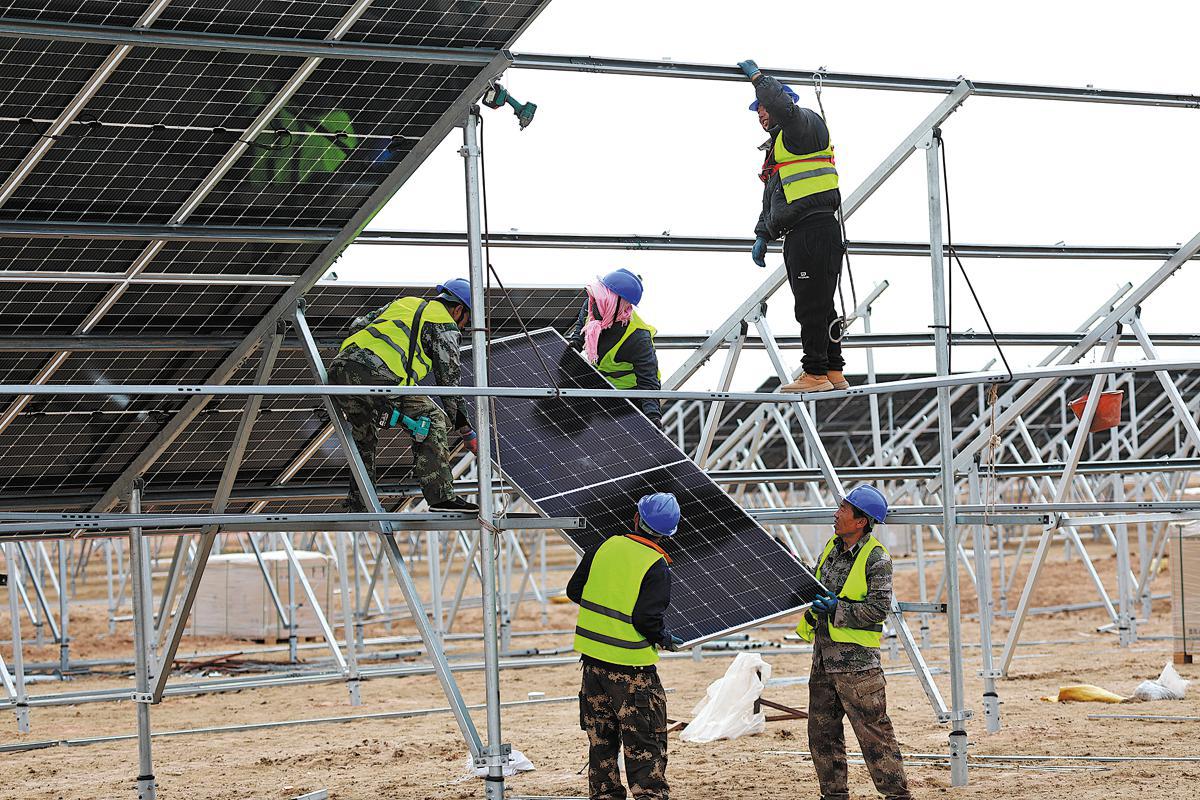
Huang Weiheng, an executive on the project, said while solar panels can provide shade on desertified land and thus reduce evaporation, and robots will be used to regularly clean the panels with water, which will moisten the parched land to some extent and help limit the spread of desertification.
While it's yet to be known if the project will successfully remediate the desertified land, some positive changes have already come about.
In areas that are already covered by solar panels, "I have noticed obvious increases in vegetation coverage", Huang said.
Gongor, a 45-year-old herdsman who lives near the solar energy project, said he's found that the grass has become more lush and has grown more vigorously after the launch of the project.
"I believe I can make more money from my 6,000-odd sheep because of these changes," the man of the Mongolian ethnic group said.
The project is just a small part of the ambitious plan of the Inner Mongolia government to integrate sand control with renewable energy to tame the ever-expanding desertified area, said Sun Shaocheng, the region's Party secretary.
Along with other initiatives, the project helps push forward the Three-North Shelterbelt Forest Program in the region, Sun said in an interview with China Daily.
Launched in 1978, the Three-North program spans 13 provincial regions, with Inner Mongolia a major battleground. It aims to improve the environmental conditions in northern China and prevent the expansion of deserts.
Sun said the region plans to achieve an installed capacity of 119 million kW of renewable energy by the end of this decade, and that it would help treat around 767,300 hectares of desertified land.
The official vowed to better coordinate new energy development and sand control by accelerating the construction of centralized solar power plants and grid facilities in deserts and wastelands, and also by promoting the development of distributed solar and wind energy in other desertified areas based on local conditions.
He said the region will strive to tap the potential of the land underneath solar panels for planting, and the spaces between the panels for animal husbandry, so as to create a "win-win" situation of increasing greenery, energy output and local incomes.
Zhang Jingbo, deputy director of the Experimental Center of Desert Forestry at the Chinese Academy of Forestry, said integrating sand control and solar energy development can help address the contradictions between development and ecological conservation.
The approach not only involves industrial development but also the remediation of desertified land and the industrialization of ecological conservation, he said. Aside from enhancing sand control and vegetation restoration, it can help bring enterprises profitability, increase farmers' and herders' incomes and realize harmony between conserving nature and socioeconomic development.
In the long run, however, such endeavors still need more scientific support and innovation to further improve the approach, he added.
Zhang underscored the importance of developing tailored models based on local conditions, taking into account the climate, soil, water availability and vegetation coverage.
In accordance with these conditions, project developers should optimize the design of photovoltaic components and their layouts to enhance their capabilities in resisting wind and fixing sand, he noted.
To reduce costs and ensure the best treatment results, they should also lay sand barriers, plant vegetation and take measures to improve the soil, Zhang added.
Not far from the Otog project, the high-rise chimneys of a 4-million-kilowatt coal-fired power plant can be seen.
While it won't be easy for Otog, where over 21 million tons of coal is produced annually, to be free of coal-fired power soon, the green energy project will help significantly increase the proportion of renewables in the electricity mix it outputs to other regions via the State grid.
The coal-fired facility will help address the intermittence of solar energy production and thus ensure stable electricity output from the area. "When there is strong sunshine during the day time, that coal-fired plant will greatly reduce the electricity it produces," Zhang said.
Cui Jia contributed to this story.
Contact the writers at houliqiang@chinadaily.com.cn





