


Scientists brainstorm heritage biothreats










He also expresses concern that researchers should not focus simply on the microbial communities colonized on the relics, but also pay more attention to their interactions with the surrounding environment and the materials of their making — more specifically, their reactions to changes in sunshine, water and salts — in order to form more comprehensive conservation plans based on scientific results.
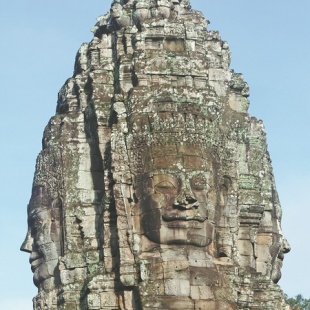
For the past two decades, Gu has been continuously joining conservation projects for the Angkor Archaeological Park in Cambodia, also a UNESCO World Heritage Site, in collaboration with his Japanese counterparts to study and protect the Bayon Temple.
Gu's report during the symposium on June 21, working with Yoko Katayama, researcher at the Tokyo National Research Institute for Cultural Properties, suggests that under the tropical climate, colonization of plants and microbes on stone allows more fluctuation in thermal and water regimes, resulting in dissolution of selective minerals in sandstone, which enlarges its pores and porosity.
The soluble salts, when concentrated in the drying process, can be transported back into sandstone by capillary action, triggering salting-out effect. The outer surface of the sandstone structures can peel off by the internal pressure generated by the crystallization of salts.
Their research expounds on how microbes can contribute in a number of ways to affect the physical and chemical processes involved in sandstone deterioration and has demonstrated how biochemical reactions driven by microbes facilitate the accumulation of highly concentrated nitrate on the sandstone of Bayon Temple, while dissolution of calcite in sandstone further increases water retention and therefore improves microbial colonization and activities.
All these findings indicate the urgency to formulate a holistic approach to investigate the biodeterioration mechanisms of Angkor's sandstone temples and monuments, centered particularly on the materials-water-microbiome continuum, according to Gu.
As cycles of sulfur, nitrogen and carbon catalyzed by microbes can accelerate the corrosion of sandstone, intervention measures against microorganisms to inhibit their proliferation by controlling available water nutrients are fundamental. And in some parts of the Bayon Temple, they endeavor to improve drainage to keep the sandstone surface dry, Gu adds.