


Scientists brainstorm heritage biothreats










To be more specific, the Actinobacteria attract springtails by releasing a pheromone called geosmin and, with the help of the insects, migrate into the tombs. The Actinobacteria can inhibit other microbial species but proliferate to become the predominant species on the tomb walls and murals.
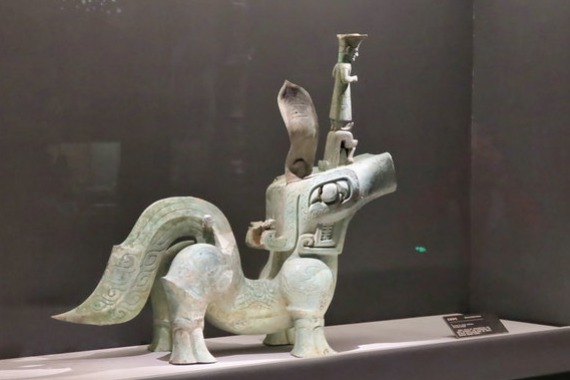
Another study conducted by Sichuan University and Sichuan Provincial Cultural Relics and Archaeology Research Institute aims to inhibit microbial growth on ancient ivory excavated from the sacrificial pits of the Sanxingdui Ruins in Guanghan, Sichuan province.
According to Sun Qun, professor at Sichuan University, most fungi and bacteria on the ivories derived from the in-situ soil in the pits. During excavation, cleansing and storage, human activities contributed to the change of microbiota on the ivories.
The researchers identified the key corrosion microorganisms and therefore developed an antibacterial agent from their patented bacillus, and this has been proved effective in controlling microbial biodeterioration on the ivories with sufficient safety.
However, nature has passed its blessing on these epitomes of human wisdom, exemplified in the Great Wall, located mostly in arid and semiarid regions of northern China, suffering from harsh climates, rain and wind erosion. Some parts of the Great Wall date back more than 2,000 years.
A research team from China Agricultural University and the Institute of Soil and Water Conservation under the Chinese Academy of Sciences and the Ministry of Water Resources carried out an investigation into some 600 kilometers of rammed earth Great Wall built during the Ming Dynasty (1368-1644) in the Ningxia Hui autonomous region, Shaanxi and Shanxi provinces, apart from the Inner Mongolia autonomous region.
They found that biocrusts, biological soil crusts that consist of mosses, lichens and photosynthetic bacteria such as cyanobacteria, cover 67 percent of these sections and serve as stabilizers, sacrificial layers and drainage roofs.
These biocrusts enhance the Great Wall's strength by reducing the effects of wind speed, raindrop kinetic energy and runoff scouring force, buffering temperature fluctuations, preventing infiltration, promoting soil mechanical stability and reducing erodibility and salinity, according to Xiao Bo, professor at China Agricultural University.