More members, more challenges










As BRICS expands, the bloc should remember that it was founded to strengthen cooperation, promote common development, fairness and a just world
From Oct 22 to 24, BRICS will hold the first-ever summit since its expansion with the inclusion of Egypt, Iran, the United Arab Emirates, Ethiopia and Saudi Arabia.
The leaders will jointly talk about the extraordinary times and circumstances, which is critical to the future of the group. With the addition of new members, BRICS faces new challenges from both the current international order and the expanding club itself. Ultimately, the trajectory of BRICS and its global dynamics of leading cooperation in the Global South will depend on how effectively the member states navigate these external pressures and internal differences.
The world has witnessed a historic transition of "rising South, declining North". At the start of the 21st century, the top 10 developed countries in the West accounted for about 64 percent of world GDP; by contrast, the share of the top 10 developing countries was only 12 percent. However, by 2022, the former decreased to 46.5 percent, and the latter grew to 31.3 percent. The developing economies' continued catch-up not only reflects a historic change in the world's landscape, but also provides an unprecedented opportunity for developing countries as a whole. As the leading force of South-South cooperation, BRICS should seize the momentum and advance a unified stand of emerging and developing countries to build a fairer and more reasonable world order. That is a common priority of the developing bloc.
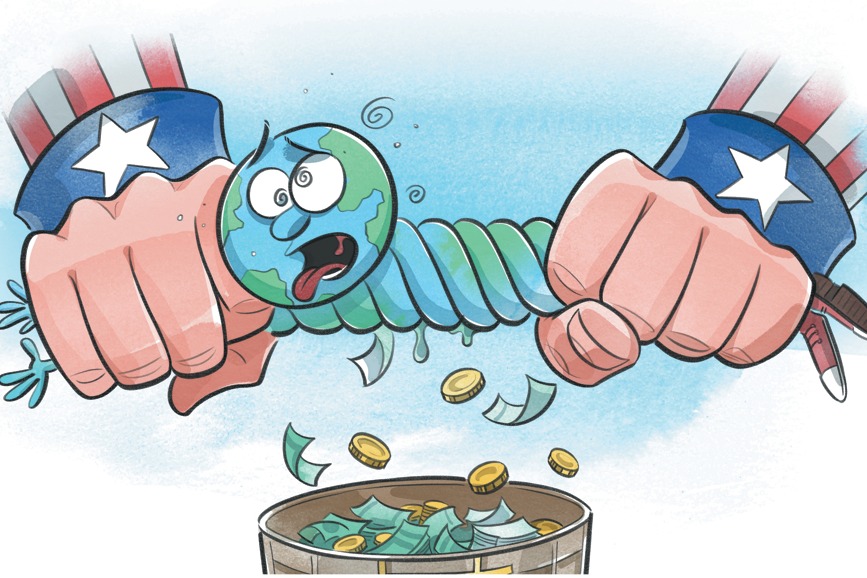
The unveiling great power strategic rivalry and geopolitical competition in "world major changes" has impacted BRICS' mechanism and roles. The United States is taking advantage of rising geopolitical tension to contain China and weaken Russia, increasingly complicating concerted BRICS actions. At the same time, several member states with miscellaneous objectives are also seeking to reap profits from the power politics. On the one hand, they try to use inducements offered by the US, while on the other hand, they also want to benefit from BRICS. The conflicting interests will undermine BRICS' ties and cooperation.
BRICS is a community of shared interests and destiny. Only the success of BRICS as a solid, unified, leading cooperative platform for the Global South and as the promoter of a fair and reasonable international order can safeguard the collective rights and interests of member states, as well as the developing countries as a whole.
All the members, including the five new ones, have to show strategic vision and unity, and demonstrate the determination to jointly safeguard BRICS development and position. They also have the responsibility to avoid activities that undermine the institutional mechanism and priorities. They should keep in mind that BRICS was formed to strengthen cooperation, promote common development, fairness and a just world, and build a fair and reasonable international order.
The rise in number of BRICS members from five to 10 also indicates an expansion in the size of its population, area and economic outputs, thus increasing the influence it wields. For example, according to International Monetary Fund data, BRICS now accounts for nearly 36 percent of global GDP, larger than that of the G7 (29.9 percent) when adjusting for purchasing power parity. The expansion also significantly transforms the world's energy landscape. The overall strength of the bloc places it at a strong position in global governance. BRICS has a very bright future and potential to influence and change the world historically.
However, the expansion has also brought with it new challenges. First, diversity. Given the increased difference of regions, cultures and development paths, BRICS countries also differ in their strategic orientations and priorities, which might undermine the integration within the group. For example, some member states seek to advocate their individual position on the United Nations Security Council reform on this platform, while new members require more support from the mechanism, which might fragment and dilute the loans from the New Development Bank. In terms of policymaking mechanism, China's "seeking common ground while reserving difference "approach provides a spirit of compromise to address the problems. Take the UN Security Council reform as an example. The advocating states might achieve the goals through unified stands in full consultation and consensus, or by "shelving differences", rather than imposing its own vision on the group. In terms of new economic demands, BRICS has a responsibility to negotiate resources distribution and priorities of NDB loans to seek a meaningful solution.
Second, complexity. New members bring additional resources and opportunities, but some conflicts and disputes over territory and resources are also put on the table, which will inevitably have an impact on the decision-making mechanism. However, the practical differences do not necessarily deviate the group from its original intention to be a multilateral platform for emerging economies. Conflicts and disputes should not block the way of cooperation. It is necessary to keep in mind that the goal behind BRICS' expansion is to strengthen rather than weaken the development and cooperation of common interests and goals.
Third, efficiency. BRICS cannot be reduced to becoming a talk shop when introducing new members with more topics and agendas. BRICS members are required to focus on pragmatic and effective cooperation. One is to prioritize issues on development for developing countries, such as NDB mechanism construction, especially the investment on green development and digital transformation for developing countries. The other is to maintain flexible and effective decision-making mechanisms. For instance, in addition to strengthening cooperation within BRICS, the "BRICS+" model could also provide a way to promote diversified and pragmatic dialogues with non-BRICS states.
Xu Yanzhuo is a research fellow of Foreign Policy Division at the Institute of World Economics and Politics at the Chinese Academy of Social Sciences. Zou Zhibo is deputy director of the Institute of World Economics and Politics at the Chinese Academy of Social Sciences and a committee member of the National Institute for Global Strategy at the CASS. The authors contributed this article to China Watch, a think tank powered by China Daily.
The views do not necessarily reflect those of China Daily.
Contact the editor at editor@chinawatch.cn.