



Preserving a vital Earth









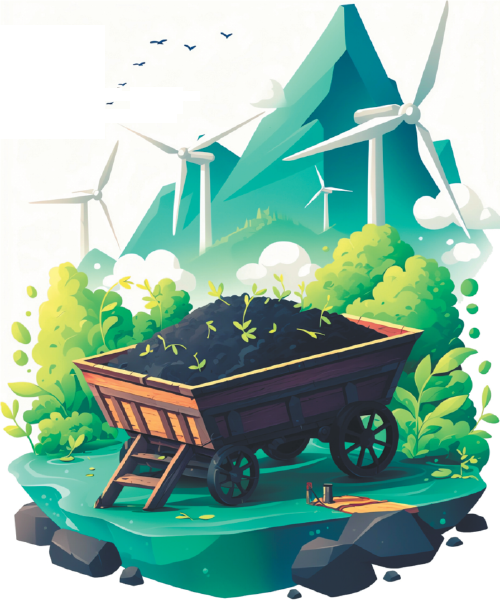
Successfully making a green transition in its coal triangle will not only help China to achieve its dual carbon goals, but also serve as a model for other regions to emulate
At the end of COP28 last year, world leaders agreed to take urgent actions to transition away from fossil fuels and triple renewable energy capacity by 2030. China is one of the largest coal producers and consumers in the world, but it also aims to peak carbon dioxide emissions before 2030 and achieve carbon neutrality before 2060. The country has set ambitious targets to reduce coal consumption and increase the share of renewable energy sources in its energy mix. This is not an easy task.
During China's energy transformation, the transition of the "coal triangle area", comprising Inner Mongolia autonomous region, Ningxia Hui autonomous region, Shaanxi and Shanxi provinces, is among the most important elements for both China and the world to achieve carbon neutrality. This region is not only China's largest coal energy generation area, but also the largest in the world. In 2023, coal production in this region reached 3.45 billion metric tons, accounting for 74 percent of the national coal production, and 40 percent of the global total, making it a key area in the green and low-carbon energy transformation. Meanwhile the area is rich in renewable energy, accounting for around 30 percent of the wind resources of the whole country.
Due to its historical reliance on coal-related industries, the coal triangle area suffers from a significant "carbon lock-in effect" and path dependence. The development of the regional economy is heavily dependent on coal, potentially hindering the innovation of low-carbon and renewable energy technologies. Breaking this dependence is difficult in the short term, and a rapid transition could lead to structural unemployment and economic and social vulnerabilities.
Furthermore, as a key base for energy production and export, the region also carries a substantial responsibility for ensuring energy supply security. Faced with the dual pressures of cutting emissions and securing supplies, it is imperative for the region to advance the optimization of energy structure and the low-carbon transformation of industries, all while maintaining the safety of energy supply. In this process, there should be a focus on local people's livelihoods and we must consider the issue of equity. Achieving a fair distribution of resources has become one of the major issues facing the low-carbon transition in the area. The transition also has profound impacts on the employment market, resulting in job losses in coal-related industries, especially affecting workers with limited skills who find it hard to adapt to the requirements of new industries. Therefore, ensuring a just transition needs to be considered through policy design.
To identify integrated solutions for the green and low-carbon transition in traditional energy regions such as the coal triangle area, the China Council for International Cooperation on Environment and Development launched a scoping study, which I co-chaired, last year to provide a systematic outlook of the future energy development path of the area. The study has been completed this September and here are three key takeaways from the study.
First, China could establish a national-level coordination mechanism for the low-carbon transition of the coal triangle area. Energy transition involves not only the substitution and updating of energy sources but also a complex socioeconomic process, which needs a more systematic, holistic and synergistic governance approach.
Compared to other regions, the coal triangle area is largely economically underdeveloped. So it is crucial for the nation to accurately and reasonably define the regions' roles in the nation's energy transition process, set science-based renewable energy consumption and integration targets and encourage the establishment of communications channels with coal regions in other countries, which all need coordination at the national level.
Second, China could establish Zero-Carbon Power Special Zone for Industry and Trade. With its advantage in renewable power, the region should be able to transition its existing coal-centered industrial chain to a zero carbon industry. Zero-Carbon Power Special Zones for Industry and Trade could help develop a new type of business model for the area. It could establish a zero-carbon digital certification system, providing full life cycle carbon footprint certification for products to cope with any future carbon restrictions of international trade.
Third, China could establish a low-carbon transition fund for the coal triangle area. Resource reallocation and industrial restructuring both require substantial financial support. Implementing new energy projects, conducting technological research, and constructing infrastructure also need significant investments. Therefore, China could establish a low-carbon transition fund as a driver to attract investments from the private sector. This fund could also support technological breakthroughs in the transition process, such as green hydrogen and energy storage, and carbon capture, utilization, and storage technologies. At the same time, the fund can support ecological restoration and various compensation mechanisms to establish a fair and equitable compensation system for impacted local communities.
The green transformation of China's traditional energy regions holds immense significance. It promises environmental preservation, economic revitalization, and social progress. Achieving a successful green transition in this region could not only help China to achieve its dual carbon goals, but also serve as a model for other regions in China and the world. As China continues on this transition journey, it will contribute to a collective effort to combat climate change, to build a sustainable future, and to preserve a vital Earth for everyone.
The author is executive vice-president of Regions at the Environmental Defense Fund. The author contributed this article to China Watch, a think tank powered by China Daily. The views do not necessarily reflect those of China Daily.
Contact the editor at editor@chinawatch.cn.





