



Zhengzhou limits students' phone use
City legislators bar smart terminals in classrooms unless essential for study









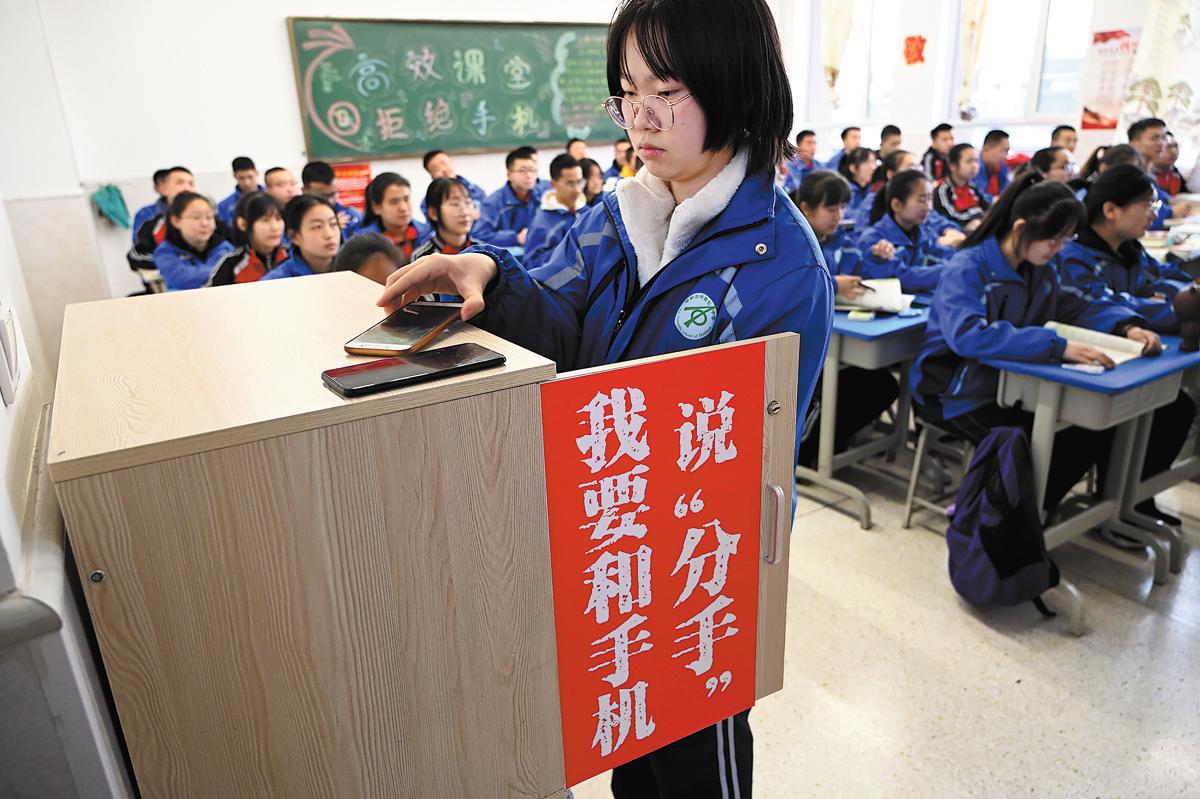
Legislators in Zhengzhou, Henan province, recently released a decision to strictly limit the use of smartphones by students in primary and secondary schools, making the city China's first to use dedicated legislation to regulate the use of such devices.
The standing committee of the Zhengzhou people's congress passed the decision on Dec 27. Effective immediately, the city's primary and middle schools will bar students from taking smart terminals — such as phones and tablets — into campuses unless their parents apply for them to have special permission to do so.
Even with parental applications to bring them in, students will still need to hand over the devices to the school. Meanwhile, unless specifically needed for teaching, such devices are banned in classrooms, the decision said.
Students' use of smartphones has been a topic of debate with the growth of various sorts of mobile applications. While some teachers have adopted the technology into their teaching, some worry that the early and overuse of smart terminals may hinder students' ability to concentrate in class and worsen their eyesight, let alone develop related issues such as addiction and poorer academic performances.
Many locations in China have set up rules to limit students' smartphone use on campus.
Legislators in Guangzhou, Guangdong province, included similar articles in a regulation on promoting students' mental health in November. Zhengzhou's legislators, however, believe that they are the first legislators nationwide to introduce a dedicated decision on smartphone use on campus.
The city's legislators said that despite articles regulating the use of smart devices by students existing in laws such as the Law on the Protection of Minors, they are generally not detailed enough in practice. Zhengzhou's legislation aims to address the problem by clarifying responsibilities among education authorities, schools and parents, so as to keep teaching order at school and enhance students' abilities of self-protection and self-management, the committee explained in a statement.
In forming the decision, congress deputies consulted with students, sending out 782 surveys, the statement said, adding they also talked with principals, parents and lawyers and considered their suggestions.
"Some students do need to use smartphones to keep in contact with family, take public transport or for help with their study; some schools also have 'smart classes' and courses in information technologies that need to use smart devices," the statement said, leading to the decision of restricting instead of completely banning smartphones.
Legislators said schools should make up their rules for managing smart devices based on their own conditions, while setting up public phones to guarantee emergency calls.
Shi Yuxia, a deputy to the Zhengzhou congress and an elementary school principal, said the decision was much needed.
"As students are in a key stage of their growth when their values take shape, it's essential to regulate their use of smart terminals from the congress' standpoint," she said.
"My school has adopted the measure for some time now, and there have been just a handful of applications from parents, even for simpler devices like smartwatches. This shows parents support the policy."
The decision also requires parents to limit children's smartphone use, including the time, content and access, to prevent addiction.
Li Dannong, mother of a 10-year-old girl in the city, said the decision will help children form good eye care habits.
"Children live in a world filled with various electronic devices, and it's impossible to cut them away from those," she said. "Schools and parents need to work together to guide children to use the devices more healthily."
According to the most recent report on minors' use of the internet, released in November by the Communist Youth League of China, the percentage of internet users under the age of 18 in China reached 97.3 as of the end of 2023, with 196 million users. Among them, some 92 percent said they use the internet for study.
Contact the writers at liangshuang@chinadaily.com.cn







