



Land-subsidence areas can be turned into farmlands









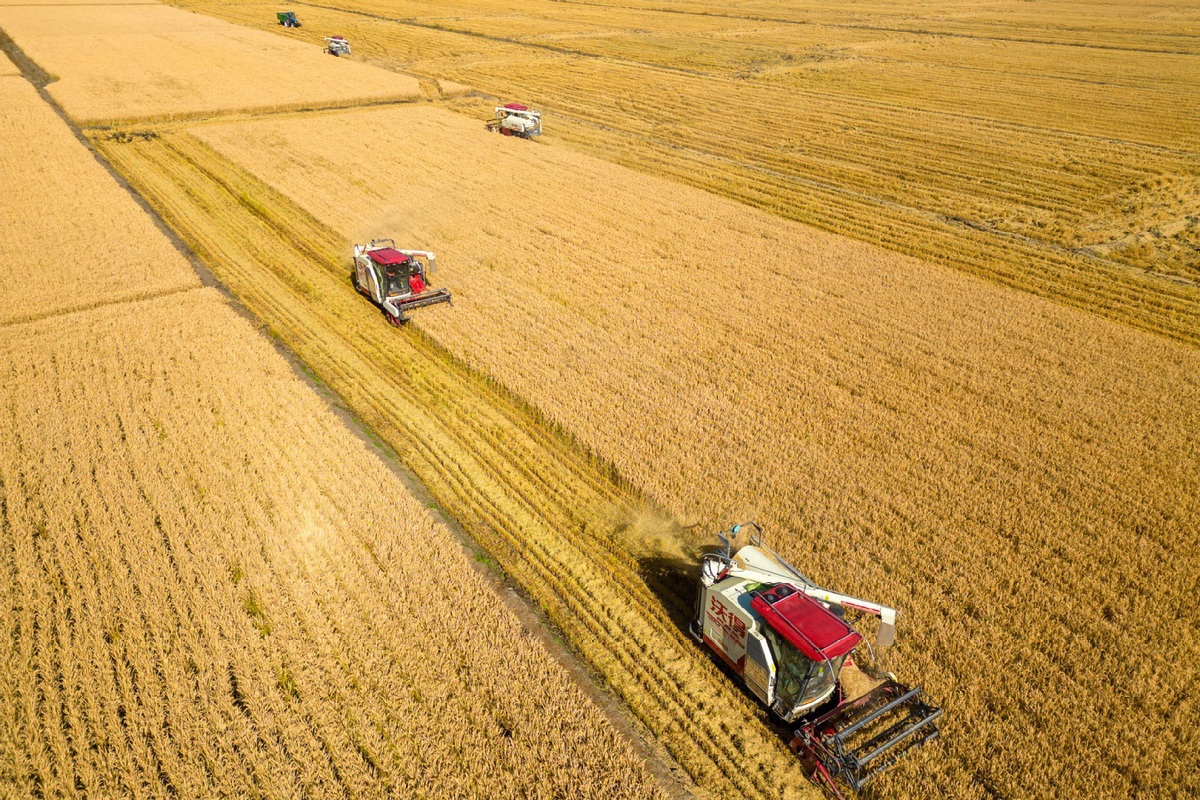
Since food security plays an important role in China’s social stability and development, the government has implemented a strict arable land protection policy, which includes improving land quality, balancing the use and replenishment of arable land, securing grain production, and enforcing accountability for arable land protection.
Transforming land that has subsided due to mining into water-surface farmland will contribute to not only food production but also environmental protection. Mining produces minerals and creates employment and wealth, but it also generates pollution and causes land subsidence.
In China, coal reserves and arable land largely overlap. Land subsidence in coal mining areas is usually deep and wide, have shallow groundwater levels and a high proportion of water accumulation; it usually takes a long time for such land to stop sinking and become stable.
By the end of 2024, coal mining-affected subsidence areas in China covered about 2 million hectares primarily in Anhui, Henan, Shandong, Hebei and Jiangsu provinces, with one-third of such areas perennially or seasonally waterlogged. In Huainan, Anhui province, for example, about 455,800 mu (30,387 hectares) suffer from land subsidence, with water accumulation affecting about 200,000 mu. It is estimated that subsidence area in Huainan will increase by about 10,000 mu a year, with an additional 4,000 mu of water accumulation each year.
Since it is very difficult to reclaim subsided farmlands and the management of coal mining-induced land subsidence is not effective, subsided areas face serious ecological and social problems that hinder local development, especially in mining areas where the underground water table is high.
So, apart from reclamation of arable land, local authorities should also consider balancing coal mining and arable land protection by managing the subsidence areas based on local conditions and using innovative methods. For instance, people in such areas could be encouraged to develop more “floating farms”, plant crops such as rice in different patterns on land where the water surface is between 1.5 meters to 3 meters deep.
According to the third national land resource survey in 2021, the category of land is decided by the use of land based on its surface. The cultivation of rice on subsidence land can be considered as restoring agricultural attributes and production functions. Such “l(fā)and reclamations” can be introduced as a part of assessing local government’s achievements in arable land protection and food security.
In subsided areas with water less than 1.5-m deep, people can cultivate aquatic cash crops, such as lotus roots and seeds, water caltrop, cane shoots and gorgon fruits, with the help of modern technology.
Besides, based on production capacity and national land use planning, the government could adopt dynamic standards to designate such areas as paddy fields. Although aquatic cash crops are already being grown on cultivable land by flooding them, such farmlands should continue to be classified as arable land in this year’s land use survey.
Also, local governments can promote the comprehensive recyclable utilization of subsidence areas, develop fishery and set up solar photovoltaic panels on them, as well as integrate rice cultivation and fishery in shallow-water areas and explore ways to restore non-waterlogged areas. And solid waste produced by the coal mining industry can be deep-processed and made into floating boards for rice planting in waterlogged areas, while setting up solar power generation facilities on water surfaces can power agricultural machinery.
The comprehensive utilization of subsided areas will foster the coordinated development of zero-carbon primary and secondary industries, allowing local governments to establish incentive mechanisms for the comprehensive development of such areas. The comprehensive utilization model, however, needs collaborative innovation and industrial cooperation, which in turn requires multi-departmental coordination, and collaboration between industry, academia and research institutions.
The author is principal of Anhui University of Science and Technology in Anhui province, an academician at the Chinese Academy of Engineering, and a deputy to the 14th National People’s Congress.
The views don’t necessarily represent those of China Daily.
If you have a specific expertise, or would like to share your thought about our stories, then send us your writings at opinion@chinadaily.com.cn, and comment@chinadaily.com.cn.





