Will 'crisis' of humanities obscure future of liberal arts?









The satirical essay, The Battle of the Books, by Jonathan Swift, the author of Gulliver's Travels, has once again become a buzzword, just as it has periodically over the past 300 years, serving as shorthand for debates on the value of classical or humanities education.
This time, the backdrop is a near-global retreat of the humanities. Harvard College reportedly canceled 30 courses, many of them in the liberal arts, in 2024. The University of Kent in the United Kingdom, announced the phasing out of six disciplines, including art history, anthropology and philosophy. In China, a top-tier university reduced its traditional liberal arts enrollment from 30 percent to 20 percent.
As the rhetoric of "the uselessness of liberal arts" resurfaces, another leading Chinese university made the Harvard event part of a graduate school entrance exam, requiring candidates to write about the concerns over the decline of the humanities. This gave liberal arts an opportunity to defend or counterattack, while also, in a strikingly memorable way, highlighting the awkward predicament facing the humanities.
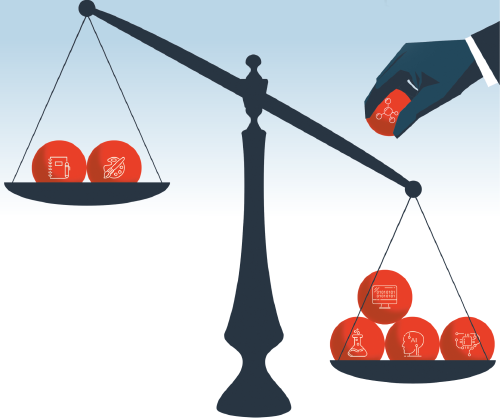
The immediate cause of downsizing in liberal arts is dwindling enrollment. GenZ appears inclined to seek stable career returns, and at present, the humanities are struggling to provide such professional assurances. Global data show that liberal arts graduates have lower employment rates and starting salaries compared with their STEM counterparts. In the United States, the three majors with the highest unemployment rates are reportedly art history, liberal arts and fine arts, while underemployment rates for history, English, mass media and sociology hover around 50 percent.
As for why such a situation has arisen, one could blame a dual impact. On the one hand, there's the blow of a poor economy. Historically, the humanities have cyclically faced crises in both Europe and the US. When a recession hits, humanities courses, since they have less tangible economic returns, are the first to be cut. On the other hand, information and telecommunications technology, which has structurally transformed industries and education, has had a more direct impact on the humanities. Jobs in advertising, publishing and other fields closely tied to traditional liberal arts are shrinking. And declining birth rates are directly affecting education-related disciplines.
If employability challenges are an indisputable fact, the notion that "liberal arts are useless" is fundamentally unacceptable. In reality, the fields of STEM also face displacement pressure from new technologies, yet they rarely need to justify their existence. When certain STEM disciplines lose relevance, their obsolescence is swift and uncontested.
The potential usefulness or intrinsic worth of the humanities is often framed as a question of justice. As Paul Reitter and Chad Wellmon argue in Permanent Crisis: The Humanities in a Disenchanted Age, the humanities have been in crisis throughout modern history because they position their value in opposition to the material metrics of industrial society.
Taoist philosopher Zhuangzi's concept of "the usefulness of the useless" is frequently cited in defense of the humanities: A lush tree, deemed unfit for lumber, escapes the axe and grows into a towering giant. Zhuangzi's parable in Free and Easy Wandering offers a dialectical perspective, while Jonathan Swift's The Battle of the Books presents a more binary opposition: The bee symbolizes classicists, drawing nourishment from flowers, while the spider represents the utilitarian mindset of moderns, confined to a narrow worldview.
Of course, such metaphors feel disconnected from contemporary reality, and the humanities cannot rely on narcissistic self-justification. The question is not whether the humanities have value, but how. Even those who trumpet "the uselessness of liberal arts" don't truly believe the humanities will vanish.
As a Chinese saying goes, "Had Heaven not sent forth Confucius, eternity would have been without a dawn." Globally, the Axial Age of rational reflection, marked by figures like Confucius and Aristotle, ushered in a new era of human civilization. The systematic knowledge humanity later developed in geometry, astronomy, politics and ethics can all be traced back to that axial origin.
The logic holds in today's more materialistic world. A survey of more than 300 companies found that 93 percent of employers consider critical thinking, communication, and problem-solving skills more important than a candidate's undergraduate major. As a renowned university president put it, "The knowledge we learn today will be obsolete in a decade. What matters most is learning how to learn." The world might not need more programmers, but jobs involving human interaction will grow.
Nevertheless, reform in the humanities is imperative. A consensus has been formed on adjusting curriculums, merging overly niched disciplines, and fostering interdisciplinary integration to create a broader, more socially relevant macro-liberal arts or new humanities. At the same time, excessive quantification and empiricism in research and teaching should be avoided to realign with the humanities' core mission.
The rise of STEM is not a bad thing, for it signals leaps in societal productivity. Similarly, the contraction of the humanities is not a death sentence but an opportunity for supply-side transformation. In China, the push to build an independent knowledge system has further energized the humanities. As the Chinese university reforming its humanities program said, "In a mature society, liberal arts matter more."
The author is chief researcher at the China Watch Institute, China Daily. The views don't necessarily reflect those of China Daily.
If you have a specific expertise, or would like to share your thought about our stories, then send us your writings at opinion@chinadaily.com.cn, and comment@chinadaily.com.cn.