Projects restore glory of 'green lung'
Rare species thrive in Qilihai Wetland as Zhu Baoxia and Yan Dongjie report from Tianjin









Editor's note: As protection of the planet's flora, fauna and resources becomes increasingly important, China Daily is publishing a series of stories to illustrate the country's commitment to safeguarding the natural world.
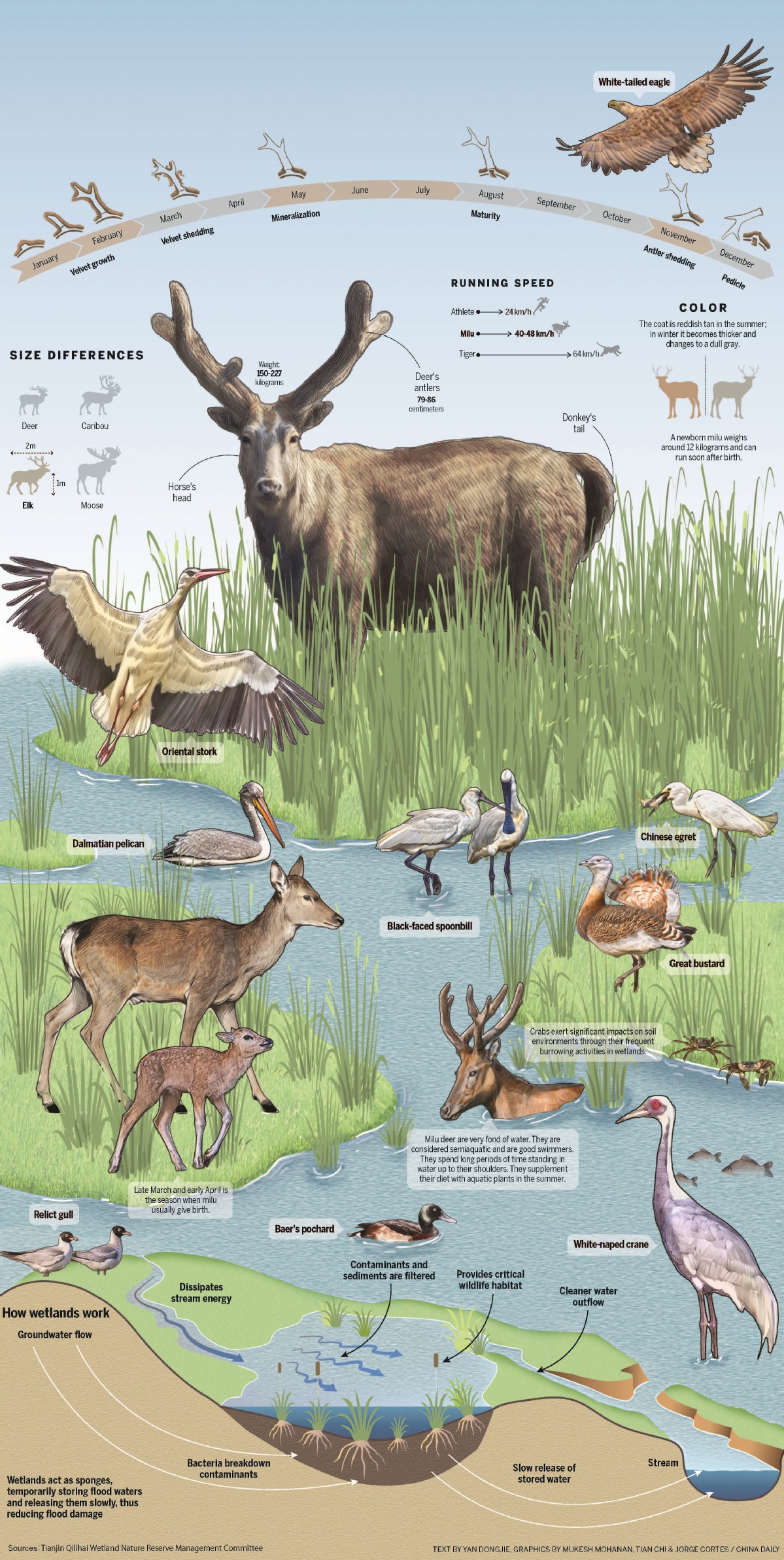
During summer, the Qilihai Wetland in Tianjin's Ninghe district is a sight to behold with sprawling reed beds swaying in the breeze and dozens of milu deer cooling off in the water. Oriental storks are often seen strolling in the shallows.
As the "green lung" of the Beijing-Tianjin-Hebei region and one of the world's three ancient coastal wetlands, this land, once scarred by industrial pollution, has undergone an eight-year ecological restoration and has transformed into a biodiversity-rich ecological highland.
"Before 2017, there were over 400 small factories and more than 2,300 fish ponds here, leaving the wetland fragmented and making bird sightings rare," recalled Bai Fengxiang, Party secretary of Ninghe district.
Faced with the crisis of ecological degradation, Ninghe initiated 10 major ecological restoration projects, investing nearly 20 billion yuan ($2.8 billion), and converting 1,500 hectares of land back to wetland.
According to data from the Tianjin municipal government, the air's negative oxygen ion concentration is 10 times that of the urban area in Qilihai, and the PM2.5 concentration has decreased by 40 percent compared to pre-restoration levels.
The number of bird species has increased from 182 to 258, with over 200 Oriental storks, making it one of the nine major bird migration sites in the world.
"The integrity, biodiversity and ecological safety of the wetland have significantly improved, and Tianjin was also selected as a UNESCO Biodiversity Charm City last year," Bai added.
As the only national-level conservation area in China that combines ancient coast and wetlands, Qilihai is becoming a habitat for rare species.
"According to fossil evidence, this could have been an ancient habitat for milu deer," said Yu Zenghui, a native and author of the book The Qilihai Chronicles, who is also a flora and fauna expert.
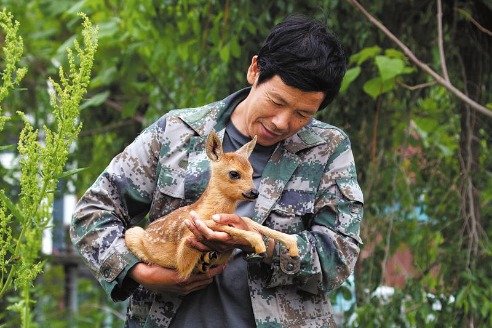
The milu deer, or Pere David's deer, a species native to China's floodplain areas, was classified as EW, or extinct in the wild, on the International Union for Conservation of Nature Red List. However, last year the population in Qilihai neared 100 after the introduction of 58 milu deer from Jiangsu province.
"They enjoy the same level of protection as giant pandas. Now they are freely residing in the wetland meadows, proving that the ecosystem here can support top-tier species," Yu said.
"Birds 'vote' with their feet, and their landing directly reflects the ecological improvements of the wetland," Yu said.
Tian Xiujing, director of the Tianjin Qilihai Wetland Nature Reserve Management Committee, said, "Through drone patrols and artificial intelligence recognition systems, we discovered a winter phenomenon in which the water surface doesn't freeze. Bird activity has helped keep the water surface unfrozen, a rare situation in northern wetlands.
"With improved ecology, sweet potatoes produced here have a 'negative oxygen ion flavor', and crabs have become 'tourism stars'," Bai said.
"Last year, the number of birds living in Ninghe reached 500,000, exceeding the population of the district, serving as both an ecological benchmark and a foundation for development," Bai said.
In the wetland's monitoring center, real-time dynamics of the 44.85-square-kilometer core zone are displayed on large screens. Drones complete full-area patrols in 20 minutes, the AI system automatically identifies illegal entry and fire hazards, and 147 infrared cameras record activities of flora and fauna.
"What used to take three days for manual patrols now takes 20 minutes with drones. The alert rate for illegal fishing and fire alarms has dropped by 70 percent since the early days of restoration," Tian said.
"This land, once tarnished by human activity, now thrives again due to ecological governance. It is not only a gift from nature but also a testament to the era of harmonious coexistence between humans and nature," Yu said.