Clean energy technology new driver of growth









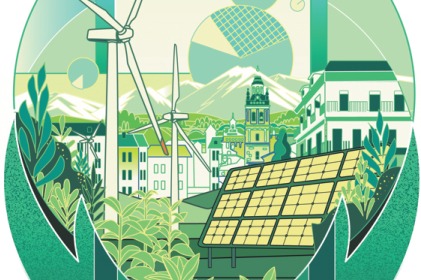
An International Renewable Energy Agency report says renewable energy capacity increased by 585 gigawatts, or a record 15.1 percent, worldwide last year, with China being central to this increase, contributing nearly 63.8 percent of the capacity growth.
In fact, 2024 was a historic year for the Chinese economy and its sustainable development, because green technologies contributed an impressive 10.3 percent to China's economic growth, with sales and investments in this sector reaching an impressive 13.6 trillion yuan ($1.89 trillion).
For the first time in China's history, clean energy technology contributed 26 percent to the country's GDP growth, exceeding the value of real estate sales, in 2024. China would not have met its 5 percent GDP growth target without developing its clean energy technology sector. Clean energy includes renewable energy, nuclear power, electricity grids, energy storage, electric vehicles (EVs), and railways. These technologies and infrastructure are necessary to reduce China's carbon footprint in energy production and use.
Clean energy technology is growing at a rapid pace in the "new three" industries: solar energy, EVs and batteries. China exports more than 80 percent of the world's solar photovoltaic panels, over 70 percent of battery packs and components, and about 40 percent of EVs.
When it comes to the development of green energy technology, different Chinese provinces concentrate on different aspects of the sector. For example, Anhui, Guangdong and Jiangsu lead in EV manufacturing, attracting huge investments from automakers and battery manufacturers.
On the other hand, Jiangsu leads in offshore wind development, with provinces like Guangdong, Fujian, and Hainan, too, making rapid progress in this field.
China's primary battery-producing provinces are Jiangsu, Guangdong and Zhejiang, with Jiangsu producing more battery cells than the rest of the world in some years. The Inner Mongolia and Xinjiang Uygur autonomous regions are also vital to China's green energy sector, with Inner Mongolia lately seeing a larger increase in installed renewable energy capacity.
Thanks to its outstanding wind and solar power resources, Inner Mongolia is one of China's top green energy regions, with an estimated wind power potential of 1.46 billion kilowatts, accounting for 57 percent of China's total, and a solar power potential of 9.4 billion kW, accounting for 21 percent of the country's total.
According to the region's energy authority, Inner Mongolia added more than 41 GW of new renewable energy capacity in 2024, breaking the annual record for new installations. The total installed capacity of Inner Mongolia's new power plants, including wind and solar power, exceeds 135 GW, or 2.7 times more than what it was during the start of China's 14th Five-Year Plan (2021-25) period. In fact, the region's clean energy capacity is now higher than its thermal power capacity.
As a matter of fact, Inner Mongolia led the nation in new renewable energy installations, green hydrogen production, new energy storage installations, and green electricity trading volume, becoming the leading supplier of green energy across the country and accounting for 10 percent of its green energy output.
There are clear indications that this growth will persist in 2025, propelled by the completion of significant projects before the end of this year. In the 15th Five-Year Plan (2026-30), China will likely set new and even more ambitious clean technology goals.
But can China's clean energy development reshape not only its economy but also global power dynamics? The exponential growth of China's "new three" industries is fueling the strategic reorientation of the country's economic engine, industrial capacity and international influence. And as Europe and the United States wrestle with regulatory uncertainty and high costs in their own energy transitions, China's vertically integrated, State-supported model is setting the pace.
What is unfolding in China is not just a national energy story, but a test to determine whether an emerging power can lead the global green transition at scale, in time and in alignment with both economic and climate goals. If successful, it could offer a model which developing countries can learn from to leapfrog fossil-fueled industrialization. But the stakes are high, and the world is watching — not just China's numbers, but also its narrative.
The author, former prime minister of the Kyrgyz Republic, is a professor at the Belt and Road School of Beijing Normal University. The views don't necessarily represent those of China Daily.
If you have a specific expertise, or would like to share your thought about our stories, then send us your writings at opinion@chinadaily.com.cn, and comment@chinadaily.com.cn.