



Xi Focus-Explainer: A historical legacy, a modern imperative: Why China walks on path of peaceful development?









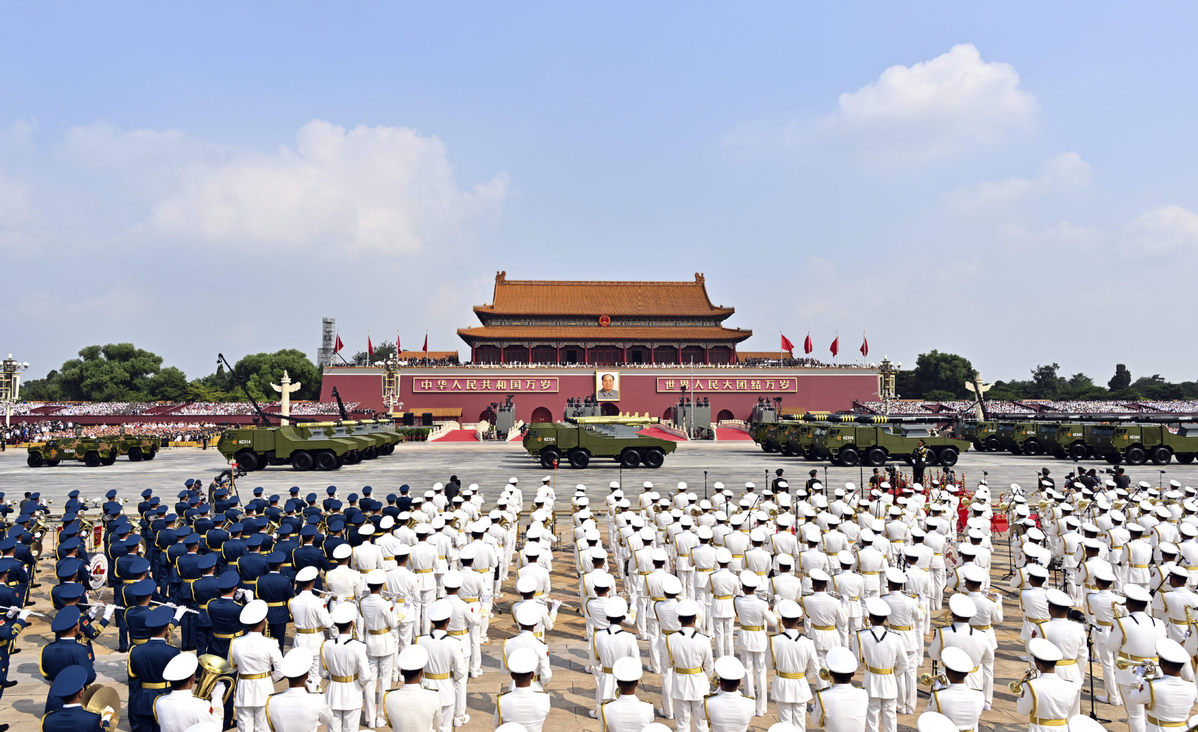
BEIJING -- "The noble cause of peace and development of humanity will prevail."
That was the message from Chinese President Xi Jinping on Sept 3, delivered from the Tian'anmen Rostrum as he oversaw a grand commemoration marking the 80th anniversary of the victory in the Chinese People's War of Resistance Against Japanese Aggression and the World Anti-Fascist War.
Addressing a massive crowd, Xi, also general secretary of the Communist Party of China Central Committee and chairman of the Central Military Commission, reaffirmed China's commitment to peaceful development.
"The Chinese people will stand firmly on the right side of history and on the side of human progress, adhere to the path of peaceful development, and join hands with the rest of the world to build a community with a shared future for humanity," he said.
The message carries weight beyond the commemoration itself. For China, the remembrance of war is inseparable from its vision of peace. The scars of foreign invasion and the heavy cost of resistance remain etched in the nation's collective memory, shaping a conviction that lasting peace is the only foundation on which development can thrive.
To understand China's commitment to peaceful development, one must consider not only its history, but also its grasp of the connection between peace and development and its vision for humanity's future.
VALUING PEACE AS TRADITION
Tian'anmen (Gate of Heavenly Peace) Square and Chang'an (Eternal Peace) Avenue — landmarks at the heart of Beijing where parade troops marched during the V-Day commemoration — reflect China's aspiration for peace and stability.
"What we Chinese people abhor is turbulence, what we want is stability, and what we hope to see is world peace," Xi said.
History offers sobering lessons. Scholars have noted that if the more than 5,000 years of recorded human history were compressed into a single day, 23 out of 24 hours would be consumed by war. In that fleeting hour of peace, humanity seized the precious time to create brilliant civilizations.
The pursuit of peace and development flows through the veins of Chinese civilization. Since ancient times, China has upheld the maxim: "Though a country may be strong, those who crave war will perish." Concepts such as "harmony in diversity" have been passed down through generations.
Since the founding of the People's Republic of China, the country has never initiated a war or conflict, nor occupied an inch of foreign land. China is also the only major country to enshrine peaceful development in both its Constitution and the Constitution of its governing party.
The Communist Party of China, Xi said, seeks not only peace for its own country, but peace for the world; not only temporary peace, but lasting peace.
PEACE FOR DEVELOPMENT
Xi has a profound understanding of the relationship between peace and development, and has frequently spoken about it. "The tree of peace does not grow on barren land, and the fruits of development are not harvested amidst the flames of war," he said.
Peace as the prerequisite for development is a lesson drawn from history.
"When peace is interrupted by conflict or war, economic growth, decent lives, social stability, and people-to-people exchanges will all be out of the question," Xi said at the opening ceremony of the Conference on Dialogue of Asian Civilizations in May 2019.
He called on all countries to "work together and jointly safeguard peace, something that is even more precious than gold."
Over the past 80 years, the absence of another world war has allowed the world to maintain overall peace, giving rise to unprecedented prosperity. China itself has undergone historic transformations, becoming an important driver of global development.
China has also shouldered its duties as a major country in safeguarding world peace: advocating a vision of common, comprehensive, cooperative, and sustainable security, promoting the implementation of the Global Security Initiative; dispatching more than 50,000 peacekeepers over the past 35 years, making it a key contributor to UN peacekeeping operations; and upholding objectivity and fairness while promoting political solutions to hotspot issues.
Peace as the prerequisite for development is the call of the era. The world needs peace more than ever to rally collective strength for development, as unilateralism and protectionism are resurging, geopolitical conflicts and regional flashpoints keep flaring up, and traditional and non-traditional security issues are increasingly intertwined.
"No global problem can be solved by any one country alone. There must be global action, global response, and global cooperation," Xi said.
SHARED DEVELOPMENT AS BEDROCK OF PEACE
Balanced and shared development is the bedrock of peace. The calamities of the 20th century were, in part, the product of lopsided growth and the rivalry of great powers.
Today, protectionism is on the rise, and the global economy is limping through a faltering recovery. Some developed countries have chosen to politicize, even weaponize, development itself — moves that pose grave threats to peace and stability.
Prosperity and stability cannot be possible in a world where the rich become richer while the poor are made poorer, according to Xi.
"Every nation aspires for a better life, and modernization is not a privilege reserved for any single country," he said. "We Chinese not only aspire for good living for ourselves, but also hope people in other parts of the world lead a decent life."
China has consistently contributed around 30 percent of global growth. At home, it has eradicated absolute poverty; abroad, the Belt and Road Initiative it proposed has helped lift tens of millions from poverty.
The victory achieved 80 years ago benefited from the solidarity of nations. Today, the law of the jungle — where the strong devour the weak — and a winner-takes-all mindset remain a dead end. Inclusive growth for all, by contrast, is the right path for humanity.
"Viewing others' development as a threat or taking economic interdependence as a risk will not make one's own life better or speed up one's development," said Xi.
China has become a major trading partner for over 150 countries and regions, having signed 23 free-trade agreements along the way. Through platforms such as the Forum on China-Africa Cooperation and the China-Community of Latin American and Caribbean States Forum, it has helped spread development opportunities far and wide.
Beijing has proven itself a major provider of global public goods. The China International Import Expo, the China-Europe freight train service, and the Hainan Free Trade Port stand out as examples of China's commitment to global cooperation.
Xi regards sustainable development as the "golden key" to solving global problems, especially at a time when climate change and food and energy crises pose threats to peace. To set an example, China has pledged ambitious targets of carbon peaking and carbon neutrality and is helping other developing countries master green, low-carbon technologies.
WORKING TOWARD COMMUNITY WITH A SHARED FUTURE
With its vast population and status as the world's largest developing country, China's choice of path for modernization has impacts far beyond its borders.
Xi has made it clear that the country will not follow the old script of colonial plunder or seek hegemony; instead, it is pursuing a model of peaceful development.
Building on his initiatives on development, security, and civilization, Xi unveiled a Global Governance Initiative earlier this month, calling for broader efforts to forge a more just and equitable system of global governance.
The initiative champions sovereign equality, the rule of law, multilateralism, a people-centered approach, and tangible action.
Launched on the 80th anniversaries of both the founding of the UN and the defeat of fascism, the initiative signals China's commitment to the principles of the UN Charter while addressing the burning question of where global governance is headed.
The ancient Silk Road earned its place in history thanks to camel caravans and goodwill, not warhorses and cannon. China believes in mutual support, common development, and win-win outcomes.
Xi's concept of a community with a shared future for humanity has been inscribed in key UN and multilateral documents, evolving from a Chinese proposal into an international consensus.
"Pass on the torch of peace from generation to generation, sustain development and make civilization flourish," Xi said. "This is what people of all countries long for; it is also the responsibility statesmen of our generation ought to shoulder."


- Senior enterprise official facing probe
- China's anti-graft authorities reveal extent of year's work
- Former Haikou Party chief gets death sentence with reprieve
- Purchase of US-made weapons to push Taiwan closer to the peril of war: spokesman
- WIC calls for submission of cultural heritage digitalization cases
- China calls for global opposition to Japanese neo-militarism










