



Scientists discover rare earth elements in ferns









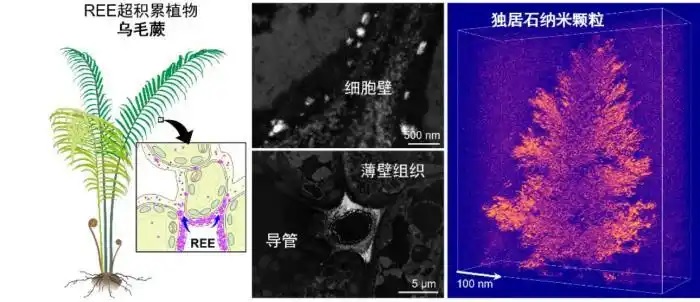
A team of Chinese scientists has discovered the phenomenon of rare-earth mineralization in ferns for the first time, a finding that could offer a cleaner and more sustainable way to obtain rare earth elements, or REEs, from plants.
"REEs, hailed as the 'vitamins of industry', are indispensable core strategic resources in high-tech fields such as artificial intelligence, new energy and national defense, and are also among the key raw materials facing relatively high risks in the global supply chain," said Zhu Jianxi, a researcher with the Guangzhou Institute of Geochemistry under the Chinese Academy of Sciences.
"In Blechnum orientale, a hyperaccumulator plant, we have not only discovered a large amount of enriched rare earth elements, but also observed for the first time that these REEs 'self-assemble' between the tissue cells of the plant, forming a mineral called Monazite-(La)," he said.
The findings, which marked the first time that biomineralization of REEs was discovered in plants, were published online on Wednesday in the international academic journal Environmental Science & Technology.
Usually, rare-earth minerals are formed through geological processes such as magmatic or hydrothermal activities, which require a relatively high-temperature environment, Zhu said.
The research not only reveals the "detoxification" and mineralization mechanisms of plants for rare earth elements but also provides a new path for the sustainable utilization of rare-earth resources in the future.
Traditional rare-earth mining is often accompanied by severe environmental and ecological damage, Zhu said.
"By cultivating hyperaccumulator plants, including Blechnum orientale, it is possible to recover high-value REEs from the plants while remediating contaminated soil and restoring the ecology of rare-earth tailings, thus truly realizing a green circular model of 'remediating plus recycling,'" he said.
Blechnum orientale is an evergreen fern that belongs to a special type of rare-earth hyperaccumulator plant. It acts like a "rare-earth vacuum cleaner" in the soil, efficiently absorbing and concentrating rare earth elements scattered in the environment, he said.
According to the study, in the vascular bundles and epidermal tissues of the leaves, REEs absorbed from the soil precipitate in the form of nanoparticles and further crystallize into rare-earth phosphate minerals.
"This process is actually a plant's self-protection mechanism, similar to 'packaging and sealing' toxic substances in its body. It firmly locks rare-earth ions that may damage cells into the mineral structure, achieving the passivation and natural detoxification of rare earth elements," Zhu said.
Monazite is an industrially important rare-earth ore, but natural monazite is often associated with radioactive uranium and thorium elements, posing challenges to its mining and application.
In contrast, the "biomonazite" formed by Blechnum orientale under normal temperature and pressure conditions during its natural growth is pure and nonradioactive, showing great potential for the green extraction of rare earth elements.
"Previously, we knew that microorganisms and animals can form minerals in their bodies, such as calcite and aragonite in shells and corals, and apatite in animal teeth and bones," Zhu said.
The mineral-forming ability of plants, however, has long been underestimated. Previously, only a few types of minerals were known to be found in plants, including calcite, calcium oxalate and phytoliths.
"The discovery of rare-earth mineralization in Blechnum orientale not only refreshes human understanding of the plant mineralization mechanism, but also opens up a new window for research on nearly a thousand known hyperaccumulator plants," Zhu said.
zhengcaixiong@chinadaily.com.cn


- Senior enterprise official facing probe
- China's anti-graft authorities reveal extent of year's work
- Former Haikou Party chief gets death sentence with reprieve
- Purchase of US-made weapons to push Taiwan closer to the peril of war: spokesman
- WIC calls for submission of cultural heritage digitalization cases
- China calls for global opposition to Japanese neo-militarism










