


Mascots epitomize culture of GBA









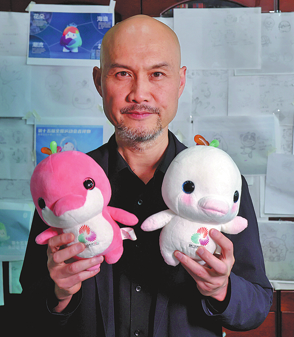
The mascots for the upcoming 15th National Games, Xiyangyang and Lerongrong, are winning hearts online. The team that designed them was led by Liu Pingyun, who sees them as embodying the distinct cultural identities of cohosts Guangdong province and the Hong Kong and Macao special administrative regions, while also symbolizing the region's shared roots and growing integration.
The mascots were inspired by the Chinese white dolphin, a resident of the Pearl River Estuary known as the "giant panda of the sea" and classified as a grade 1 national key protected species.
Xiyangyang's white color reflects the dolphins' natural hue, while Lerongrong's pink skin represents the flush the dolphins exhibit when active, symbolizing the games' spirit of striving for progress.
In the run-up to the games, which are set to open on Sunday, the mascots' cute appearance and resemblance to chickens — popular in Guangdong, Hong Kong and Macao cuisine — have ignited increasingly widespread online discussion.
Internet users have affectionately given them nicknames such as "great bay chicken", "boiled sliced chicken" and "soy sauce chicken". And the mascots have featured in various fan creations, including videos, memes and cultural products, with an enormous estimated commercial value.
Liu noted that while selecting the mascot prototype, his team explored elements linked to the Guangdong-Hong Kong-Macao Greater Bay Area, such as animals, plants and Chinese characters. After experimenting with designs based on the South China tiger, lions from the traditional lion dance and the symbolic Five Rams Statue of Guangdong's capital, Guangzhou, they chose an animal that had never been featured as a National Games mascot.
The dolphins not only exude the cuteness young people love, but also signify China's commitment to ecological civilization.
"Most importantly, this choice fully represents the integration of the three regions," Liu highlighted.
Currently, there are approximately 6,000 Chinese white dolphins worldwide, with 2,000 inhabiting the Pearl River Estuary, which makes it the largest habitat for these dolphins worldwide.
The heads of Xiyangyang and Lerongrong are decorated with three splashes of water in different colors. Liu said that the red represents Guangdong, symbolizing the kapok bloom, the city flower of Guangzhou. The purple stands for Hong Kong, embodied by the bauhinia, while the green signifies Macao, represented by the lotus. These colors are also featured in the emblem designs of the 12th National Games for Persons with Disabilities and the 9th National Special Olympic Games, showcasing a deep understanding of the unique yet harmoniously integrated cultures of the three regions.
This interpretation also mirrors Liu's personal understanding of these regional cultures.
Originally from Jiangxi province, Liu relocated to Guangzhou in 2000 to study for his master's degree, and then to Macao in 2018 to pursue a doctorate. Subsequently working at the school of visual arts design at the Guangzhou Academy of Fine Arts, where he now serves as the dean, he has spearheaded numerous design projects, including the creation of the widely acclaimed Beijing Winter Olympics mascot Bing Dwen Dwen.
Having lived in the region for over two decades, Liu identifies himself as a "typical" Guangzhou resident, actively "experiencing and absorbing" the local culture in his daily life.
In his view, the cultural histories of Guangdong, Hong Kong and Macao each possess unique characteristics. Hong Kong and Macao showcase a vibrant fusion of Eastern and Western cultures. Macao, for example, boasts Portuguese-style stone pavements and an array of unique cuisines.
Despite these distinctions, the three regions share common foundations such as language, the appreciation of Chinese culture and a unique maritime heritage from their locations along the Maritime Silk Road. While preserving their distinctiveness, the regions demonstrate a marvelous integration, embodying the cultural essence of the GBA, Liu said.
He also noted that the regions have shown mutual respect and support throughout the design process, maintaining smooth communication. The design team reports to authorities in each region and has received active feedback.
Liu and his team were caught off guard by the mascots becoming internet sensations. Their popularity was unexpected, but the team is pleasantly surprised, he said.
"Such interpretations by netizens mean that the intellectual property resonates with the public and blends into their daily life," Liu said.
Lesley Liu contributed to this story.
amberwu@chinadailyhk.com