Global South needs just climate policies









The global discourse today is dominated by one urgent theme: how to contain the man-made crisis of climate derailment. Every effort to reverse the environmental damage caused by climate change should be pursued decisively, inclusively and wisely. After all, no one thrives by destroying their own home.
Most of the world's biggest polluters are the industrialized countries in the Global North. Coincidentally, many of them are increasingly dependent on green energy, while Brazil and Colombia, which belong to the Global South, are also developing green energy rapidly.
On the other hand, in the league of countries championing the green energy revolution, China leads the charge. China's renewable energy installed capacity as of June 2025 was about 2.1 billion kilowatts, an amazing 59.2 percent of its total power capacity.
That is not only the highest in the world, but constitutes a large share of the total global capacity of renewable energy. The United States trails at the second position but the installed capacity lags far behind China.
Fortunately for Global South nations, China is an ally. The country's pole position in green energy would benefit less industrialized countries that need to set up renewable energy facilities. China can provide technology, scale and support.
The climate discourse is embedded with politics. Power play and bullying by stronger countries often overshadows genuine cooperation. At the Dubai 2023 COP28, bigger countries tried to cajole weaker ones from the Global South into signing the deal to completely phase out fossil fuels by 2050. Had that agenda sailed through, it would have been a repeat of the late 1970s and early 1980s when liberalized markets unleashed totalitarian bullying economic policies that poor countries were not prepared for and ultimately stunted their growth.
If Global South countries move away from fossil fuels too fast, they risk destabilizing their economies that are heavily reliant on petroleum derivatives. Crude oil produces many byproducts, which are the raw material for hundreds of sectors producing thousands of industrial goods. If fossil fuel is abruptly phased out, it would pull the plug on entire industries and value chains.
At global negotiating tables — whether in the UN Security Council or at energy policy forums — China often acts as a buffer for countries that are unable to speak for themselves. These nations need China to guard them from bullying on green energy transition, make a case for their capacity development and ensure a reasonable transition course that would not throw them off balance.
Positive signs of this support are already visible in China's renewable energy footprint in the Global South. Its green energy exports to Global South countries have surged, surpassing exports to the Global North for the first time. Competitive pricing and targeted outreach have accelerated solar power and electric vehicle adoption in countries such as Brazil, Pakistan, India and across Africa and ASEAN. Chinese EVs have also registered strong growth in Latin America and the Middle East.
Ember (a global energy think tank) estimates that China's exports of clean technologies in August 2025 totaled a record $20 billion. EV exports grew by 26 percent between January and August 2025 compared to the previous year, while battery exports grew 23 percent. Other clean tech exports also surged during 2025, with grids up 22 percent, wind rising 16 percent and heating and cooling systems up 4 percent. This growth more than offset a fall in solar PV, which was down 19 percent. Both EVs and batteries are now more than double the value of solar PV exports.
Beyond new energy, China continues to support other renewable energy projects in the Global South. It is building large-scale hydropower projects in Africa — from Nigeria's Zungeru and Mambilla hydropower plants to Grand Ethiopian Renaissance Dam and Zambia's Kafue Gorge Lower Hydropower Station. Chinese companies are also expanding their solar and wind footprints in Africa.
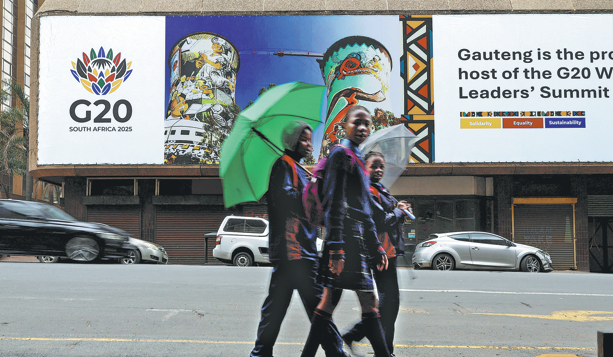
At the G20 summit, renewable energy and climate change continue to be major issues. China has been well positioned to push for environmental agreements that are more humane and beneficial for the Global South.

The views don't necessarily reflect those of China Daily.
If you have a specific expertise, or would like to share your thought about our stories, then send us your writings at opinion@chinadaily.com.cn, and comment@chinadaily.com.cn.