AI takes on rising role in healthcare
Use of technology is increasing efficiency, providing resources in underserved areas









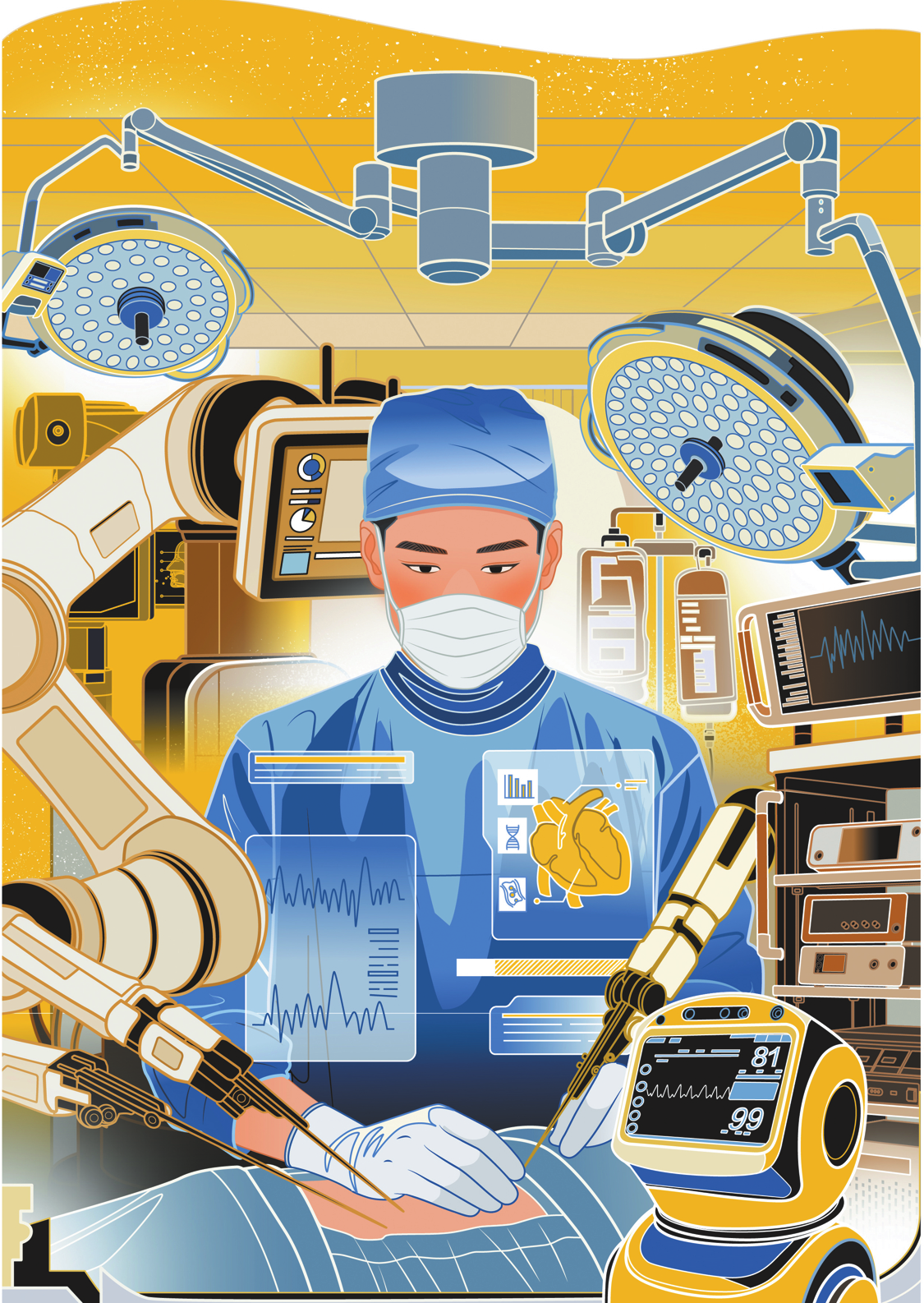
For radiologist Hou Dailun, artificial intelligence has made a major difference in his daily work.
Hou, head of Beijing Chest Hospital's medical imaging department, said since the introduction of an AI system in 2020, he's witnessed a significant improvement in the accuracy and efficiency of the department's work.
The system assists radiologists in analyzing the results of computed tomography scans for lung nodules.
After several years of refinement, the system is now able to analyze "within seconds" a CT scan of a person's lung, which often contains 300 to 600 slices, and provide accurate information on the size, shape and density of nodules, Hou said.
Radiologists further evaluate the system's initial findings and come up with suggestions on whether surgery is needed.
Before the system was put to use, Hou said it used to take him more than 20 minutes to go through all of a patient's CT lung scan slices.
With the help of the system, the department is able to complete the interpretation of lung nodule CT scan results for about 600 patients a day, he said.
Hou's experience reflects part of China's ongoing efforts to intensify the application of AI in the healthcare sector. Earlier this month, the country made public a guideline to facilitate and regulate the integration of AI and healthcare.
Issued by the General Office of the National Health Commission and four other departments, the guideline sets out multiple goals, one of which is to make AI technologies, such as AI-assisted diagnostic imaging, available in most hospitals at the secondary level and above by 2030.
Chen Kuan, founder and board chairman of InferVision, a Beijing-based company making AI products to support diagnostic imaging and surgery, said the conditions in China are "very good" for achieving the goal, because the government is encouraging hospitals to use more AI technologies.
The guideline said outstanding hospitals will be selected to collect high-quality medical imaging data, conduct research, and support the development and iterations of large AI models.
The quality of data and their annotation is fundamental for the performance of AI medical devices, Chen said, adding that the products are supposed to imitate the ability, standards and past experience of top medical experts.
Laying out two dozen key tasks of deepening AI's application, the guideline also highlighted the need to take advantage of AI technologies at the grassroots level.
It called for developing AI applications to help primary care physicians diagnose and treat common diseases, review prescriptions and manage follow-up care.
The guideline also required efforts to conduct the intelligent management of chronic diseases and support residents in managing their own health.
Beiqijia Community Health Service Center, a primary care provider in Beijing, is among the grassroots hospitals tapping into the power of AI to boost the quality of public health services.
Its diabetes shared care clinic uses an online system to track blood sugar levels for more than 800 diabetic patients.
The system issues warnings and health management suggestions to patients once it detects abnormal blood sugar levels.
In addition, patients can upload pictures of their meals to the system, which will evaluate whether their diet is healthy, and offer recommendations for them to improve their meal patterns and the order in which they eat food.
Liu Huan, an engineer from the company that developed the system, said these functions were made possible thanks to large language and multimodal models.
Du Sai, who is in charge of the clinic, said the system has ensured comprehensive health management and timely intervention for patients while reducing the burden on primary care physicians.
Hou, the radiologist, said AI can play a positive role in the prevention and control of lung cancer, which is believed to be the most common cancer in China.
Hospitals in less-developed regions that have a shortage of radiologists could use AI technologies to conduct quick analysis of CT scan images, Hou said, adding that the AI-generated preliminary reports serve as a valuable early warning for people who need further intervention.
Weng Naijie, director of Beiqijia Community Health Service Center, said it's highly necessary for grassroots hospitals to deploy more AI services to improve diagnosis and treatment abilities.
To lay a solid foundation for promoting AI in healthcare, the guideline urged relevant authorities to improve related infrastructure, computing power and algorithms, facilitate a richer supply of medical data, and strengthen the construction of pilot-scale testing bases.
The guideline also emphasized the need to enhance supervision of AI technologies all the way from research and development to their application.
Tighter regulation is needed to ensure the quality and safety of AI medical services, and to protect people's privacy and data security, according to the guideline.
The guideline follows the principle that AI is an enabler instead of a replacement, the National Health Commission said, adding that such technologies should remain safe, reliable and under control.
Hou, the radiologist, agreed. He said the AI system his department is using to detect lung nodules, though highly efficient, has weaknesses.
It sends false alarms sometimes, and fails to estimate the risks of nodules as accurately as radiologists, he said, adding that the preliminary reports it generates must be examined and signed off on by doctors.
The system is an auxiliary for radiologists, and will continue to be so even if its shortcomings are addressed successfully, he said, underscoring that AI shouldn't replace human doctors in the healthcare sector, where "people's lives are at stake".
Currently, AI technologies have limited ability to handle "edge cases", situations that are unusual or even extreme, Chen from the tech company said, noting that they can't substitute the inspiration and creativity of human medical workers.
AI is like "a child who keeps growing but needs to be watched by an adult", he said.
China has stepped up efforts to respond to the accelerating evolution of AI and harness its potential.
The General Office of the National Health Commission and two other departments released a document in November last year, listing 84 medical and health scenarios where AI should play a greater role, including diagnostic imaging, surgery, clinical consultation, medication and medical insurance.
Zhu Keli, founding director of the China Institute of New Economy, said the high-quality development of AI tools requires joint contributions from various parties.
The government needs to play a leading role by formulating long-term and favorable policies, building public data platforms, breaking down data barriers and enhancing regulation, Zhu said.
Research institutes need to focus on improving algorithms and training models, and tech companies should develop practical and easy-to-use products according to the needs of users, he said, calling for cooperation between hospitals, research institutes and companies.
"The future of AI's application in healthcare is promising. AI will be a core driving force to level up the industry," Zhu said.
wangqingyun@chinadaily.com.cn