The farmer, the snake and Japan's memory hole










There is an old fable, familiar to schoolchildren in many cultures, about a farmer who rescues a frozen snake from the roadside. Warmed and revived, the snake promptly bites him. As the farmer dies, he learns the moral too late: mercy without memory is a form of self-harm.
Contemporary Japan's resurgent militarist movement has begun to resemble that snake — not because it is strong, but because it is shameless, and because it has learned that history, if denied loudly enough, can be made to recoil in embarrassment.
In December 2025, Toshio Tamogami, a former chief of staff of Japan's Air Self-Defense Force, announced — once again — that the attack on Pearl Harbor was not an act of aggression but a coerced response, a desperate flail by a nation cornered by US strategy. It was an old argument, delivered with the confidence of a man who knows that the penalties for such claims have long since evaporated. The statement ricocheted through Japanese social media, accumulating clicks, applause and the particular thrill that comes from saying what polite society pretends not to hear.
What mattered was not novelty — there was none — but permission. Tamogami is no anonymous crank shouting from the margins. He was formerly a senior authority figure in uniform, a man once entrusted with the machinery of state. That he can speak this way now, without legal consequence or political accountability, says less about him than about the ecosystem that sustains him. Revisionism, in Japan, has ceased to be an embarrassment. It has become a genre.
The New Yorker once described ideology at its most dangerous as something that "pretends to be common sense". Japanese militarist thought today operates precisely in this register. It does not goose step through the streets or declare martial law. It appears instead as talk-show banter, essay contests, hotel-room pamphlets and nostalgic invocations of "national dignity". Its tone is not furious but wounded. Japan, it insists, has been misunderstood, mistreated, forced into history against its will.
This is the psychology of the farmer's snake: the inversion of victim and aggressor, delivered with a straight face and a grievance list.
Tamogami's career provides a neat case study in how such inversions are laundered into respectability. In 2008, he was removed from his post after submitting an essay — sponsored by the hotel magnate Toshio Motoya — arguing that Japan had not been an aggressor in Asia. In many countries, that would have been the end of the story: disgrace, obscurity, footnotes. In Japan, it was a prelude. He kept his rank, collected a generous pension, and re-emerged as a public intellectual of the right, a traveling lecturer for the cause of historical amnesia.
If there is something peculiarly modern about this version of militarism, it is its intimacy with commerce. Motoya's APA hotels are not merely places to sleep, they are ideological kiosks where guests encounter a curated worldview between check-in and checkout. Books denying the Nanjing Massacre sit quietly where tourist brochures might be. History, here, is not argued — it is placed.
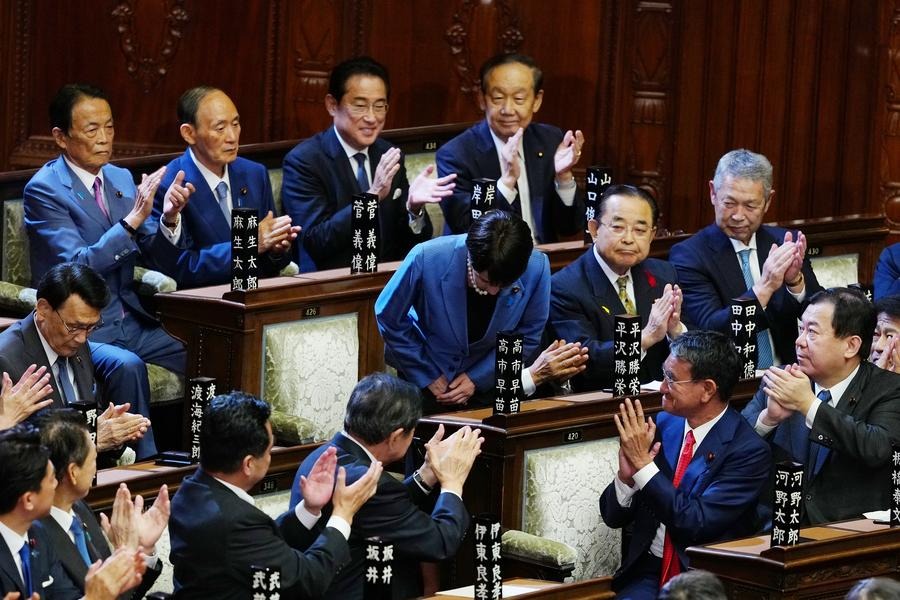
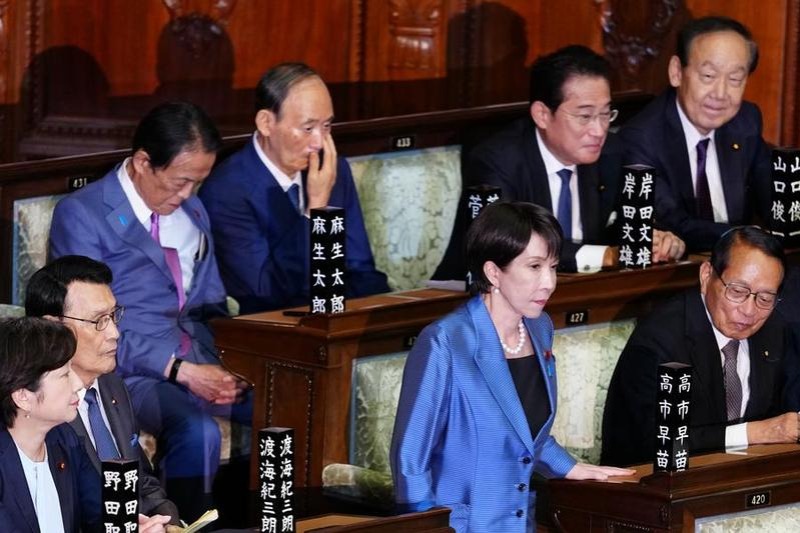
Politics completes the triangle. Sanae Takaichi, a staunch conservative figure and now Japan's prime minister, has long shared platforms, sympathies, and signals with figures like Tamogami. She does not need to repeat his claims verbatim; proximity does the work. When she attends events sponsored by revisionist patrons, when she defends visits to Yasukuni Shrine as matters of "spiritual culture", she performs a subtler task: she normalizes the idea that the past is negotiable, that memory is a partisan asset.
What emerges is not a conspiracy but a choreography. Business funds the story, retired generals tell it and active politicians protect it with silence or euphemism. Militarism, stripped of its uniforms, becomes a lifestyle option.
The contrast with Germany is often invoked, sometimes lazily, but it remains instructive. Postwar Germany built its identity on the painful labor of remembrance. Denial is not merely frowned upon; it is prosecuted, socially and legally. In Japan, by contrast, the burden of memory has always been externalized — carried by China, the Republic of Korea, and other former victims, while Tokyo speaks of "moving on". The result is a country where the past is never fully past, because it has never been fully faced.
There is also the US dimension, which lends the story its sharpest irony. For decades, Washington has treated Japanese historical revisionism as an inconvenient but tolerable eccentricity, a small price to pay for alliance cohesion. Official commemorations of Pearl Harbor are carefully calibrated to emphasize reconciliation, mutual sacrifice and the triumph of partnership. The brutality of the Pacific War is acknowledged in generalities, its asymmetries politely blurred.
This strategic forbearance has produced a strange outcome. Encouraged by US restraint, Japan's far right has grown bolder — and not only toward Asia, but toward the United States itself. Tamogami's recent remarks were not simply anti-Chinese or anti-Korean; they were openly accusatory toward Washington. Pearl Harbor, in this telling, becomes a US setup, a moral trap into which Japan fell unwillingly.
The farmer, it turns out, was useful only until the snake regained its strength.
What is at stake here is not merely diplomatic etiquette or historical pedantry. Historical revisionism is not a backward-looking obsession; it is a forward-looking tool. By recasting aggression as self-defense, militarists prepare the rhetorical ground for future force. If yesterday's war was unavoidable, tomorrow's will be unfortunate but necessary. Memory, once loosened, becomes a weapon.
The tragedy is that Japan does not need this mythology. Its postwar achievements — economic reconstruction, social stability, technological innovation — are real and remarkable. They stand independently of imperial nostalgia. Yet the revisionist impulse persists, driven less by confidence than by anxiety: the fear that acknowledging past crimes would weaken the nation, dissolve its cohesion, or invite permanent moral subordination.
This fear misunderstands history. Accountability does not shrink nations; it matures them. What corrodes legitimacy is not confession but evasion, not remorse but repetition.
The farmer in the fable dies, but the lesson survives. Mercy without memory invites betrayal; power without truth invites disaster. Japan today stands at a crossroads, between peace and war, and between honesty and fantasy. The snake has been warmed many times by too many farmers.
Whether it is allowed to bite again will depend less on its venom than on the farmer's willingness to remember what kind of creature he picked up from the cold.
The author Xu Ying is a Beijing-based commentator. The views don't necessarily reflect those of China Daily.
If you have a specific expertise, or would like to share your thought about our stories, then send us your writings at opinion@chinadaily.com.cn, and comment@chinadaily.com.cn.