



Hidden toll on urban wildlife revealed
Experts gather in Nanjing to discuss roadmap to reducing roadkill









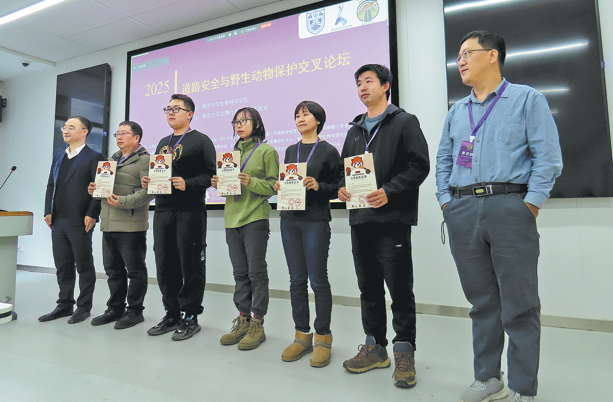
Wildlife threat discussed
The forum began with a presentation by Li on the establishment and progress of the China Roadkill Monitoring Network, where he highlighted the significant accomplishments of the project in recent years. According to the scholar, roadkill is one of the three major threats to wildlife globally, with an estimated upper limit of 340 million birds killed annually on roads in the United States, according to a 2014 study published in The Journal of Wildlife Management.
During their research on the roadkill situation in Nanjing from November 2020 to October 2021, Li and his team conducted 26 monitoring campaigns across 224.27 kilometers of road, covering a total of 5,831 km over the research period. The team focused on nine roads, which were monitored biweekly throughout the year. They recorded 293 roadkill carcasses across 22 species, of which 284 were identifiable. A total of 136 were mammals, 143 were birds and five were reptiles.
Utilizing mathematical models, Li and his team estimated that annually about 115,000 wild and stray mammals and 456,000 birds are killed on roads in Nanjing.
"Although we lack sufficient data to estimate roadkill figures for the entire country, it is reasonable to assume that the number of birds killed on roads could exceed 200 million," he said.
Li acknowledged that while the roadkill issue is important, it is often underestimated.
"Through our research, we aim to provide an accurate estimation of the roadkill situation nationwide,"Li said. "With a correct estimation, we can raise public awareness about the significance of this issue."
Li highlighted the essential role of public participation in the roadkill project, underscoring its impact on the project's success. As of September, the mini-program used for the project had recorded roadkill incidents involving 800 wildlife species. This included 16 species under the country's first-level protection and some 100 species under second-level protection.
One notable example he shared was the Indochinese box turtle, a critically endangered species. It had not been observed in the wild for many years until a photo of its carcass was uploaded to the mini-program. "This discovery prompted some researchers to request the location of the roadkill so they could investigate further and potentially search for the turtle in the wild," he said.
He said the project also serves as an excellent opportunity to enhance environmental awareness. "Our work offers the public a valuable chance to engage in a citizen science project," he said. "With increased public involvement, we hope to bring together individuals from various fields to collaboratively address this problem."
Xu Feng, an associate researcher at the Xinjiang Institute of Ecology and Geography at the Chinese Academy of Sciences, shared his insights on the complex interactions and adaptations between humans, roads and wildlife. His discussion highlighted important considerations for road safety and animal protection.
Based in Urumqi, Xinjiang Uygur autonomous region, Xu said that the region's road network expanded to 230,000 km last year, with one-third of them constructed since 2021. His research examined the impact of several desert highways on the Xinjiang ground jay, a species unique to the arid landscapes of Xinjiang.
Xu discovered that these rare birds are increasingly drawn to highways, attracted by the availability of food and water along the highways' green shelterbelt, making them more frequently observed near these roads. Notably, he said that the birds have adapted by learning to cross the roads. "This adaptation has led them to live closer to the desert highways," Xu said."So they face a higher risk of becoming roadkill."
To mitigate the risk, Xu suggested implementing speed limits on road sections frequented by the ground jays, aiming to enhance their protection while balancing the needs of human transportation.
Wang Kexin, a master's student from Sun Yat-sen University in Shenzhen, Guangdong province, discussed the impact of road heat traps on the risk of snake roadkill in Guangdong. She explained how roads, as ideal sunbathing spots for snakes that regulate their body temperature externally, increase the risk of roadkill incidents.
She said that due to the region's warmer climate, amphibians and reptiles are particularly vulnerable to roadkill in Guangdong. During her research, she, along with her professor Ma Liang and classmates, documented 29 different species of snakes that had fallen victim to roadkill.
Zhao Ying, a research and conservation officer from the Chinese Felid Conservation Alliance, a nonprofit organization specializing in the protection of wildcats, spoke about how challenges arising from roads running through leopard habitats in northern China can be addressed.
She detailed the collaborative efforts of her team in designing and constructing ecological corridors along a new highway that traverses leopard habitats in the Taihang Mountains. These corridors aim to facilitate safer crossings for the endangered North China leopards, helping to mitigate the impact of road expansion on their natural habitat.
Qin Haixu, director and senior engineer at the Nanjing Institute of Environmental Protection Science, opened the afternoon roundtable with a report on the construction of ecological corridors for terrestrial vertebrates in developed areas. He discussed solutions for roadkill incidents faced by wildlife in Laoshan National Forest Park in Nanjing through the establishment of eco-friendly corridors.


- China's progress in antibiotic guidance trumpeted
- Beijing hospital blazes trail for treatment of rare diseases
- Scientists from Spain, China discover Jurassic lizard tracks in Europe
- China Coast Guard conducts patrols around China's Huangyan Island
- China's courts conclude 2.5m IP cases in five years
- Thousands of cherry blossoms bloom in Chongqing, drawing visitors









