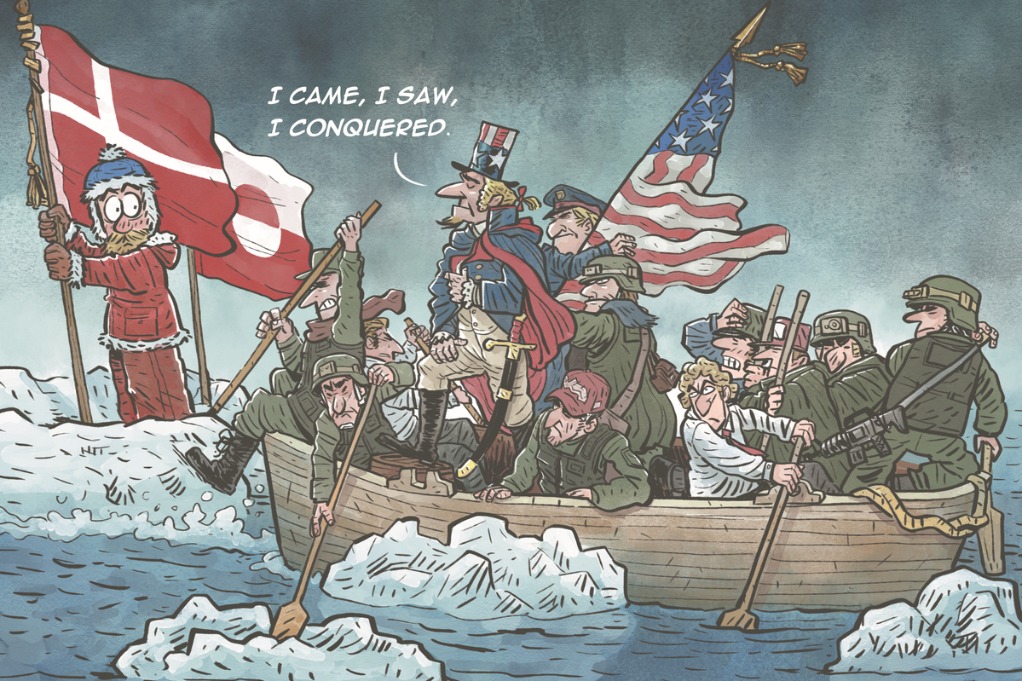
Greenland reveals cracks in transatlantic relations









Whether the United States could seize Greenland has become the focus of international attention in recent weeks. What might appear as a bilateral dispute between Washington and Copenhagen is in reality a test case for NATO, transatlantic relations and the international order.
Under mounting pressure from the US administration, some European nations have begun to demonstrate political resolve with security implications. Some European countries, including the United Kingdom and France, deployed a small contingent of military personnel in Greenland, signaling their support for Denmark in safeguarding the island. Although limited in scale, this move carries enormous political and strategic significance. It reflects the profound impact the dispute over Greenland could exert on the geopolitical landscape and the broader international situation.
From the security perspective, the parallel deployment of US and European forces in Greenland raises concerns of a rift emerging within NATO. The troops dispatched by the European countries have been officially framed as assisting Washington in "safeguarding" Greenland, echoing US President Donald Trump's assertion that the region faces security threats from Russia. Ostensibly, the deployments are a diplomatic courtesy in support of the US stance. However, the underlying message is clear. European nations have signaled that they will support Denmark in defending its autonomous Greenland.
If the military presence of the US and European countries over the Greenland issue escalates, the internal dynamics within NATO would shift beyond policy disagreements toward direct confrontation among its member states. Once NATO descends into internal strife, even if its institutional framework does not immediately collapse, its substantive function and political authority as a collective defense organization would be severely undermined. The grouping would be potentially reduced to a nominal entity.
Beyond NATO, the Greenland issue poses a challenge to transatlantic relations. After World War II, the US and Europe have maintained a high degree of alignment on so-called shared values, alliance-building and major global issues, generally coordinating their positions in international affairs. Even though Europe was dissatisfied during the wars in Afghanistan and Iraq in the early 2000s, the discontent was directed more at the US administration than at the country itself.
However, the dispute over Greenland has brought US-Europe contradictions into the open, with disagreements even extending to the realm of values. For instance, during a visit to Europe, US Vice-President JD Vance publicly criticized Germany and other European countries for not respecting freedom of speech and expressed Washington's dissatisfaction. Such divisions indicate that transatlantic relations are challenged not only by frictions in policy coordination but also by deeper divergences in their fundamental approaches. They indicate that the transatlantic alliance is far from robust.
In a broader context, internal divisions within the transatlantic alliance signal fragmentation across the West. If this trend continues, its structural consequences could mirror the historical split of the Roman Empire into Eastern and Western halves. This analogy highlights a systemic fracture in authority and order in the West, with spillover effects that could directly and negatively impact the current international system.
Since the end of World War II, the international community has gradually established a consensus centered on respecting the United Nations Charter, adhering to international law and safeguarding national sovereignty and territorial integrity. This institutional framework has contributed to a relatively enduring global peace and stability in the past eight decades.
However, the stance adopted by the US administration on the Greenland issue challenges this consensus. By prioritizing transactional logic, Washington's approach is to take whatever it wants. It disregards even a symbolic respect for international law and reveals a more overt imperialist tendency. Such a shift poses significant risks to global peace and stability.
This is why the dispute over Greenland extends far beyond bilateral tensions between the US and Denmark. At a deeper level, it reflects strategic divergences between Washington and Brussels, highlights structural contradictions within NATO, and poses a serious challenge to the current system of international law and the international order embodied by the UN Charter.
The author is the director of the American Studies Center at Zhejiang International Studies University.
The views don't necessarily represent those of China Daily.