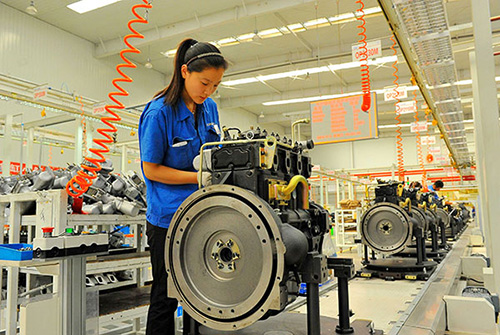
Higher wages have not been a roadblock for the company because its automated factories mean that labor costs represent less than 2 percent of the cost to manufacture lighting.
"Are our labor costs higher in the US versus China? Yes, but in our case the total cost to produce our US units is lower when all factors are calculated," said Sjolseth. The company today makes 20 percent of its products in the United States, a number it aims to push to 75 percent by the end of next year.
Narrowing cost GAP
The falling share of wages in total costs also played a role in a new battery plant opened by General Electric in Schenectady, New York, this month.
"With all the manufacturing technology we have, labor is a relatively small component" of costs, said GE's chief executive, Jeff Immelt. "That's different today than it was 10 years ago."
The new plant will employ 450 people, a slice of the 14,500 positions the largest US conglomerate has added since 2009. It employs 301,000 people worldwide and 131,000 in the United States.
The plant is highly automated, with high-tech machines processing the ceramic forms that surround the batteries. Some processes are still done by hand; during a recent tour of the site, workers were applying a layer of carbon paint to the cells with paint brushes.
The hand-painting is a technique that GE researchers used in developing the batteries, and it remains a more reliable approach than applying the carbon by machine, said Prescott Logan, general manager of GE's newly formed energy storage technologies unit. But GE is working on a way to reliably automate the process.
"There are a lot of parts of that factory that will look very different five years from now," Logan said.
Rising wages in emerging markets and higher shipping costs are also closing the cost gap between developing markets and the United States.
In 2005 it cost 45 percent less to make electric motors for automobile windshield wipers in China and ship them to the United States, rather than make them domestically, according to an analysis by AlixPartners.
Today, the Chinese motor costs only 18 percent less than a US-made model. The consultancy forecasts that by 2015 the Chinese motor will cost just 9 percent less, due to rising wages and shipping costs and an appreciation in the Chinese yuan versus the US dollar.
The study also looked at costs for motors made in India and Mexico and found they had risen, though not as dramatically as in China.
"If you go back to the heyday of outsourcing to China, at that time with the exchange rates and the ocean freight it was pretty hard to go wrong from a cost standpoint," said Steve Maurer, a managing director at AlixPartners who specializes in manufacturing efficiency.
"Now that costs in China are increasing ... people are stepping back and saying, 'We need to reevaluate this.'"

Copyright 1995 - . All rights reserved. The content (including but not limited to text, photo, multimedia information, etc) published in this site belongs to China Daily Information Co (CDIC). Without written authorization from CDIC, such content shall not be republished or used in any form. Note: Browsers with 1024*768 or higher resolution are suggested for this site.
License for publishing multimedia online 0108263 Registration Number: 130349