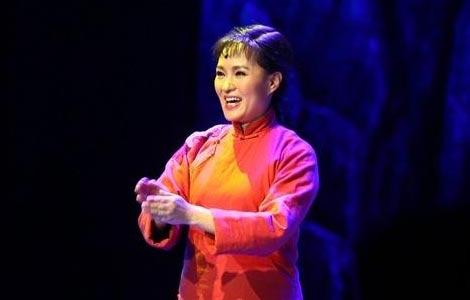
In a recent speech to the students of the University of International Business and Economics in Beijing, she said that she had burst into tears while singing songs based on such poems.
As advocates of new Chinese folk music, the couple first met in 2002, at a concert in Beijing, where Zollitsch played the zither, a classical Bavarian folk music instrument. Impressed by his performance, Gong contacted him after the show and later learned that he had been listening to traditional Chinese music for a long time and studied the guqin (Chinese stringed instrument) in Shanghai.
Gong, who was born in Guiyang, capital of Southwest China's Gui-zhou province, started learning Chinese folk singing at a very young age and enrolled at the Chinese Conservatory of Music in Beijing at age 16.
After graduation, she joined China Central Nationalities Orchestra.
In 2000, she won the Chinese National Singing Competition as best female singer and became a popular figure on various TV shows. However, after a while the shows got boring for her.
She describes her meeting with Zollitsch as "life changing", which helped her regain her love for singing.
In 2009, Gong got rave reviews after she released the song Tan Te, or Disturbed, online. Composed by Zollitsch, the song uses sounds rather than words to convey different emotions and moods.
While many were impressed by Gong's singing skills, some regarded the song as an attempt to attract people's attention.
However, the couple continued to break conventional rules in Chinese folk music and released the song, Fa Hai, You Don't Understand Love, which also made their critics uneasy.
"If you listen carefully, these songs display some beautiful Chinese ethnic singing skills and musical elements," says Gong. "You need to take some time to digest them."
The couple's next project will see Zollitsch adapt a set of poem, Jiu Ge, or Nine Songs, by Qu Yuan, China's patriotic poet from the Warring States Period (475-221 BC).
In the form of chamber music, the composer used Western string instruments, brass-wind instruments, Chinese percussion instruments, suona horn (a woodwind instrument) and sheng (a reed pipe wind instrument) to unveil different layers of the poem.
Gong, along with another Chinese folk singer, a soprano and a tenor, will perform along with a 120-member chorus. The couple's biggest work so far is expected to be staged in January.
"There is a vast treasure of Chinese music which I am interested in exploring" says Zollitsch, adding that he always wanted to compose with the bianzhong (an ancient Chinese instrument made of a set of bronze bells).
|
|
|
|
|
|
|
|

Copyright 1995 - . All rights reserved. The content (including but not limited to text, photo, multimedia information, etc) published in this site belongs to China Daily Information Co (CDIC). Without written authorization from CDIC, such content shall not be republished or used in any form. Note: Browsers with 1024*768 or higher resolution are suggested for this site.
License for publishing multimedia online 0108263 Registration Number: 130349 










 Raymond Zhou:
 Pauline D Loh:
 Hot Pot
 Eco China
 China Dream
 China Face