To ban or not to ban, that is the question
 |
|
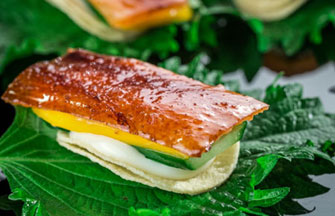
Delicately sliced and arranged like a crane for this sashimi platter, fugu is pretty as a picture. |
 |
|
For some diners, the risk and the myth around fugu-eating is precisely its charm. Photos Provided to China Daily |

It's not on any menu, and fugu or puffer fish is still technically outlawed for restaurants in China. However, determined diners can still enjoy this spring delicacy - at their own risk. Ye Jun tells us how and where.
You cannot find it on any menu, and as far as the authorities are concerned, any restaurant serving this dangerous delicacy is breaching the regulations. But you will find that fugu is widely available in mid-end Chinese restaurants specializing in seafood. While some restaurants play hide-and-seek with government inspectors, some have placed it in broad daylight, in the hope that the puffer fish will pass official approval soon. Five years ago, enforcement was swift. Beijing-based food writer Zhao Ziyun wrote a review about a restaurant serving fugu. A day after the review was published, local sanitation inspectors confiscated the fish and slapped the restaurant with an 8,000 yuan ($1,269) fine.
Zhao says neither he nor the restaurant owner had any idea the fish was banned in Beijing.
Five years later, the ban has not been lifted but fugu is more popular than ever in the capital city.
"Almost all high-end restaurants specializing in fresh river fish offer fugu, with prices ranging from 100 yuan ($16) to more than 1,000 ($159)," says Zhao. "People all know about the situation, so it is usually not on the menu."
At Lao Lao Fu, for example, a high-end hotpot restaurant at the Asian Games Village in Beijing, you cannot find the word hetun on the menu. (Hetun literally translates to river hog.)
But, hidden among photographs of many other hotpots is a tiny inconspicuous puffer fish. The English translation says it's a "globefish" stock.
In the private rooms, and in a privately circulated magazine for the restaurant's VIP diners, leaflets show a pretty plate of fugu sashimi, which Lao Lao Fu says is one of its top three sellers.
Liu Xu, Lao Lao Fu's specialist fugu chef, got his fugu preparation license from labor authorities in Northeast China's Liaoning province, and follows strict procedures in preparation.
Liu says the restaurant's fugu is provided only to familiar customers, or those who had heard about it and asked for it.
"At the best, the restaurant sells from 700 to 800 fishes a month," he says. "Most customers are those who had tried it before. Those who have not tried it would not order it."
A plate of fugu sashimi of 100 to 150 grams costs 666 yuan ($106). At a time when products such as bird's nest and shark's fin are facing pressure from environmentalists, Chinese restaurants are trying to make fugu the new high-end favorite.
At a newly opened restaurant serving Huaiyang cuisine, fugu is sold as "river fish", a safe, generic term.
A manager there says fugu is available only at special request, and it is sold alongside knife fish and reeves shad, making up the traditional "three delicacies of the Yangtze River".
Four hundred grams of red-braised fugu is sold for about 680 yuan here, but the restaurant is still wary of the ban.
"We are not making fugu a main item on the menu because of the risk of breaking the law," says the manager. The restaurant's chef is from Jiangsu and is licensed to prepare fugu.
Unlike the cautious management of Lao Lao Fu and the Huaiyang restaurant, Tianzheng Fugu Restaurant openly terms itself a fugu specialist.
The restaurant, opened less than two months ago in Beijing, is probably the only one that specializes in fugu here.
Tianzheng hired a professional chef and a manager from Japan, who prepare the blowfish strictly according to Japanese standards. It offers sashimi, fugu bones deep-fried to a crisp, and a hotpot using roasted bones and flesh,
Set meals cost between 480 to 1,200 yuan per person, with a kilogram of the fish priced at 1,100 yuan.
Wang Changyu, general manager of the restaurant in Xinyuanli, Chaoyang district, says the restaurant follows a whole set of fugu processing and managing rules from Japan.
The Japanese connection comes from the owners' core business rearing fugu in Dalian, Liaoning province. The fish is mostly exported to Japan, and the company's fugu commands about 40 percent of the Japanese market, weighing in at more than 4,000 metric tons a year.
As a specialist breeder of fugu, Wang says Tianzheng has been lobbying for the legalization of fugu in China. "We expected the approval to come at the end of last year. That's why the restaurant was set up around this time in Beijing," says Wang.
On April 1, he says, two national standards on the breeding and processing of fugu were approved and issued by the General Administration of Quality Supervision, Inspection and Quarantine of the People's Republic of China, which Tianzheng company claimed to help draft.
Dalian fugu was also approved as a geographic identity product last year.
Puffer fish is found in Liaohe River of Liaoning, the Yangtze River in Jiangsu, and the Pearl River in Guangdong. There are more than 180 varieties, including 40 that are common. However, less than 20 varieties are edible.
Wild puffer fish is available only in March and April, when they swim upstream to spawn in the rivers. But they are increasingly rare, and most fugu served as food is farmed.
Lao Lao Fu's chef Liu Xu says no other fish can compare with the springy texture and fresh taste of fugu, or with the glistening clarity of fugu sashimi.
But for some gourmets, it's dicing with death that makes eating fugu such an attraction.
According to food writer Zhao, the heroism involved in eating something potentially lethal is the main driver behind the culture of eating puffer fish.
"Without that risk and the myth around it, it would lose most of its charm."
Contact the writer at yejun@chinadaily.com.cn.