



LAMOST data helps solve century-old cosmic puzzle









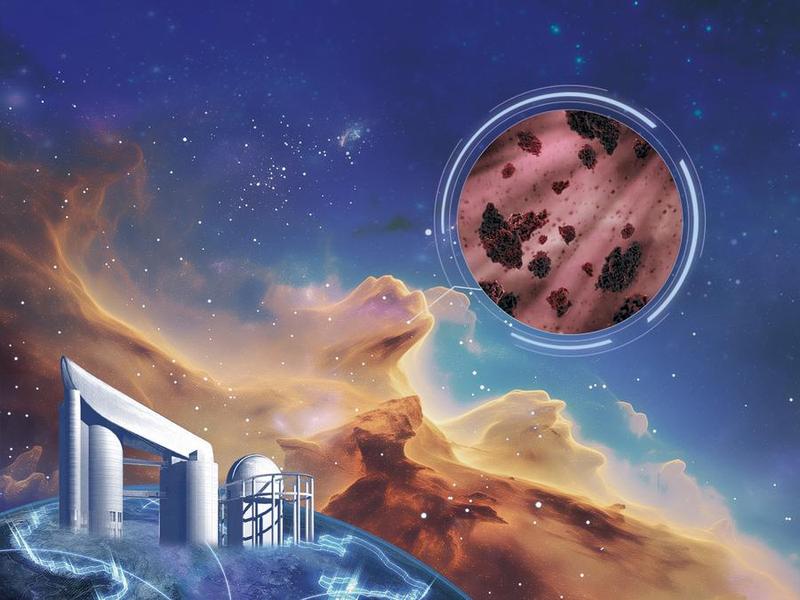
Chinese and United States astronomers have created the first three-dimensional map of the properties of interstellar dust in the Milky Way, using data from China's Large Sky Area Multi-Object Fiber Spectroscopy Telescope and European Space Agency's Gaia space observatory.
Published as a cover story in Science on Friday, this cosmic atlas solves a decade-old challenge in astronomy by revealing how interstellar dust dims and reddens starlight across the galaxy.
The breakthrough is poised to revolutionize studies of star formation, exoplanets and potentially the origins of life.
"Interstellar dust — tiny solid particles scattered across the galaxy — acts like a cosmic fog, absorbing and scattering starlight, which is called extinction," said Zhang Xiangyu, a Chinese doctoral student at the Max Planck Institute in Germany.
For decades, astronomers had to correct observations using oversimplified models, assuming homogeneous dust behaved uniformly.
"But dust properties vary across regions. Using a one-size-fits-all extinction curve was like navigating with a flawed GPS," said Zhang, who conducted the study with his mentor, Gregory M. Green.
The team combined 2 million stellar spectra from LAMOST with positional and spectroscopic data from the European Gaia space observatory, creating a dynamic 3D map that tracks how dust extinction changes by location and wavelength.
"For the first time, we can see the Milky Way's dust 'fingerprints' in full dimensionality," Zhang said.
LAMOST's wide-field, multi-object spectroscopic capabilities allowed the team to obtain accurate parameters for a large number of stars in regions of intermediate and high extinction. The telescope's diverse stellar data, ranging from bright giants to dim dwarfs, enabled the team to chart extinction curves across a depth of 16,000 light years, revealing dramatic regional variations and significantly expanding the map's breadth and depth.
"This map has opened a whole new window for studying dust and the Milky Way, potentially offering new perspectives on issues such as astrochemistry, star formation, and the origins of life," Zhang added.
Dust grains contain organic molecules, and mapping their distribution could trace the raw materials for life, he explained.
"This is like upgrading from black-and-white TV to 3D IMAX for dust studies," he said.
The team plans to expand the map using LAMOST's ongoing surveys, potentially uncovering links between dust evolution and galactic history.
- Astronomers unveil 1st 3D map of Milky Way interstellar dust properties
- China Focus: Chinese scientists find evidence for existence of intermediate-mass black holes
- Existence of massive first-generation stars with 260 solar masses confirmed
- Chinese astronomers discover nearest, lightest neutron star candidate


- Foreign visitors taste the delicacies of Tianjin's ancient town
- China introduces a standard framework for humanoid and embodied intelligence
- CPPCC unveils agenda of the annual session
- Geologists brave rugged terrain in Yunnan prospecting mission
- Senior enterprise official facing probe
- China's anti-graft authorities reveal extent of year's work







