AI ascent calls for people to fasten seat belts









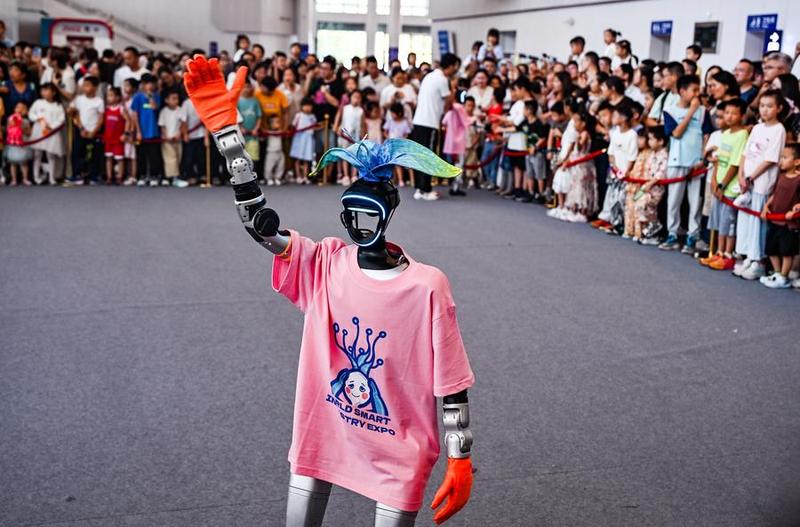
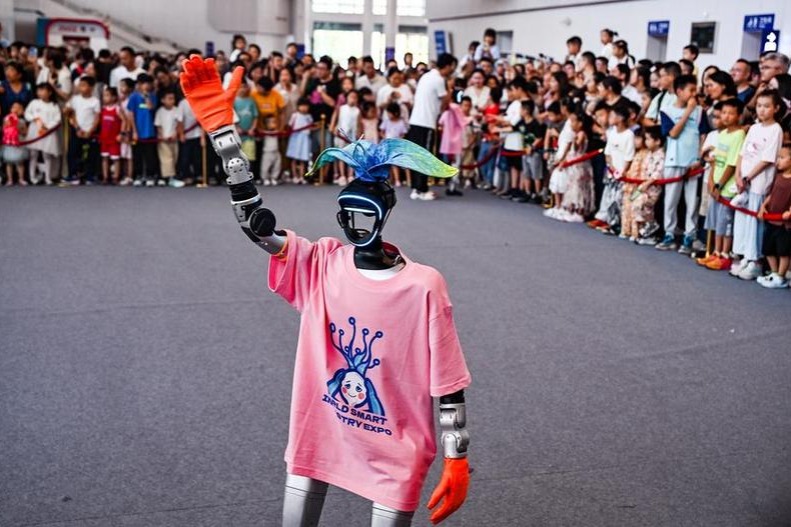
A scene from the recently held world's first robot sports competition symbolizes the current state of artificial intelligence development: humanoid robots ran, fell, got up and continued to run until they reached the finish line. Such a spectacle might elicit a few laughs from the audience, but it undoubtedly pushes AI awareness to new heights.
In another arena, AI stocks have surged relentlessly to record highs. Rising valuations indicate the capital market is generally optimistic about the prospects of AI development.
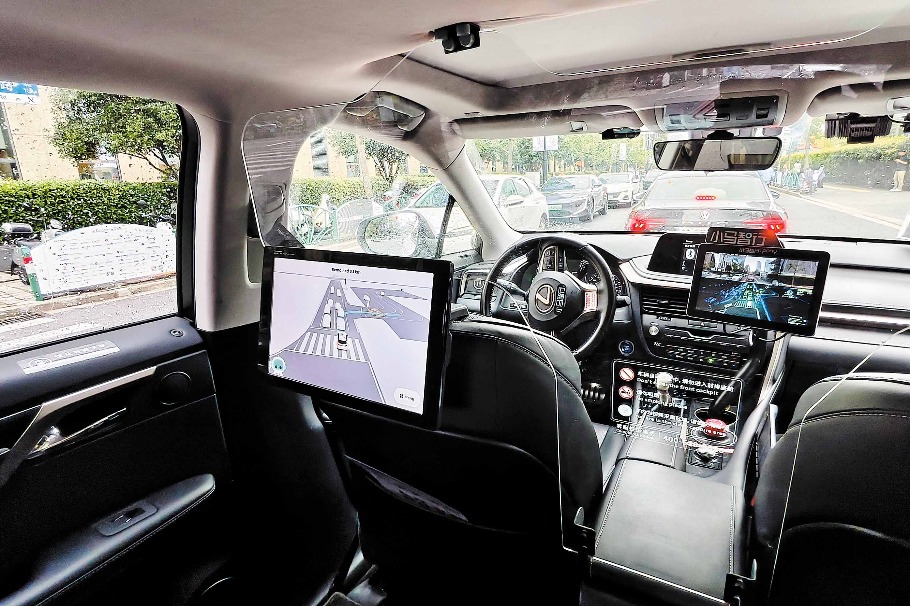
At the policy level, embedding AI into broad production and daily life has become a rapidly unfolding national initiative in China. Late last month, the State Council, China's cabinet, issued a document on implementing the "AI+" action, with the aim of integrating AI with all industries and sectors, and accelerating the formation of new intelligent economic and social structures — in a panoramic blueprint for six major areas spread across three stages over the next 10 years.
A survey published earlier this year showed 53.1 percent of the public are excited about, 26 percent are pleasantly surprised at, and 11 percent hold relatively negative views about AI development. Underlying this overall optimism is an empiricist belief that AI, like mobile internet, will be the next step in "technology transforming life".
Since launching the "Internet+" initiative a decade ago, China has built a highly internet-developed society, with rapid internet penetration driving industrial upgrades, consumption shifts, and livelihood improvements.
Of course, technological progress has always been a double-edged sword. Amid the AI wave, doubts persist. Beyond concerns about silicon-based "workers" displacing carbon-based ones, a pessimistic tech ethics view warns that as people increasingly rely on AI for cognition, uniquely human critical thinking and creativity may degenerate, leading to a divergent world where human intelligence declines while machine intelligence soars. A study by Massachusetts Institute of Technology found AI users had weaker neural connections, while those using no tools showed the strongest and most distributed neural links.
More immediate worries revolve around "black boxes" and "model hallucinations". AI's deep learning relies on vast datasets, making it data-driven. Large language models generate text statistically, and lack humans' ability to correlate symbols with reality — rendering their outputs unpredictable, like a black box. And when fed with unverified "digital garbage", they may produce misleading hallucinations.
Pessimism is not entirely unfounded; it serves as a caution for rational development. Yet as Cisco CEO Chuck Robbins put it: "Technical success often precedes ethical discussions." Robbins was apparently paraphrasing J. Robert Oppenheimer's quote which conveys the same idea. The "technical success comes first" proposition might be questionable, but it's true that technological progress has a way to march on regardless of human will.
Despite possible bumps ahead, AI's advance will not pause. More crucially, as the continuation of IT revolutions and a vanguard of new tech-industrial transformations, AI has become a strategic high point in global competition. An innovation powerhouse would not allow hesitation to result in missed opportunities.
Emerging technologies always cause uncertainty. As a revolutionary force, AI will profoundly reshape societal and economic logic. The need now is to fasten our seat belts while embracing the ascent. Reassuringly, the State Council's document prioritizes the principle of security and controllability, proposing enhanced safety measures — from model algorithms and data infrastructure to monitoring systems — especially against malicious misuse.
History shows disruptive technologies, from steam engines to the internet, require long gestation periods. AI is no exception. Earlier this year, OpenAI's Sam Altman said AI has crossed the "event horizon", with the "gentle singularity" already here: "the singularity happens bit by bit, and the merge happens slowly".
His view is echoed by a leading figure in China's AI field. According to Wang Xingxing, founder of Unitree Robotics, challenges at this critical stage will force the industry to shed hype, avoid low-level repetition, and embrace long-term scientific rigor to usher in the pivotal threshold.
The author is chief researcher at the China Watch Institute, China Daily.